Superbike Gets Bootstrapped Instrument Refit

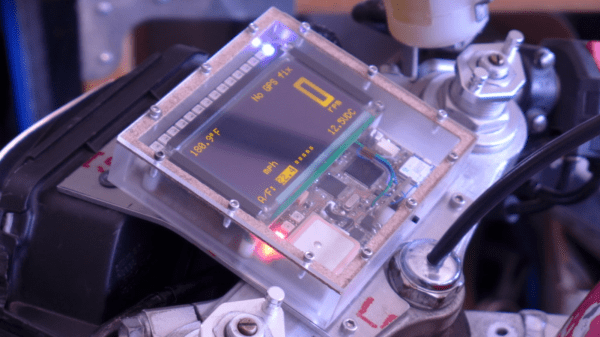
[Josh] got rid of the standard, factory gauges on his GSXR Super-bike and installed a custom built instrument panel which displays some additional parameters which the regular instrumentation cluster did not. He was working on converting his bike in to a Streetfighter – a stripped down, aggressive, mean machine. The staid looking gauges had to go, besides several other mods to give his bike the right look.

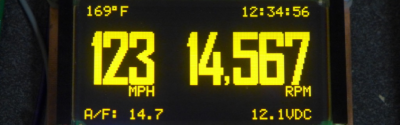
GSXR_03Luckily, he had the right skills and tools available to make sure this DIY hack lives up to the Streetfighter cred of his bike. The important parameter for him was to log the Air / Fuel mixture ratio so he could work on the carburation. Along the way, he seems to have gone a bit overboard with this build, but the end result is quite nice. The build centers around a Planar 160×80 EL graphic display lying in his parts bin. The display didn’t have a controller, so he used the Epson S1D13700 graphic controller to interface it with the microcontroller. An Atmel ATmega128L runs the system, and [Josh] wrote all of his code in “C”.
Continue reading “Superbike Gets Bootstrapped Instrument Refit”

Flashed The Wrong Firmware? Swap Out The LCD To Match!

We always joke about the hardware guys saying that they’ll fix it in firmware, and vice-versa, but this is ridiculous. When [Igor] tried to update his oscilloscope and flashed the wrong firmware version in by mistake, he didn’t fix it in firmware. Instead, he upgraded the LCD display to match the firmware.

See, Siglent doesn’t make [Igor]’s DSO any more; they stopped using the 4:3 aspect ratio screens and replaced them with wider versions. Of course, this is an improvement for anyone buying a new scope, but not if you’ve got the small screen in yours and can’t see anything anymore. After playing around with flashing other company’s firmware (for a similar scope) and failing to get it done over the JTAG, he gave up on the firmware and started looking for a hardware solution.

It turns out that a few SMT resistors set the output screen resolution. After desoldering the appropriate resistors, [Igor] bought a new 7″ LCD screen online only to find out that it has a high-voltage backlight and that he’d need to build an inverter (and hide the noisy circuit inside his oscilloscope). Not daunted, he went digging through his junk box until he found a backlight panel of the right size from another display.

Yet more small soldering, and he had frankensteined a new backlight into place. Of course, the larger LCD won’t fit the case without some cutting, double-sided tape, and a healthy dose of black tape all around insulates the loose electricals. Et voilá!

We have to hand it to [Igor], he’s got moxie. It’s an ugly hack, but it’s a definite screen upgrade, and a lesser hacker would have stopped after flashing the wrong firmware and thrown the thing in the trash. We’d be proud to have that scope sitting on our desk; it’s a definite conversation starter, and a badge of courage to boot.

Developed On Hackaday – It’s A Badge. No, It’s The HaDge

Sometime back, we announced start of a new project under the “Developed on Hackaday” series – a Badge for the Hackaday community. At its core, this badge is a single node in an Internet of Badges. At every event this badge is deployed at, a Hackaday Sub-Etha mesh network will be created, and each badge will be able to transmit and receive messages from other badge wearers. There are plans for an Sub-Etha to Internet gateway, so even if badge wearers are on the other side of the world, they’re still connected through the HaDge network.

Things have been moving along quickly, so I thought of doing a quick round-up and share progress with the community. First off, it has a name. HaDge, as in HackaDay Badge. Our objectives up until now were to set up a team, name the project, set up repositories and lock down on a working bill of materials. Within a few weeks, we’ve got all of that tied down. The HaDge group chat channel has been super active, and everyone’s been pitching in with ideas and suggestions. A spreadsheet seemed like a good idea – it let everyone add in their suggestions regarding candidate parts, create a feature list and then talk about it on the channel.

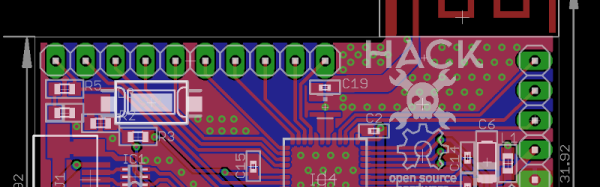
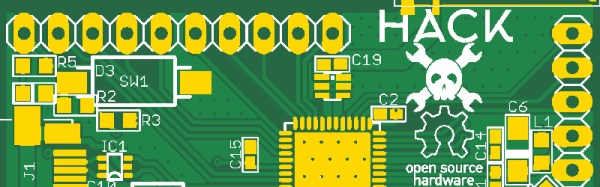
We realized early on that building the hardware is going to take some time. So in the interim, we need a dev kit platform to get in to the hands of the software developers so they can start working on the smarts that will power the HaDge. [Michele Perla] had already built JACK (Just another Cortex kit) – a development kit powered by the Atmel SAM D21. It’s pretty bare bone with just the bare minimum of parts to make it work while keeping an eye on reliability. The microcontroller+radio on the HaDge is the Atmel SAM R21 – a close relative of the D21, so it made sense to respin the JACK and create HACK (Hackaday Cortex kit) – a development kit powered by the Atmel SAM R21 that is going to be used as the core of the HaDge. [Michele] has worked hard single-handedly to complete the design and it is now ready to go for PCB fabrication soon. We are just awaiting some feedback and review of the Antenna part of the design. None of us on the hardware team have a strong RF-fu so we don’t want to make an avoidable mistake. If you’d like to review and help vet the HACK design, grab the design files from the github repo and let us know.

Once HACK board layout is cleared for fabrication, we’ll work on building kits that can be sent out to the software folks. We will also be working on porting the HACK design in to KiCad and this is something I have already stared work on. I started by using the neat Eagle2KiCad conversion tool by [LachlanA]. It’s not perfect, but it does reduce the work involved in porting over from Eagle to Kicad. Once that is done, hardware development for the actual HaDge will see some progress – keep a watch on the project page.

Boeing’s New Microlattice, Now The Lightest “Metal” Ever

Mr McGuire: I just want to say one word to you. Just one word.
Benjamin: Yes, sir.
Mr McGuire: Are you listening?
Benjamin: Yes, I am.
Mr McGuire: Plastics.

You may recognize the above dialog from the movie “The Graduate” starring a young [Dustin Hoffman], whose character is getting advice about what line of work he should get into after university. Maybe Mr McGuire’s advice should have been “Microlattice.”

If you take a step back for a moment and survey the state of materials, you’ll see that not much has changed in the last 50 years. We’re still building homes out of dead trees, and most cars are still made out of iron(although that is starting to change.) It’s only been just recently has there been advances in batteries technology – and that only came about with the force of a trillion-dollar mobile phone industry behind it. So we’re excited by any new advance we see, and Boeing’s new “Microlattice” tickles our fancy.

Boeing isn’t giving away the recipe just yet, but here is what we know: it’s 99.99% empty space, making it extremely light. It’s so light, that if you drop it, it floats to the ground. It’s also compressible, giving it the ability to absorb energy and spring back (you can see it in action in the after the break.) It’s made by creating a sacrificial skeletal structure the shape of the final lattice, then coating that template with nickel-phosphorus alloy. The temporary inner structure is then etched away, leaving a “microlattice” of tiny interconnected hollow rods with wall thickness of about 100 nanometers. Of course it doesn’t take a rocket surgeon to figure out why Boeing is interested in such materials, they are eye it as an extremely lightweight building material for planes and spacecraft.

Continue reading “Boeing’s New Microlattice, Now The Lightest “Metal” Ever”

Dragon Doors Round Off Hobbit Themed Restaurant

[Abhimanyu Kumar] is renovating a hotel in Nainital, near the India-Nepal border, and like any self-respecting Lord of the Rings fan, he wanted to give the restaurant a Hobbit theme. He built circular windows and to top it off a gorgeous round door complete with dragon hinges.

I asked him how well the doors work, as the 50kg (over 110lbs) weight of each of the doors must put a lot of strain on the hinges. [Abhimanyu] told me, “The door opens quite smoothly.While building the hinges even I was concerned about needing support as all other commercially available hinges we tried broke down or got bent.”

However, once the dragon hinge was installed it worked better that we expected and the door stays about 0.5″ over the ground at all times. The dragon hinges (made from 1/4-inch iron) integrate the hinge pins to the wings of the dragon, making it look like they are taking off when the doors open.

He has posted plenty of pictures of the build and the final product looks incredible.  The tail of the dragon is quite long and provides a lot of support for the entire door. Each hinge itself weighs about 30kg, so it should be strong enough to hold up a door for a long time without any sagging. Kudos to him for some serious engineering!

Passive, But Not Innocuous

Maxim Integrated recently posted a series of application notes chronicling how there’s more going on than you’d think in even the simplest “passive” components. Nothing’s safe: capacitors, resistors, and even printed circuit boards can all behave in non-ideal ways, and that can bite you in the reflow-oven if you’re not aware of them.

You might already know that capacitors have an equivalent series resistance that limits how fast they can discharge, and an equivalent inductance that models departures from ideal behavior at higher frequencies. But did you know that ceramic capacitors can also act like voltage sources, acting piezoelectrically under physical stress?

For resistors, you’ll also have to reckon with temperature dependence as well as the same range of piezoelectric and inductance characteristics that capacitors display. Worse, resistors can display variable resistance under higher voltages, and actually produce a small amount of random noise: Johnson Noise that depends on the value of the resistance.

Finally, the third article in the series tackles the PCB, summarizing a lot of potential manufacturing defects to look out for, as well as covering the parasitic capacitance, leakage currents, and frequency dependence that the actual fiberglass layers themselves can introduce into your circuit.

If you’re having a feeling of déjà-vu, the same series of articles ran in 2013 in Electronic Design but they’re good enough that we hope you won’t mind the redundant repetition all over again. And if you’re already quibbling with exactly what they mean by “passive”, we feel your pain: they’re really talking about parasitic effects, but we’ll let that slide too. We’re in a giving mood today.

[via Dangerous Prototypes]

Conference Badges Are The Newest Form Of Hardware Art

About four decades ago, many European truck drivers started placing electronic LED badges in their windshields. Most of them were simple; nothing more than an animated heart pierced by an arrow. It became a common distraction in the highway night panorama of that time, at least until it became illegal. Most motorists became accustomed to seeing them, and the idea of the truck drivers making a statement with electronics always stuck with me. Now I have the chance to help people make a similar statement. Conference badges are not just a way to identify those who have registered, but a fashion statement and a mark of pride for conference organizers. They’ve become an art form, and engineers always want to stretch the limits of what is possible.

Every September, we have BalCCon, an international hacker’s conference at Novi Sad, Serbia. I was asked to design a badge for the 2016 event, and this is the first (well, the second) release. It is based on the PIC18LF24K50 and consists of a circle of LEDs which randomly displays pre-defined patterns. Every badge has its own infrared transceiver (LED-receiver pair), so the fun begins when two or more badges spot each other: they go from Adagio to full on Rondo, losing their default, dull visual pattern for a more dynamic, attention grabbing one, but most importantly – they synchronize. This means that, in a group of people, all badges will play the same pattern in unison. Every badge can spread the pattern code, so the whole group, however large, soon becomes synchronized. But if one of them “gets lost” somehow, it will try to learn it back from a neighbor or it might even launch into its own, randomly generated one. Sometimes it manages to spread it further and you get to witness a battle for light show domination.

This isn’t merely a story of designing badges, but of design choices that come in on budget while achieving a look that will delight those who end up wearing the hardware.

Continue reading “Conference Badges Are The Newest Form Of Hardware Art”