Desoldering Surface Mount and Through Hole Components

SMT And Thru-Hole Desoldering

My introduction to electronic manufacturing was as a production technician at Pennsylvania Scale Company in Leola PA in the early 1980’s. I learned that to work on what I wanted to work on I had to get my assigned duties done by noon or thereabouts. The most important lesson I had learned as a TV repairman, other than not to chew on the high voltage cable, was to use your eyes first. I would take a box of bad PCB’s that were essentially 6502 based computers that could count and weigh, and first go through inspecting them; usually the contents were reduced 50% right off by doing this. Then it was a race to identify and fix the remaining units and to keep my pace up I had to do my own desoldering.
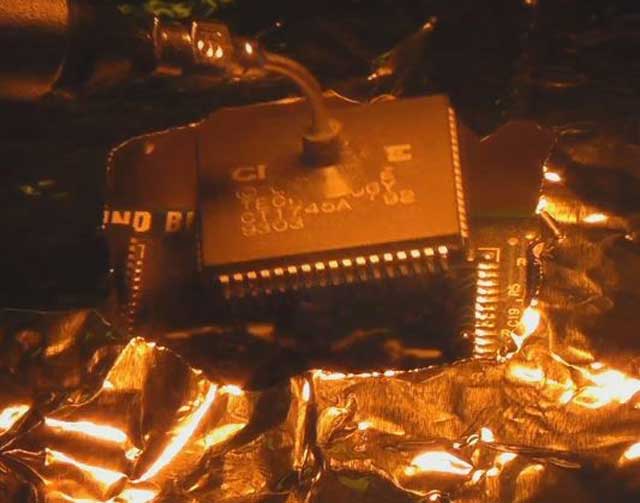
Desoldering with IR System

It worked like this; you could set units aside with instructions and the production people would at some point go through changing components etc. for you or you could desolder yourself. I was pretty good at hand de-soldering 28 and 40 pin chips using a venerable Soldapulit manual solder sucker (as they were known). But to really cook I would wait for a moment when the production de-soldering machine was available. There was one simple rule for using the desoldering station: clean it when done! Failure to do so would result in your access to the station being suspended and then you might also incur the “wrath of production” which was not limited to your lunch bag being found frozen solid or your chair soaked in defluxing chemicals.

Continue reading “SMT And Thru-Hole Desoldering”

The ChipWhisperer At Defcon

We’ve seen [Colin]’s entry to The Hackaday Prize before. After seeing his lightning talk at Defcon, we had to get an interview with him going over the intricacies of this very impressive piece of hardware.

The ChipWhisperer is a security and research platform for embedded devices that exploits the fact that all security measures must run on real hardware. If you glitch a clock when a microcontroller is processing an instruction, there’s a good probability something will go wrong. If you’re very good at what you do, you can simply route around the code that makes up the important bits of a security system. Power analysis is another trick up the ChipWhisperer’s sleeve, analyzing the power consumption of a microcontroller when it’s running a bit of code to glean a little information on the keys required to access the system. It’s black magic and dark arts, but it does work, and it’s a real threat to embedded security that hasn’t had an open source toolset before now.

Before our interview, [Colin] did a few short and sweet demos of the ChipWhisperer. They were extraordinarily simple demos; glitching the clock when a microcontroller was iterating through nested loops resulted in what can only be described as ‘counter weirdness’. More advanced applications of the ChipWhisperer can supposedly break perfectly implemented security, something we’re sure [Colin] is saving for a followup video.

You can check out [Colin]’s 2-minute video for his Hackaday Prize entry below.

Continue reading “The ChipWhisperer At Defcon”

Open Source GPU Released

GPLGPU

Nearly a year ago, an extremely interesting project hit Kickstarter: an open source GPU, written for an FPGA. For reasons that are obvious in retrospect, the GPL-GPU Kickstarter was not funded, but that doesn’t mean these developers don’t believe in what they’re doing. The first version of this open source graphics processor has now been released, giving anyone with an interest a look at what a late-90s era GPU looks like on the inside, If you’re cool enough, there’s also enough supporting documentation to build your own.

A quick note for the PC Master Race: this thing might run Quake eventually. It’s not a powerhouse. That said, [Bunnie] had a hard time finding an open source GPU for the Novena laptop, and the drivers for the VideoCore IV in the Raspi have only recently been open sourced. A completely open GPU simply doesn’t exist, and short of a few very, very limited thesis projects there hasn’t been anything like this before.

Right now, the GPL-GPU has 3D graphics acceleration working with VGA on a PCI bus. The plan is to update this late-90s setup to interfaces that make a little more sense, and add DVI and HDMI output. Not bad for a failed Kickstarter, right?

Reverse Engineering A GPS Watch To Upload Custom Firmware


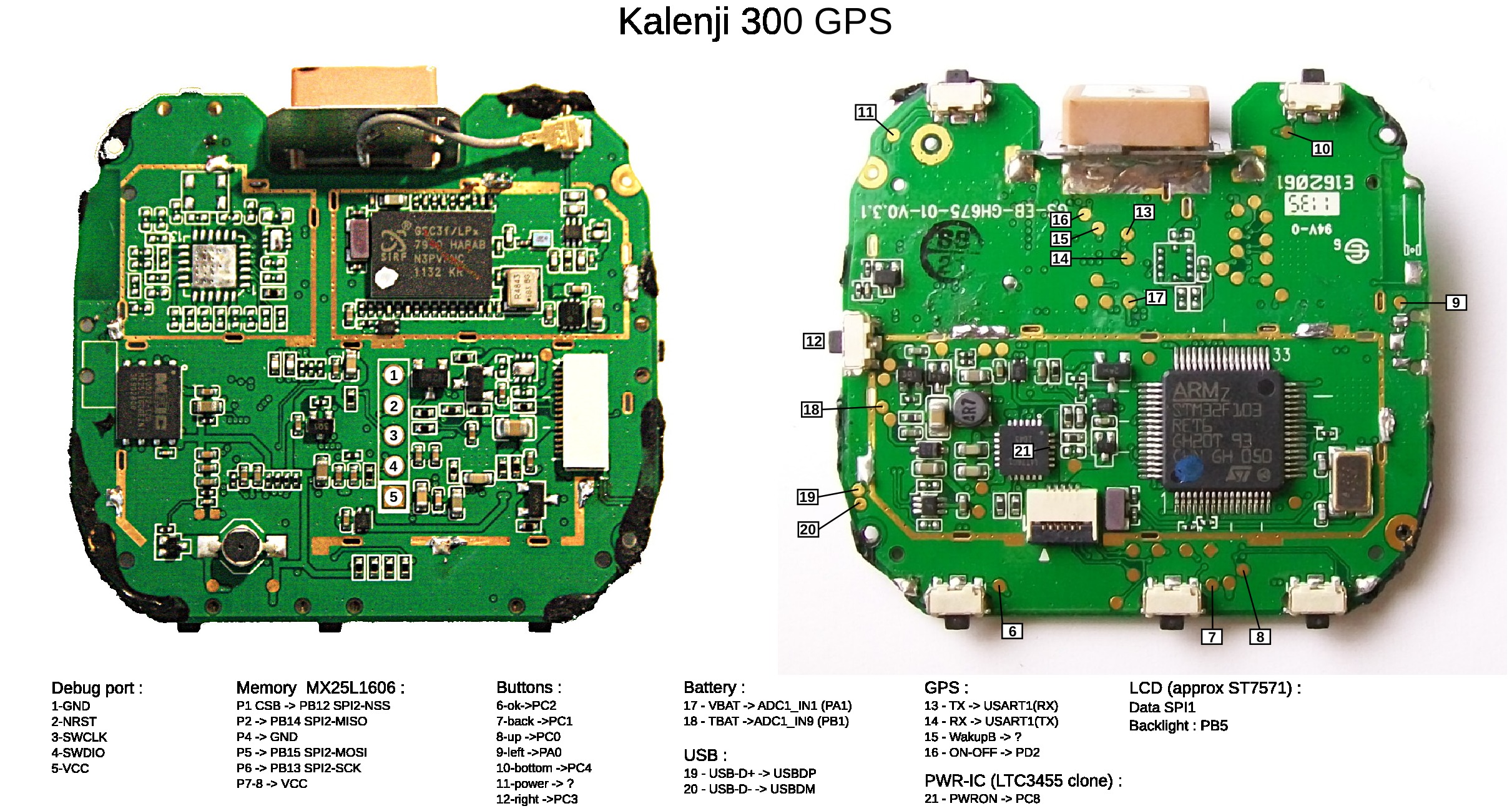
Sometimes GPS watches are too good to be left with their stock firmware. [Renaud] opened his Kalenji 300 GPS watch, reverse engineered it in order to upload his own custom firmware.

The first step was to sniff the serial traffic between the PC and the microcontroller when upgrading firmware to understand the protocol and commands used. [Renaud] then opened the watch, figured out what the different test points and components were. He used his buspirate with OpenOCD to extract the existing STM32F103 firmware. The firmware helped him find the proper value to store in a dedicated register for the boot loader to start.

By looking at the disassembly code he also found the SPI LCD initialization sequence and discovered that it uses a controller similar to the ST7571. He finally compiled his own program which uses the u8glib graphics library. Follow us after the break for the demonstration video.

Continue reading “Reverse Engineering A GPS Watch To Upload Custom Firmware”

An Open Source 1MHz Arbitrary Waveform Generator With An Awesome UI

1MHZ DDS


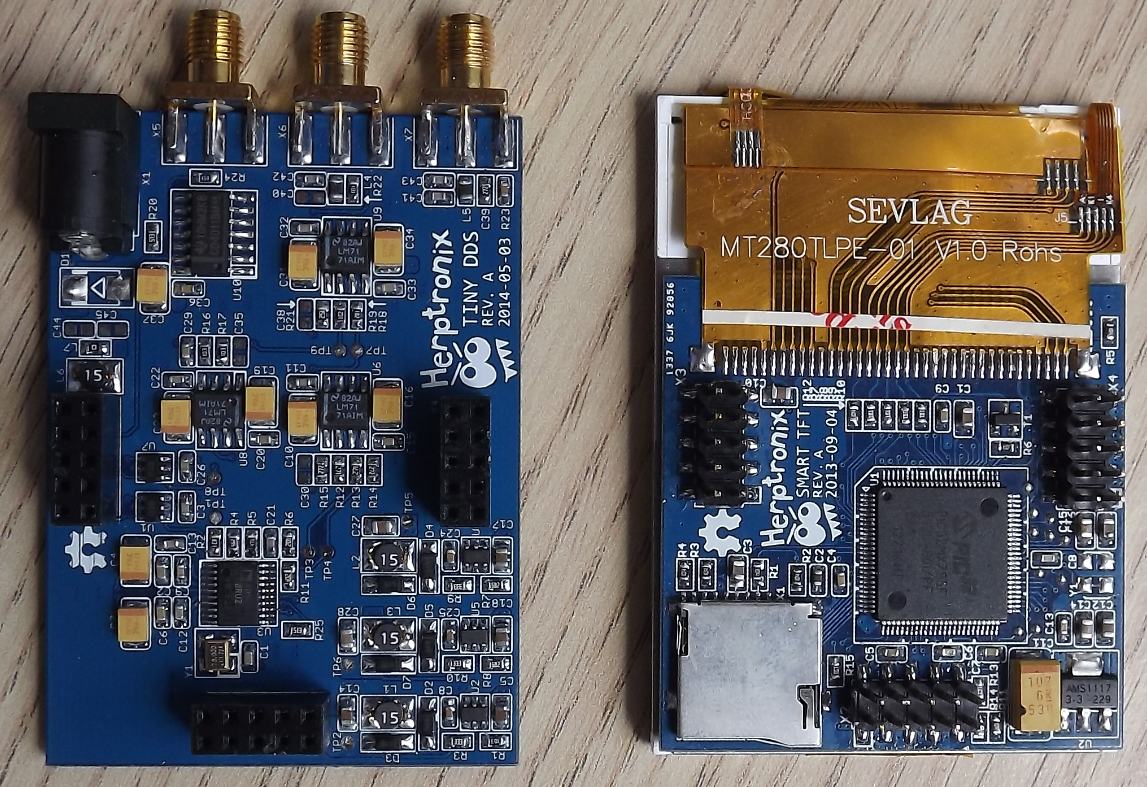
[Herp] just shared a nice 1MHz Arbitrary Waveform Generator (right click -> translate to English as google translation links don’t work) with a well designed user interface. His platform is based around a PIC32, a TFT module with its touchscreen and the 75MHz AD9834 Direct Digital Synthesizer (DDS). Of course the latter could generate signals with frequencies up to 37.5MHz… but that’s only if two output points are good enough for you.

As you can see in the video embedded below, the ‘tiny dds’ can generate many different kinds of periodic signals and even ones that are directly drawn on the touchscreen. The offset and signal amplitude can be adjusted using several operational amplifiers after the DDS ouput and a separate SMA TTL output is available to use a PIC32 PWM signal. The platform can read WAV audio files stored on microSD cards and also has an analog input for signal monitoring. Follow us after the break for the video.

Continue reading “An Open Source 1MHz Arbitrary Waveform Generator With An Awesome UI”

DEFCON 22: Badge Talk

I got a great seat on the main floor for the first big DEFCON 22 talk which is a welcome to the con and discussion of the badge hardware. [LosT], the creator of this year’s badge, started the discussion with a teaser about the badge… there’s a phone number hidden as part of the challenge. [LosT] took a call from someone chasing the puzzles. The guy was in the audience which was pretty fun.

The process of building a puzzle that can be solved at DEFCON is really tough. How do you make it just hard enough that it won’t get pwned right away but easy enough that a large number of attendees will be able to figure it out during the weekend? The answer is to build a secure system and introduce strategic flaws which will be the attack vectors for the attendees solving the badge challenge.

Of course the badge can be used as a development platform. The populated electronics on the board all have these nice little footprints which can be cut to disconnect them from the chip. The breakout headers on either side of the board allow you to connect headers for your own uses. Great idea!

The back of the lanyards have special characters on them too. This encourages community at the conference. To solve the puzzle you need to find others with different lanyards. Compare the glyphs and crack the code (so far I have no clue!!).

Know what I’m doing wrong? Have suggestions on where to go from here? I’ll be checking the comments!

San Francisco Event: Hardware Developers Didactic Galactic


header2

It’s a mouthful to say, but an evening-ful of fun. San Franciscans who like to talk about all things hardware need to block this one out on their calendars:

Hardware Developers Didactic Galactic
Thursday, August 14th 2014 starting 6pm-9:30pm
500 3rd St., Suite 230 in San Francisco

The night will include a few talks on hardware; So far we know [Matt Berggren] is doing FPGA stuff, [Chris Gammell] will talk about KiCAD, and I’m going to talk about the community adventure that is Mooltipass. We’re also looking for others to make presentations so step up and share your hardware passion!

In addition to the formal talks there’ll be plenty of time for chewing the fat with all the other hardware-awesomes that will be there. See you a week from tomorrow, and don’t be shy about bringing your own hardware to show off!