Checking In On The ISA Wars And Its Impact On CPU Architectures

An Instruction Set Architecture (ISA) defines the software interface through which for example a central processor unit (CPU) is controlled. Unlike early computer systems which didn’t define a standard ISA as such, over time the compatibility and portability benefits of having a standard ISA became obvious. But of course the best part about standards is that there are so many of them, and thus every CPU manufacturer came up with their own.

Throughout the 1980s and 1990s, the number of mainstream ISAs dropped sharply as the computer industry coalesced around a few major ones in each type of application. Intel’s x86 won out on desktop and smaller servers while ARM proclaimed victory in low-power and portable devices, and for Big Iron you always had IBM’s Power ISA. Since we last covered the ISA Wars in 2019, quite a lot of things have changed, including Apple shifting its desktop systems to ARM from x86 with Apple Silicon and finally MIPS experiencing an afterlife in  the form of LoongArch.

Meanwhile, six years after the aforementioned ISA Wars article in which newcomer RISC-V was covered, this ISA seems to have not made the splash some had expected. This raises questions about what we can expect from RISC-V and other ISAs in the future, as well as how relevant having different ISAs is when it comes to aspects like CPU performance and their microarchitecture.

Continue reading “Checking In On The ISA Wars And Its Impact On CPU Architectures”

Long-tail pair waves

Current Mirrors Tame Common Mode Noise

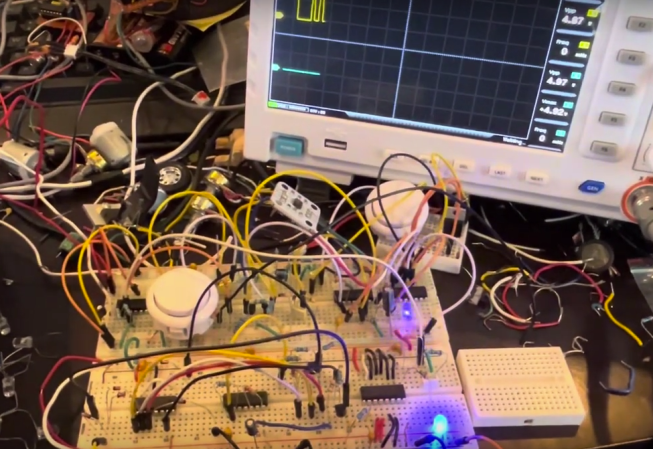
If you’re the sort who finds beauty in symmetry – and I’m not talking about your latest PCB layout – then you’ll appreciate this clever take on the long-tailed pair. [Kevin]’s video on this topic explores boosting common mode rejection by swapping out the old-school tail resistor for a current mirror. Yes, the humble current mirror – long underestimated in DIY analog circles – steps up here, giving his differential amplifier a much-needed backbone.

So why does this matter? Well, in Kevin’s bench tests, this hack more than doubles the common mode rejection, leaping from a decent 35 dB to a noise-crushing 93 dB. That’s not just tweaking for tweaking’s sake; that’s taking a breadboard standard and making it ready for sensitive, low-level signal work. Instead of wrestling with mismatched transistors or praying to the gods of temperature stability, he opts for a practical approach. A couple of matched NPNs, a pair of emitter resistors, and a back-of-the-envelope resistor calculation – and boom, clean differential gain without the common mode muck.

If you want the nitty-gritty details, schematics of the demo circuits are on his project GitHub. Kevin’s explanation is equal parts history lesson and practical engineering, and it’s worth the watch. Keep tinkering, and do share your thoughts on this.

Continue reading “Current Mirrors Tame Common Mode Noise”

The Trials And Tribulations Of Building A Pasta Display

We love unique displays here at Hackaday. If you can figure out how to show information on some weird object, we’re all about it. So when [Julius Curt] wrote in to share his work on the Pasta Analog Display, we were hooked from the subject line.

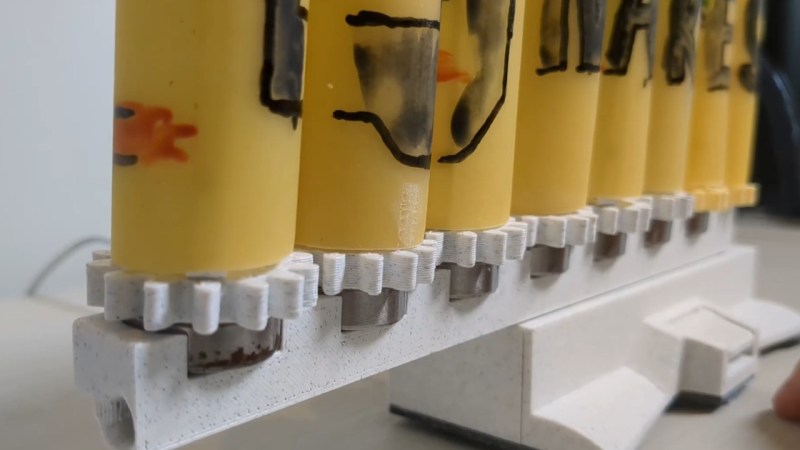
But in reading his account, it ended up being even better than we hoped for. Because it turns out, getting pasta to behave properly in an electromechanical device is trickier than you might think. Oh sure, as [Julius] points out, those ridges on the side of penne might make them look like gears — but after spending the time and effort to build a particularly slick 3D printed frame to actually use them as such, it turns out they just won’t cooperate. You’d think the pasta makers of the world would have some respect for mechanical tolerances, but unfortunately not.

Continue reading “The Trials And Tribulations Of Building A Pasta Display”

The Mysterious And Important Work Of Prop Design On Severance

Have you seen Severance? Chances are good that you have; the TV series has become wildly popular in its second season, to the point where the fandom’s dedication is difficult to distinguish from the in-universe cult of [Kier]. Part of the show’s appeal comes from its overall aesthetic, which is captured in this description of the building of one of the show’s props.

A detailed recap of the show is impossible, but for the uninitiated, a mega-corporation called Lumon has developed a chip that certain workers have implanted in their brains to sever their personalities and memories into work and non-work halves. The working “Innies” have no memory of what their “Outies” do when they aren’t at work, which sounds a lot better than it actually ends up being. It’s as weird as it sounds, and then some.

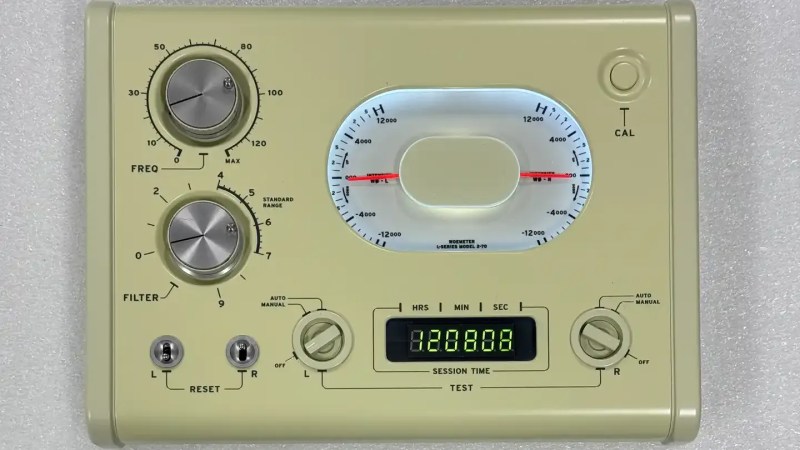
The prop featured here is the “WoeMeter” from episode seven of season two, used to quantify the amount of woe in a severed worker — told you it was weird. The prop was built by design house [make3] on a short timeline and after seeing only some sketches and rough renders from the production designers, and had to echo the not-quite-midcentury modern look of the whole series. The builders took inspiration from, among other things, a classic Nagra tape recorder, going so far as to harvest its knobs and switches to use in the build. The controls are all functional and laid out in a sensible way, allowing the actors to use the device in a convincing way. For visual feedback, the prop has two servo-operated meters and a string of seven-segment LED displays, all controlled by an ESP-32 mounted to a custom PCB. Adding the Lumon logo to the silkscreen was a nice touch.

The prop maker’s art is fascinating, and the ability to let your imagination run wild while making something that looks good and works for the production has got to be a blast. [make3] really nailed it with this one.

Thanks to [Aaron’s Outie] for the tip.

Physical Computing Used To Be A Thing

In the early 2000s, the idea that you could write programs on microcontrollers that did things in the physical world, like run motors or light up LEDs, was kind of new. At the time, most people thought of coding as stuff that stayed on the screen, or in cyberspace. This idea of writing code for physical gadgets was uncommon enough that it had a buzzword of its own: “physical computing”.

You never hear much about “physical computing” these days, but that’s not because the concept went away. Rather, it’s probably because it’s almost become the norm. I realized this as Tom Nardi and I were talking on the podcast about a number of apparently different trends that all point in the same direction.

We started off talking about the early days of the Arduino revolution. Sure, folks have been building hobby projects with microcontrollers built in before Arduino, but the combination of a standardized board, a wide-ranging software library, and abundant examples to learn from brought embedded programming to a much wider audience. And particularly, it brought this to an audience of beginners who were not only blinking an LED for the first time, but maybe even taking their first steps into coding. For many, the Arduino hello world was their coding hello world as well. These folks are “physical computing” natives.

Now, it’s to the point that when Arya goes to visit FOSDEM, an open-source software convention, there is hardware everywhere. Why? Because many successful software projects support open hardware, and many others run on it. People port their favorite programming languages to microcontroller platforms, and as they become more powerful, the lines between the “big” computers and the “micro” ones starts to blur.

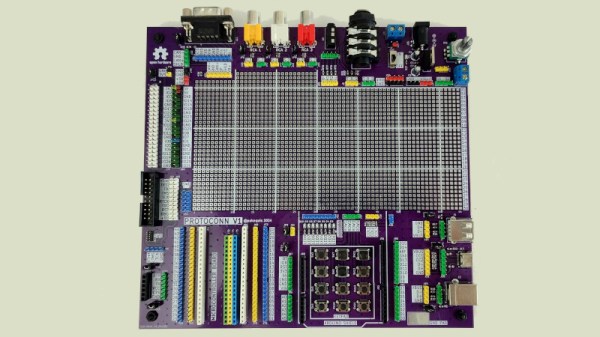
And I think this is awesome. For one, it’s somehow more rewarding, when you’re just starting to learn to code, to see the letters you type cause something in the physical world to happen, even if it’s just blinking an LED. At the same time, everything has a microcontroller in it these days, and hacking on these devices is also another flavor of physical computing – there’s code in everything that you might think of as hardware. And with open licenses, everything being under version control, and more openness in open hardware than we’ve ever seen before, the open-source hardware world reflects the open-source software ethos.

Are we getting past the point where the hardware / software distinction is even worth making? And was “physical computing” just the buzzword for the final stages of blurring out those lines?

Open Source Hardware, How Open Do You Want It To Be?

In our wider community we are all familiar with the idea of open source software. Many of us run it as our everyday tools, a lot of us release our work under an open source licence, and we have a pretty good idea of the merits of one such document over another. A piece of open source software has all of its code released under a permissive licence that explicitly allows it to be freely reproduced and modified, and though some people with longer beards take it a little too seriously at times and different flavours of open source work under slightly different rules, by and large we’re all happy with that.

When it comes to open hardware though, is it so clear cut?  I’ve had more than one rant from my friends over the years about pieces of hardware which claim to be open-source but aren’t really, that I think this bears some discussion.

Open Source Hardware As It Should Be Done

To explore this, we’ll need to consider a couple of open source hardware projects, and I’ll start close to home with one of my own. My Single 8 home movie cartridge is a 3D printable film cartridge for a defunct format, and I’ve put everything necessary to create one yourself in a GitHub repository under the CERN OHL. If you download the file and load it into OpenSCAD you can quickly create an STL file for your slicer, or fiddle with the code and make an entirely new object. Open source at its most efficient, and everyone’s happy. I’ve even generated STLs ready to go for each of the supported ISO values. Continue reading “Open Source Hardware, How Open Do You Want It To Be?”

Build A Parametric Speaker Of Your Own

The loudspeaker on your home entertainment equipment is designed to project audio around the space in which it operates, if it’s not omnidirectional as such it can feel that way as the surroundings reflect the sound to you wherever you are. Making a directional speaker to project sound over a long distance is considerably more difficult than making one similar to your home speaker, and [Orange_Murker] is here with a solution. At the recent Hacker Hotel conference in the Netherlands, she presented an ultrasonic parametric speaker. It projects an extremely narrow beam of sound over a significant distance, but it’s not an audio frequency speaker at all.

Those of you familiar with radio will recognize its operation; an ultrasonic carrier is modulated with the audio to be projected, and the speaker transfers that to the air. Just like the diode detector in an old AM radio, air is a nonlinear medium, and it performs a demodulation of the ultrasound to produce an audio frequency that can be heard. She spends a while going into modulation schemes, before revealing that she drove her speaker with a 40 kHz PWM via an H bridge. The speaker itself is an array of in-phase ultrasonic transducers, and she demonstrates the result on her audience.

This project is surprisingly simple, should you wish to have a go yourself. There’s a video below the break, and she’s put all the files in a GitHub repository. Meanwhile this isn’t the first time we’ve seen a project like this.

Continue reading “Build A Parametric Speaker Of Your Own”