Eradicating Mosquitoes From Your Backyard — With Seltzer?

Q: What do you call 8000 dead mosquitoes in a Mason jar?

A: A good start. And [Dan Rojas]’s low-tech mosquito trap accomplished the feat in two nights with nothing fancier than a fan and a bottle of seltzer.

We know what you’re thinking: Where’s the hack? Why not at least use a laser sentry gun to zap skeeters on the fly? We agree that [Dan]’s mosquito trap, consisting of a powerful fan to create suction and a piece of window screen to catch the hapless bloodsuckers, is decidedly low-tech. But you can’t argue with results. Unless he’s fudging the numbers, a half-full Mason jar of parasite cadavers is pretty impressive. And you have to love the simplicity of the attractant he’s using. Mosquitoes are attracted to the CO2 exhaled by tasty mammals, but rather than do something elaborate with a paintball gun cartridge or the like, [Dan] simply cracks a bottle of seltzer and lets it outgas. Dead simple, and wickedly effective. The trapped bugs quickly desiccate in the strong air stream, aided by a few spritzes of isopropyl alcohol before cleaning the screen, which leaves them safely edible to frogs and insects.

Simple, cheap, and effective. Sounds like a great hack to us. And it’s really just a brute-force implementation of this mosquito-killing billboard for areas prone to Zika.

Continue reading “Eradicating Mosquitoes From Your Backyard — With Seltzer?”

Quick Hack Cleans Data From Sump Pump

Nobody likes to monitor things as much as a hacker, even mundane things like sump pumps. And hackers love clean data too, so when [Felix]’s sump pump water level data was made useless by a new pump controller, he just knew he had to hack the controller to clean up his data.

Monitoring a sump pump might seem extreme, but as a system that often protects against catastrophic damage, the responsible homeowner strives to take care of it. [Felix] goes a bit further than the average homeowner, though, with an ultrasonic sensor to continually measure the water level in the sump and alert him to pending catastrophes. Being a belt and suspenders kind of guy, he also added a float switch to control the pump, but found that the rapid cycle time made his measurements useless. Luckily the unit used a 555 timer to control the pump’s run time after triggering, so a simple calculation of the right RC values and a little solder job let him increase the on time of the pump. The result: a dry basement and clean data.

We recently discussed the evolution of home automation if you want to know more about the systems that sensors and actuators like these can be part of. Or for a more nuts and bolts guide to networking things together, our primer on MQTT might help.

Dog-Operated Treat Dispenser

Every good dog is deserving of a treat. [Eliasbakken]’s dog [Moby] is a certified good boy,  so he designed a dispenser with a touchscreen that his dog can boop to treat himself when he isn’t barking up a ruckus.

Adding a touchscreen to a treat dispenser when a button would suffice is a little overkill, but we’re not here to judge. [Eliasbakken] is using a BeagleBone Black — a Linux-based development platform — as this dispenser’s brains, and a Manga touchscreen that is likely to see a lot of use.  A wood-like material called Vachromat was laser cut for the frame and glued together, while an RC servo with a 3D-printed jointed pushing arm to dispenses the treats. The dispenser’s hopper only holds fifteen, so we expect it will need to be refilled every fifteen seconds or so.

Continue reading “Dog-Operated Treat Dispenser”

Home Automation: Evolution Of A Term

Home automation: for me the term recalls rich dudes in the ’80s who could turn off their garage lights with remote-control pads. The stereotype for that era was the more buttons your system had—even non-enabled ones—the more awesome it was, and by extension any luxury remote control had to be three times the size of any TV remote.

And it was a luxury–the hardware was expensive and most people couldn’t justify it. Kind of like the laser-disc player of home improvements. The technology was opaque to casual tinkering, it cost a lot to buy, and also was expensive to install.

The richie-rich stereotypes were reinforced with the technology seen in Bond movies and similar near-future flicks. Everything, even silly things, is motorized, with chrome and concrete everywhere. You, the hero, control everything in the house in the comfort of your acrylic half-dome chair. Kick the motorized blinds, dim the track lighting, and volume up the hi-fi!

This Moonraker-esque notion of home automation turned out to be something of a red herring, because home automation stopped being pretty forever ago; eventually it became available to everyone with a WiFi router in the form of Amazon Echo and Google Nest.

But the precise definition of the term home automation remains elusive. I mean, the essence of it. Let’s break it down.

Continue reading “Home Automation: Evolution Of A Term”

Measuring Air Flow With Ultrasonic Sensors

Measuring air flow in an HVAC duct can be a tricky business. Paddle wheel and turbine flow meters introduce not only resistance but maintenance issue due to accumulated dust and debris. Being able to measure ducted airflow cheaply and non-intrusively, like with this ultrasonic flow meter, could be a big deal for DIY projects and the trades in general.

The principle behind the sensor [ItMightBeWorse] is working on is nothing new. He discovered a paper from 2015 that describes the method that measures the change in time-of-flight of an ultrasonic pulse across a moving stream of air in a duct. It’s another one of those “Why didn’t I think of that?” things that makes perfect sense in theory, but takes some engineering to turn into a functional sensor. [ItMightBeWorse] is using readily available HC-SR04 sensor boards and has already done a proof-of-concept build. He’s getting real numbers back and getting close to a sensor that will go into an HVAC automation project. The video below shows his progress to date and hints at a follow-up video with more results soon.

Here’s wishing [ItMightBeWorse] the best of luck with his build. But if things go sideways, he might look to our post-mortem of a failed magnetic flow meter for inspiration.

Continue reading “Measuring Air Flow With Ultrasonic Sensors”

Talking To A Lamp

Barking commands at furniture seems a bit odd but with voice controlled home automation platforms becoming the norm, you may be spending more time talking to your light fixtures than your kids. In one such project, [Becky Stern] used an Alexa Dot and an ESP8266 respond to voice commands.

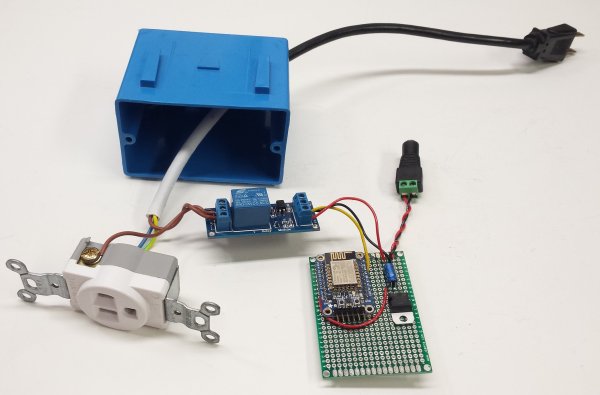
The design uses the Alexa Dot to interpret voice commands such as ‘Alexa turn the light ON’. The ESP8266 with a relay feather wing is used to switch the actual lamp ON and OFF. The glue between the two is the fauxmoESP library that allows the ESP8266 to receive commands from the Alexa API.

The best part of the project is the lamp itself which has a wooden base and is perfect for such experiments. [Becky Stern] does a wonderful job at carving out enough space and filling it with the electronics. The additional sanding and wood staining make the project more impressive and worthy of a living room. The idea could be easily extended to other own household items. Check out the video of the project below and for more inspiration, take a look at Theia IoT Light-Switch. Continue reading “Talking To A Lamp”

Building A Better Baby Bottle Boiler

[Sebastian Foerster] hasn’t been at his blog in a while. He and his wife just had twins, so he’s been busy standing waiting for formula or milk to warm up. Being a technical kind of guy, he took a look at the tools currently on the market to do this, analyzed them, and decided instead to do it himself.

[Sebastian] looked to his Nespresso Aeroccino – a milk frother designed to give you hot or cold frothy milk for the top of whatever beverage you decide to put it on top of. It made the milk a bit too hot, 60°C, but once it got to the temperature, it would shut off, so if [Sebastian] could get it to shut off at a lower temperature, he had found the solution!

After taking the Aeroccino apart and going over the circuit, it seemed like a simple design relying on a resistor and NTC (negative temperature coefficient) thermistor connected to an ATTiny44 microcontroller. [Sebastian] didn’t want to have to reprogram the ATTiny, so he looked at the resistor and NTC. The resistor and thermistor create a voltage divider and that voltage is read in by the microcontroller through an analog pin. After looking up some info on the thermistor and replacing the resistor with a potentiometer, [Sebastian] could adjust the shut-off temperature while measuring with a thermometer. When he got the temperature he liked, he reads the value of the potentiometer and then replaces it with a couple of resistors in series.

Now [Sebastian] gets the babies’ bottles ready from fridge to temperature in about 25 seconds. He doesn’t have to worry about keeping an eye on the bottles as they heat up. We’re sure that getting two bottles ready in under a minute is much better on the nerves of new parents than waiting around for ten minutes. For more fun with thermistors, check out our article on resistors controlled by the environment or check out this bluetooth bbq thermometer!