Hacklet 102 – Laundry Projects

Ah laundry day. The washing machine, the dryer, the ironing, and the folding. No one is a fan of doing laundry, but we (I hope) are all fans of having clean clothing. Hackers, makers, and engineers are always looking for ways to make a tedious task a bit easier, and laundry definitely is one of those tedious tasks. This week we’re checking out some of the best laundry projects on Hackaday.io!

laundrifyWe start with [Professor Fartsparkles] and Laundrify. Anyone who’s shared a washer and dryer with house or apartment mates will tell you how frustrating it can be. You bring your dirty laundry downstairs only to find the machines are in use. Wait too long, and someone has jumped in front of you. Laundrify fixes all that. Using a current sensor, Laundrify can tell if a machine is running. An ESP8266 monitors the current sensor and sends data up to the cloud – or in this case a Raspberry Pi. Users access this laundry as a service system by opening up a webpage on the Pi. The page includes icons showing the current status of each machine. If everything is in use, the users can join a queue to be notified when a machine is free.


borgmachineNext up is [Jose Ignacio Romero] with Borg Washing Machine. [Jose] came upon a washer that mechanically was perfect. Electrically was a different story. The biggest issue was the failing mechanical timer, which kept leaving him with soapy wet clothing. Washing machine timers boil down to mechanically timed multipole switches. They’re also expensive to replace. [Jose] did something better – he built an electronic controller to revitalize his washer. The processor is a PIC16F887. Most of the mains level switching is handled by relays. [Jose] programmed the new system using LDmicro, which is a ladder logic implementation for microcontrollers. For the uninitiated, ladder logic is a programming language often used on industrial Programmable Logic Controller (PLC) systems. The newly dubbed borg machine is now up and running better than ever.


hackitgreen

Next we have [Michiel Spithoven] with Hot fill washing machine. In North America, most washing machines connect to hot and cold water supplies. Hot water comes from the home’s water heater. This isn’t the case in The Netherlands, where machines are designed to use electricity to heat cold water. [Michiel] knew his home’s water heater was more efficient than the electric heater built into his machine. [Michiel]  hacked his machine green by building an automated mixing manifold using two solenoid valves and a bit of copper pipe. The valves are controlled by a PIC microprocessor which monitors the temperature of the water entering the machine. The PIC modulates the valves to keep the water at just the right temperature for [Michiel’s] selected cycle. [Michiel] has been tracking the efficiency of the new system, and already has saved him €97!


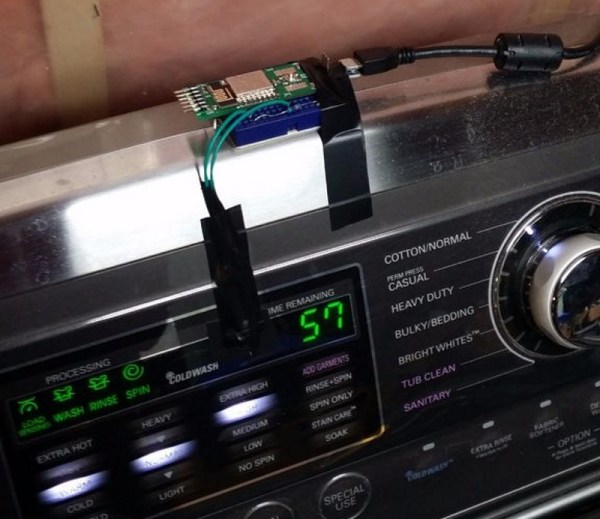
laundrespFinally we have [Mark Kuhlmann] with LaundrEsp. [Mark’s] washing machine has a nasty habit of going off-balance and shutting down. This leaves him with soggy clothing and lost time re-running the load. [Mark] wanted to fix the problem without directly modifying his machine, so he came up with LaundrEsp. When the machine is running normally, a “door locked” light is illuminated on the control panel. As soon as the washer shuts down – due to a normal cycle ending or a fault, the door unlocks and the light goes out. [Mark] taped a CdS light detecting resistor over the light and connected it to an ESP8266. A bit of programming with Thinger.io, and [Mark’s] machine now let’s him know when it needs attention.

If you want to see more laundry projects check out our brand new laundry project list! If I missed your project, don’t take me to the cleaners! Drop me a message on Hackaday.io, and I’ll have your project washed, folded, and added to the list in a jiffy. That’s it for this week’s Hacklet. As always, see you next week. Same hack time, same hack channel, bringing you the best of Hackaday.io!

Roll Your Own Amazon Echo On A Raspberry Pi

Speech recognition coupled with AI is the new hotness. Amazon’s Echo is a pretty compelling device, for a largish chunk of change. But if you’re interested in building something similar yourself, it’s just gotten a lot easier. Amazon has opened up a GitHub with instructions and code that will get you up and running with their Alexa Voice Service in short order.

If you read Hackaday as avidly as we do, you’ve already read that Amazon opened up their SDK (confusingly called a “Skills Kit”) and that folks have started working with it already. This newest development is Amazon’s “official” hello-world demo, for what that’s worth.

There are also open source alternatives, so if you just want to get something up and running without jumping through registration and licensing hoops, you’ve got that option as well.

Whichever way you slice it, there seems to be a real interest in having our machines listen to us. It’s probably time for an in-depth comparison of the various options. If you know of a voice recognition system that runs on something embeddable — a single-board computer or even a microcontroller — and you’d like to see us look into it, post up in the comments. We’ll see what we can do.

Thanks to [vvenesect] for the tip!

YAGDO – Yet Another Garage Door Opener

It seems like every few months we cover another garage door opener, and the concept is quickly becoming the “Hello World” of DIY home automation. In this installment, reader [ray] made his own garage door opener and chose the ESP8266 as the wireless interface of choice, but spiced the application up with an ultrasonic sensor that detects whether the car is in the garage and a web app that shows history, plus integration with Blynk for remote access. For posterity, he made the project open source as well.

The video is well produced with lots of details and instructions, and the circuit board and assembly are refined and clean. It may be a “Hello World”, but it’s done right.

Some of the other garage door hacks we’ve covered in the last year include the fingerprint scanner opener, the IM-ME opener, the motion-based security opener, the cat-enabled opener, the OpenCV Pi opener, and a Bluetooth Low Energy opener.

Continue reading “YAGDO – Yet Another Garage Door Opener”

Aquarium Light Mimics The Outdoor Sky

[OlegZero] has some pet fish in his basement, and decided to work on a little project for them — an aquarium light that mimics the outdoors. He calls it the FishLight project.

His goal was to create a light panel that could imitate the color of the outdoor sky (approximately) using an RGB LED strip. During normal operation, the LEDs cycle through the colors of day, from dusk to dawn using an ATmega88 microcontroller. After his girlfriend saw what it could do, she quickly came up with the idea to add a cityscape to the background to turn it into a piece of attractive decor for their home.

Still fail to see the point of going to this much effort for a few fish? Well, besides it turning into a rather nice artistic light for their basement, the concept can be applied to other animals as well. Like encouraging chickens to produce more eggs by making the days “longer” with artificial light. As it turns out chickens produce less eggs when the days get shorter — an easy fix with something like this!

Mirror Monitor Responds To Your Gestures

[DerVonDenBergen] and his friend are working on a pretty slick mirror LCD with motion control called Reflecty — it looks like something straight out of the Iron Man movies or the Minority Report.

Like most mirror monitors they started with a two way mirror and a de-bezelled LCD — but then they added what looks like an art gallery light off the top — but instead of a light bulb, the arm holds a Leap Motion controller, allowing gesture commands to be given to the computer.

The effective range of the Leap Motion controller is about 8-10″ in front of the display allowing you to reach out and point at exactly what you want — and then squeeze your fist to click. A complete gallery of images is available over on Imgur, but stick around after the break to see a video of the display in action — we kind of want one.

Continue reading “Mirror Monitor Responds To Your Gestures”

R2-D2 Keeps This University Bathroom Smelling Fresh

For a fun university project, [Cengizhan Can] and friends decided to make an automated air freshener for one of their bathrooms at the Utrecht University in the Netherlands. Happening to have an old R2-D2 plastic candy jar, they decided to try to see if they could make it Star Wars themed.

They loaded up the R2-D2 shell with an Arduino, a ton of sensors (don’t worry, nothing for spying) and an actuator for triggering the air freshener. During normal operation the LCD will display ambient temperature information and the approximate number of air freshener shots remaining in the canister. An external door sensor checks to see if the stall is open, and coupled with a light sensor, only sprays freshener after use, and when no one is in the stall anymore.
Continue reading “R2-D2 Keeps This University Bathroom Smelling Fresh”

Laser-Cut Lamp With Magic Switch

This laser-cut lamp is an awesome example of what you can do with a laser cutter and a bit of creativity. It was completely laser cut and features no fasteners, except for a bit of glue.

[PaisleyGarbage] has been making lamps for a while now and had the concept for this one early on. After rendering a model of it on the computer, he decided it was finally time to try making it. It wasn’t quite as easy as he thought it’d be, but the challenges along the way only help you to learn when doing a project like this.

He laser cut alternating strips of wood and acrylic to create the unique sandwiched light look of the final product. Instead of using fasteners or anything, he even slid the pieces together on acrylic dowels keeping the design as minimalist and clean as possible. But the part we really like is the magnetic switch.

Continue reading “Laser-Cut Lamp With Magic Switch”