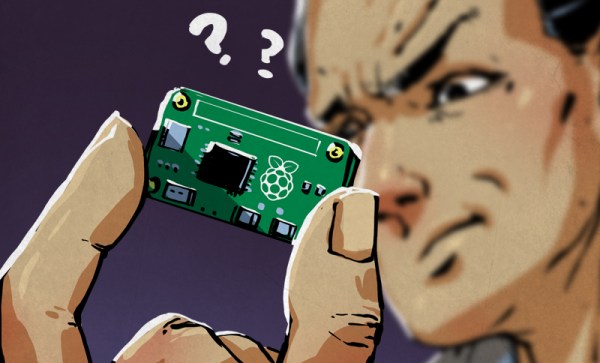
I ordered a Raspberry Pi Zero from Adafruit in their Startup Pack right after they were released. There are a few Greater Than Zero Pis (GTZPi) already on my workbench so my purchase was driven by curiosity, not necessity. With no rush on delivery it eventually got here, and I finally got around to looking at it. My experience with the Pi family began with the Pi B+ and, shortly after that, the Pi 2. The speed difference between them was noticeable so I decided to dive in and further test the performance of the Zero.
If you just wait around long enough, the future becomes the past. And that’s happened to the “Back to the Future” future, as you probably all remember. But BttF-themed projects are still pouring in.
[ossum] sent us the link for his build of Doc Brown’s briefcase that only opens above 88 mph. His writeup is fantastically detailed, and worth a look if you’re interested in working with a GPS unit and microcontrollers, driving seven-segment LEDs with shift registers, or just driving too fast in an old Jetta. And there’s a video demo just below the break if you’re not a believer.
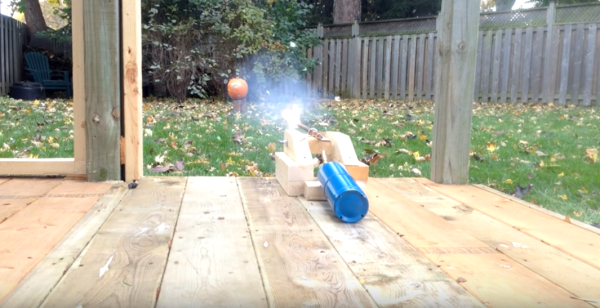
If your local surplus store is fresh out of supercapacitors but you’re just really in the mood to fire stuff at other stuff, check out [austiwawa]’s step-by-step guide to building a thermal cannon. It shoots whatever will fit into a 1/2″ copper pipe, propelled by cut-up matchheads and lit by a propane torch. [austiwawa] demonstrates it by firing an AA battery at an unsuspecting pumpkin. For what it’s worth, we don’t necessarily condone applying this much heat to alkaline cells.
[austiwawa] used a copper pipe for the barrel because it provides the fastest heat transfer. One end of it is flattened and folded over to form the propellant chamber. A couple of packs worth of match heads are tamped down into the folded end with a paper towel serving as wadding. [austiwawa] tosses in his battery, lights the torch, and then runs away.
This whole dangerous contraption is secured to a wooden base with a u-bolt and a couple of pipe straps, and suspended between more pieces of wood with a length of threaded rod for stability and aiming.
We’ll let the safety-conscious readers do our work for us in the comments, but in the meantime, note that this thing is not safe. As [austiwawa] demonstrates, the copper gets brittle and will split open along the folded edge.
But kudos anyway to [austiwawa] for showing shot after shot of the cannon in action at the end of his video. You know where to find it.
If it’s a stronger, more beautiful barrel you’re after, just machine one by hand.
Software Defined Radio (SDR)–the ability to process radio signals using software instead of electronics–is undeniably fascinating. However, there is a big gap from being able to use off-the-shelf SDR software and writing your own. After all, SDRs require lots of digital signal processing (DSP) at high speeds.
Not many people could build a modern PC from scratch, but nearly anyone can get a motherboard, some I/O cards, a power supply, and a case and put together a custom system. That’s the idea behind GNU Radio and SDR. GNU Radio provides a wealth of Python functions that you can use to create sophisticated SDR application (or, indeed, any DSP application).
If Python is still not up your alley (or even if it is), there’s an even easier way to use GNU Radio: The GNU Radio Companion (GRC). This is a mostly graphical approach, allowing you to thread together modules graphically and build simple GUIs to control you new radio.
Even though you usually think of GRC as being about radios, it is actually a good framework for building any kind of DSP application, and that’s what I’ll show you in the video below. GRC has a signal generator block and interfaces to your sound card. It even has the ability to read and write data to the file system, so you can use it to do many DSP applications or simulations with no additional hardware.
Open source EDA software KiCad has been gaining a lot of traction recently. CERN has been devoting resources to introduce many new advanced features such as differential pair tracks, push and shove routing and this plenty more scheduled in the pipeline. One important requirement of EDA packages is a seamless interface with mechanical CAD packages by exporting 3D models in industry common formats. This improves collaboration and allows further engineering designs such as enclosures and panels to be produced.
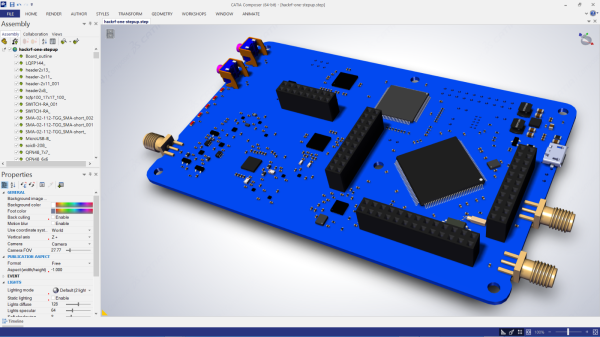
KiCad has had a 3D viewer available for quite a long time. But it uses the VRML mesh format (.wrl files) and there are compatibility issues which prevent it from rendering certain versions of VRML files. Moreover, the VRML mesh export is not particularly useful since it cannot be easily manipulated in mechanical CAD software. Recent versions of KiCad now offer IDFv3 format export – the Intermediate Data Format, a mechanical data exchange specification for the design and analysis of printed wiring assemblies. Taking advantage of this new feature, [Maurice] created KiCad StepUp – an export script that allows collaborative exchange between KiCad and FreeCAD.
A FreeCAD macro and a corresponding configuration file are added to the KiCad project folder. You start with .STEP files for all the components used in the KiCad design. The next step is to convert and save all .STEP files as .WRL format using FreeCAD. On the KiCad side, you use the .WRL files as usual. When you want to export the board, use the IDFv3 option in KiCad. When [Maurice]’s StepUp script is run (outside of KiCad) it replaces all instances of .WRL files with the equivalent .STEP versions and imports the board as well as the components in to FreeCAD as .STEP models. The result is a board and its populated components which can be manipulated as regular 3D objects.
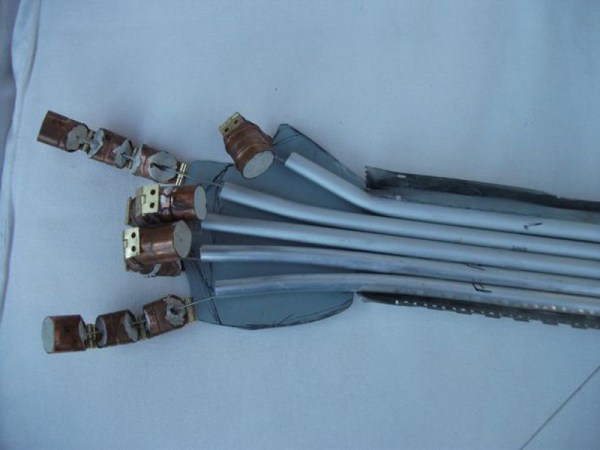
According to his Instructables profile, [bwebby] wants to make cool stuff in the special effects industry. We think he has a pretty good chance at it based on the animatronic hand he built.
The finger segments are made from copper pipe. They are connected to each other and to the sheet metal palm with tiny hinges and superglue. That stuff inside the finger segments is epoxy putty. It keeps the ends of the tendons made from bicycle gearing cable firmly attached to the fingertip segments, and provides a channel through the rest of the fingers. These cables run through 50mm aluminium tubes that are set in a sheet metal forearm, and they connect to high-torque servos mounted on a piece of MDF. [bwebby] used a Pololu Mini Maestro to control the servos using the board’s native USB interface and control software.
Watch [bwebby] run through some movements and try out the grip after the break. If you want to make an animatronic hand but aren’t ready for this type of undertaking, you could start with an approach closer to puppetry.
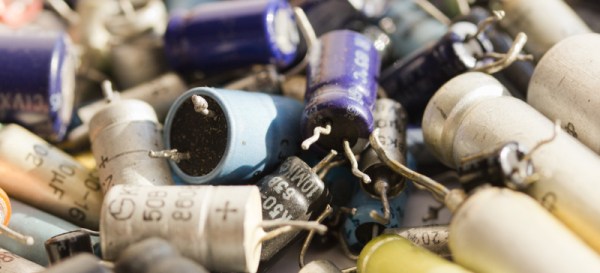
Maxim Integrated recently posted a series of application notes chronicling how there’s more going on than you’d think in even the simplest “passive” components. Nothing’s safe: capacitors, resistors, and even printed circuit boards can all behave in non-ideal ways, and that can bite you in the reflow-oven if you’re not aware of them.
You might already know that capacitors have an equivalent series resistance that limits how fast they can discharge, and an equivalent inductance that models departures from ideal behavior at higher frequencies. But did you know that ceramic capacitors can also act like voltage sources, acting piezoelectrically under physical stress?
For resistors, you’ll also have to reckon with temperature dependence as well as the same range of piezoelectric and inductance characteristics that capacitors display. Worse, resistors can display variable resistance under higher voltages, and actually produce a small amount of random noise: Johnson Noise that depends on the value of the resistance.
Finally, the third article in the series tackles the PCB, summarizing a lot of potential manufacturing defects to look out for, as well as covering the parasitic capacitance, leakage currents, and frequency dependence that the actual fiberglass layers themselves can introduce into your circuit.



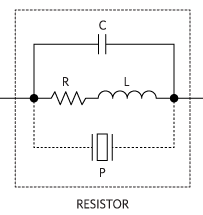 For resistors, you’ll also have to reckon with temperature dependence as well as the same range of piezoelectric and inductance characteristics that capacitors display. Worse, resistors can display variable resistance under higher voltages, and actually produce a small amount of random noise:








