Dissecting The AVR DebugWire

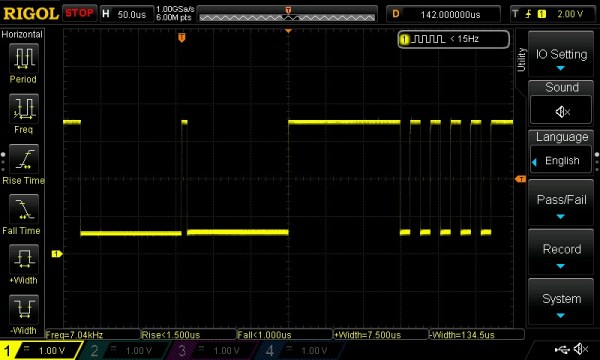
Anyone who’s ever written more than a dozen or so lines of code knows that debugging is a part of life in our world. Anyone who’s written code for microcontrollers knows that physical debugging is a part of our life as well. Atmel processors use a serial communications protocol called debugWire, which is a simpler version of JTAG and allows full read/write access to all registers and allows one to single step, break, etc. [Nerd Ralph], a prominent fixture here at Hackaday has dug into the AVR debugWire protocol and enlightened us with some valuable information.

While the protocol side of debugWire is a mostly-solved problem, the physical layer was giving him trouble. He started with a diode, and then went through a couple resistors and other components to interface with the debugWire pin on the AVR microcontroller, doing most of the troubleshooting work so now you don’t have to. He notes that interface components might need to be tailored to specific USB-TTL adapters, so keep that in mind if you care to delve into working with debugWire yourself.

We’re no strangers to debugging techniques here at Hackaday. As always, be sure to let us know if you run across any new techniques or try anything new yourself!

Fast LED Matrix Graphics For The ESP32

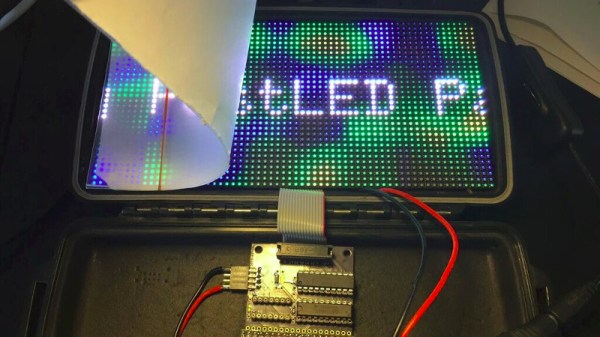
Many of you will have experimented with driving displays from your microcontroller projects, and for most people that will mean pretty simple status information for which you’d use standard libraries and not care much about their performance. If however any of you have had the need for quickly-updating graphics such as video or game content, you may have found that simpler software solutions aren’t fast enough. If you are an ESP32 user then, [Louis Beaudoin] may have some good news for you, because he has ported the SmartMatrix library to that platform. We’ve seen his demo in action, and the results as can be seen in the video below the break are certainly impressive.

In case you are wondering what the SmartMatrix library is, it’s an LED matrix library for the Teensy. [Louis]’s port can be found on GitHub, and as he was explaining to us over a beer at our Cambridge bring-a-hack, it takes extensive advantage of the ESP32’s DMA capabilities. Making microcontrollers talk with any sort of speed to a display is evidently a hot topic at the moment, [Radomir Dopieralski]’s talk at our Dublin Unconference a few weeks ago addressed the same topic.

We have to admit a soft spot for LED panels here at Hackaday, and given the ESP32’s power we look forward to writing up the expected projects that will come our way using this library.

Continue reading “Fast LED Matrix Graphics For The ESP32”

Medium Machine Mediates Microcontroller Messages

Connecting computers to human brains is currently limited to the scope of science fiction and a few cutting-edge laboratories. Tapping into some nerves farther from our central wetware is possible and [Peter Buczkowski] shows us his stylish machine for implanting a pattern into our brains without actively having to memorize anything.

His Medium Machine leverages a TENS unit to activate forearm muscles in a pattern programmed into an Arduino. Users place their forearm across two aluminum electrodes mounted on a tasteful wooden platform and extend a single finger over a button. Electrical impulses trigger the muscles which press the button. That’s all. After repeating the pattern a few times, the users should be able to recite it back on command even if they aren’t aware of what it means. If this sounds like some [Johnny Mnemonic] memory cache, you are absolutely correct. This project draws inspiration from the [William Gibson] novel which became a [Keanu Reeves] movie.

Users can be programmed with a Morse code message or the secret knock to open an attic library or play a little tune. How about learning a piano song?

Continue reading “Medium Machine Mediates Microcontroller Messages”

Big Mouth Billy Bass Channels Miley Cyrus

Here’s a Big Mouth Billy Bass with extra lip thanks to Alexa. If you’re not already familiar, Big Mouth Billy Bass is the shockingly popular singing animatronic fish designed to look like a trophy fish mounted to hang on your wall. In its stock condition, Billy uses a motion sensor to break into song whenever someone walks by. It’s limited to a few songs, unless you like to hack things — in which case it’s a bunch of usable parts wrapped in a humorous fish! Hackaday’s own [Bob Baddeley] combined the fish with an Amazon Echo Dot, connecting the two with an ATtiny84, and having Billy speak for Alexa.

[Bob] had a few problems to solve, including making Billy’s mouth move when there was audio playing, detecting when the Echo was on, moving the motors and playing the audio. After a bit of research and a lot of tweaking, a Fast Fourier Transform algorithm designed for the ATtiny was used was used to get the mouth moving. The mouth didn’t move a lot because of the design of the fish, and [Bob] modified it a bit, but there was only so much he could do.

It’s all well and good for the fish to lie there and sing, but [Bob] wanted Billy to move when Alexa was listening, and in order the detect this, the best bet was to watch for the Dot’s light to turn on. He tried a couple of things but decided that the simplest method was probably the best and ended up just taping a photo-resistor over the LED. Now Billy turns to look at you when you ask Alexa a question.

With a few modifications to the Dot’s enclosure, everything now fits inside the original mounting plaque and, after some holes were drilled so the Dot could hear, working. Billy has gone from just a few songs to an enormous entire library of songs to sing!

We’ve seen Alexa combined with Big Mouth Billy Bass before, but just demos and never an excellent guide like [Bob’s].  The nice thing about this guide is that once you’ve hacked the hardware, it’s a breeze to add new functionality using Alexa skills.

Continue reading “Big Mouth Billy Bass Channels Miley Cyrus”

Zephyr Adds Features, Platforms, And Windows

Zephyr is an open source real-time operating system (RTOS) that appeared on the scene a few years ago with support for a few boards. The new 1.11 release adds a lot of features, a lot of new boards, and also has a Windows development environment. But don’t worry, the environment is portable so it still runs on Linux and Mac, as well.

The OS has support for many ARM and x86 boards. It also supports ESP32, NIOS II, and can also target Linux which is useful for debugging or studying execution using desktop tools.

Continue reading “Zephyr Adds Features, Platforms, And Windows”

Emulating OBD-II On The ESP32

It used to be that you could pop the hood and with nothing more than flat head screwdriver, some baling wire, and tongue held at the optimal angle, you could fix anything that ailed your car. But today, for better or for worse, the average automobile is a rolling computer that runs on gasoline and hope (if it even still has a gasoline engine, that is). DIY repairs and maintenance on a modern car is still possible of course, but the home mechanic’s toolbox has needed to evolve with the times. If you want to do anything more advanced than changing a tire, you’ll really want to have the gear to interface with the vehicle’s computer via the OBD-II port.

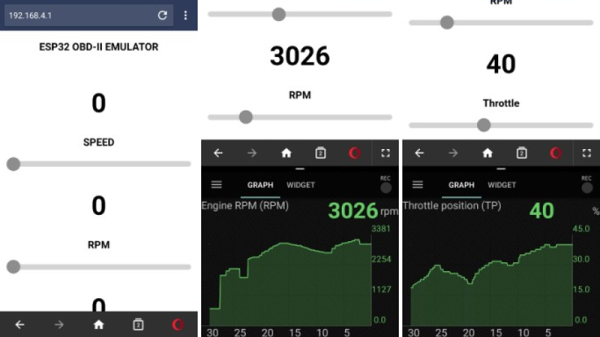
But for some, even that isn’t enough. [limiter121] recently wrote in to tell us of an interesting project which doesn’t read the OBD-II port in a vehicle, but actually emulates one. Like so many others this hack was born out of necessity, as a way to test an OBD-II project without having to sit out in the driveway all day. It allows you to create fictitious speed and engine RPM values for the OBD-II device or software under test to read, complete with a slick web interface to control the “car”.

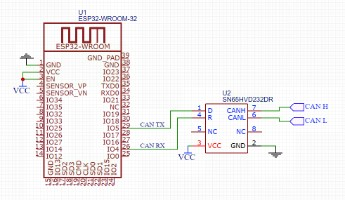
So what makes it tick? Surprisingly little, actually. At the most basic level, an ESP32-WROOM-32 is connected up to a SN65HVD230 CAN transceiver chip. You’ll also need a 3.3V power supply, as well as a USB to serial adapter to do the initial programming on the ESP32. From there it’s just a matter of compiling and flashing the code [limiter121] has made available in the GitHub repo.

If you’re wondering if such products don’t already exist on the commercial market, they do. But like so many other niche projects, the price is a bit hard to swallow for the home hacker. Compared to the nearly $300 USD list price of commercial offerings such as the Freematics OBD-II Emulator, building one of these ESP32 based emulators should only cost you around $20.

Unless you’re developing an OBD-II reader, you probably don’t have much use for an OBD-II emulator. But this project could still be useful for anyone who wants to learn more about OBD from the comfort of their couch.

New App Note Day: Internet Of Pillows

The Internet of Things is a cancer that consumes all reasonable expectations of technology, opens vast security holes we’ve never had to deal with before, and complicates life in the pursuit of quarterly gains from whatever technology startup is hot right now. We are getting some interesting tech out of it, though. The latest in the current round of ‘I can’t believe someone would build that’ is the Internet of Pillows. No, it’s not a product, it’s just an application note, but it does allow us to laugh at the Internet of Things while simultaneously learning about some really cool chips.

The idea behind this ‘smart’ pillow is to serve as a snoring sensor. When the smart pillow detects the user is snoring, a small vibration motor turns on to wake up the user. There’s no connectivity in this smart pillow, so the design is relatively straightforward. You need a microphone or some sort of audio sensor, you should probably have a force-sensitive resistor so you know the pillow is actually being used, and you need a vibration motor. Throw in a battery for good measure. Aside from that, you’re also going to need a microcontroller, and that’s where things get interesting.

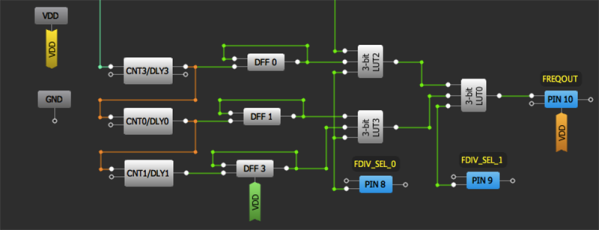
This application note was written as a demonstration of what Dialog’s GreenPAC devices can do. We’ve seen these things before, and the idea behind these devices is something like a ‘modern-day PAL’ or ‘a really, really limited FPGA’. It’s a bit more than that, though, because the GreenPAC devices are mixed-signal, there are some counters and latches in there, and all the programming is done through a graphical IDE. If you need a small, low-power chip that only does one thing, the GreenPAC is right up your alley.

So, how does this device detect snoring? The code pulls data from the sound sensor every 30 ms, with a 5 ms time window. If this sound repeats again within six seconds, it’s assumed the user is snoring. The logic then turns on the vibration motor, greatly annoying whoever is sleeping. All of this is done through a graphical IDE, which I’m sure will draw the ire of some, but there really aren’t that many pins or that many LUTs on GreenPAC devices, so it’s never going to get too out of hand.

The GreenPAC is a very interesting family of parts that we don’t see too much of around here. That’s a shame, because for low-power applications that don’t need a lot of horsepower, the GreenPAC seems like it would be very useful. Slightly more useful than an Internet of Things pillow, at least.