Parts: LM317 Adjustable Voltage Regulator

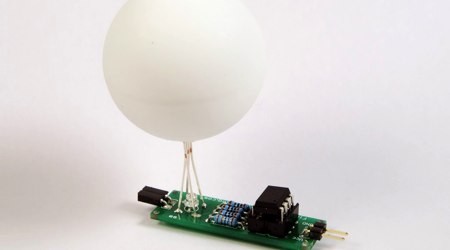
Every project needs a power supply. As 3.3volt logic replaces 5volt systems, we’re reaching for the LM317 adjustable voltage regulator, rather than the classic 7805. We’ve found four different hobbyist-friendly packages for different situations.

A simple voltage divider (R1,R2) sets the LM317 output between 1.25volts and 37volts; use this handy LM317 calculator to find resistor values. The regulator does its best to maintain 1.25volts on the adjust pin (ADJ), and converts any excess voltage to heat. Not all packages are the same. Choose a part that can supply enough current for your project, but make sure the package has sufficient heat dissipation properties to burn off the difference between the input and output voltages.

Continue reading “Parts: LM317 Adjustable Voltage Regulator”

24kJ Capacitor Bank

The Leyden jar capacitor posted the other day fails to compare to what [FastMHz], one of the members over at the 4HV.org forums, has been busy building, a 24kj capacitor discharge bank. This capacitor bank will be configured for 4500v @ 2400uF and can be charged up slowly using microwave oven transformers. It can then release all its stored energy in under a millisecond through a triggered spark gap. This allows for some pretty big sparks as seen in this video, we are not sure about the laughing in the video maybe the power has gone to his head? Continue reading “24kJ Capacitor Bank”

Boston LED Sweatshirt Arrestee Interviewed

In today’s episode of Boing Boing tv, [Xeni] interviews [Star Simpson]. She was arrested a year ago at Boston’s Logan airport for wearing a sweatshirt with a breadboard and some LEDs attached. With a collective groan, we watched this event unfold just months after Boston was held captive by Mooninites. After many court dates, [Star] is being forced to apologize and perform community service. She has since left MIT, disappointed with their nonexistent support, and left Boston entirely. Watch the interview for her side of the story. She’s posted how to recreate the sweatshirt.

Open Source Neural Activity Monitors

Yesterday we linked to an OCZ Neural Acutator Interface teardown. Several in the comments wanted to know more about the sensor electrodes. Check out the OpenEEG project and OpenEEG mailing list for information on sensing, amplifying, and recording brain activity (EEG). The OpenEEG project maintains an open source Simple ModularEEG design. Two other open source variants of the ModularEEG are the MonolithEEG and [Joshua Wojnas’] Programmable Chip EEG BCI. All three projects use Atmel microcontrollers, with designs in Cadsoft Eagle.

Brain activity is measured using passive or active electrodes. Passive electrodes require a conductive paste to make proper contact with the skin (examples: 1, 2). Active EEG sensors don’t need conductive goop because they have an amplifier directly on the electrode (examples: 1, 2, 3).

[via anonymous reader, comments]

OCZ Neural Impulse Actuator Teardown

m8ta fun did an extensive teardown of OCZ’s Neural Impulse Actuator (NIA). OCZ’s computer/mind interface is actually a fairly straight forward design. An analog front-end cleans and amplifies the ‘neural’ signal with a few op-amps before feeding it to a 24 bit analog to digital converter (ADC). A USB enabled PIC microcontroller reads the 24bit parallel ADC output through a common 7400 series parallel to serial adapter IC. The device has an ICSP programing header (top right), though it’s not yet clear if the PIC can be read or written.

[Thanks, joeyo]

Backup DVD Burning Robot

[Aaron Shephard] at mini-itx.com just finished a backup DVD burning robot based on an EPIA M10000 Mini-ITX motherboard and scavenged parts. A Perl script interacts with stepper motors, LEDs, and sensors through the parallel port on the motherboard. The robot inserts DVDs for burning, flips them for labeling, and stacks completed discs in a pile. Coasters are rejected to a ‘penalty box’ for easy disposal.

We’ve also covered some other optical disc duplicators in the past.

[thanks maxthereal]

Old School High Voltage Capacitance


What would MacGyver do if he needed a high voltage capacitor but only had some foil, tape, water, salt, a nail and a plastic jug?  He would build a salt water Leyden jar, that’s what.  The Leyden jar is a very simple capacitor. Invented in 1745, it has been integral to many scientific experiments. Check the wikipedia entry to learn more about the history.

This specific type is quite easy to make. It uses a salt water interior instead of foil on the inside and outside. That means you could slap one of these together in a few minutes to impress your friends and/or electrocute yourself accidentally.  Please be careful as this is high voltage.