Paintball Gun Silencer


In paintball, the element of surprise can make the difference between victory and defeat. While we can’t help you with the sounds of labored breathing and shuffling feet as you waddle across the field, we did find this guide on how to make a silencer for your paintball gun.

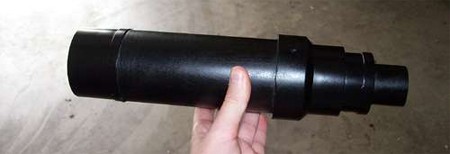
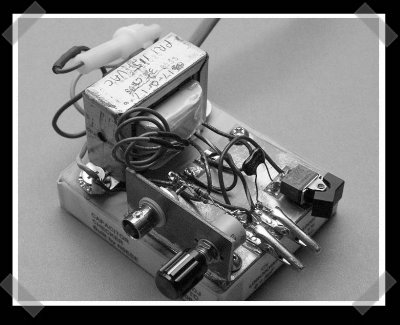
To build this you will need two lengths of PVC pipe, one slightly larger in diameter than the barrel of the gun, the other about 1″ beyond that. You will also need PVC reducers that fit the pipes, cotton balls, and various cutting and finishing tools. Cut the stopper tab from the smaller pipe and put into a reducer, hammering the reducer into place. Cut the pipe about 1″ away from the reducer, being careful to make the cut as even (perpendicular to the length of the pipe) as possible. Now drill six straight lines of ten holes along the pipe with the smallest drill bit possible. Sand down the inside of the pipe by wrapping sandpaper around a cylindrical stick and move the stick in and out of the pipe. Cut the larger pipe so that it is slightly shorter than the smaller pipe. Fit the two pipes together and fill the area between the two with about 20 cotton balls. After that, fit the second reducer to the other end. At this point the silencer is functional, but guide author [MrAngryPants] suggests painting it black.

As the paintball and CO2 are expelled from the gun, the cotton baffles dampen the resulting sound wave.

Pulse, The Emotional Visualization Organism


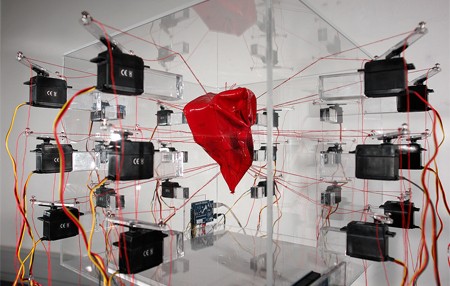
[Markus Kison] built a device called Pulse, which is part art installation and part data visualization tool. What the emotional visualization organism called Pulse actually does is scan new posts on Blogger.com blogs for synonyms of keywords related to 24 distinct emotions from eight emotional groups. A red cone in the center expands when keywords are detected, in effect acting as a mood indicator for Blogger.com blogs.

The 24 distinct emotions are based on [Robert Plutchik]’s psychoevolutionary theory of emotion, and the device itself is built from a glass case, various servo motors, and custom controller for the servos. This is a compelling idea, but we wonder whether it scans for modifying words or just the keywords alone. It wouldn’t make a lot of sense to have the sadness region expand drastically if many people simultaneously post the sentence “I’m not sad at all.” Video embedded after the break.

Continue reading “Pulse, The Emotional Visualization Organism” →

Really Bare Bones Board Arduino Clone


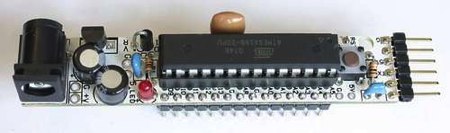
Modern Device’s Really Bare Bones Board is an Arduino clone designed to have an incredibly small footprint. It’s barely wider than the requisite AVR and is laid out so you can reduce the size even further. Don’t need the power connector? Just snip it off. Don’t need the voltage regulator? That can be removed just as easily. The kit is only $12 and all through-hole components. [youevolve] posted a build guide that shows exactly how easy it is to assemble.

Related: Freeduino SB 2.1 review

Data Manipulation With Sprog


Linux Journal’s [Mike Diehl] pointed out an interesting tool for manipulating data: Sprog. Sprog lets you assemble machines to complete specific data processing tasks. You snap together gears that read input data, process the data in different ways, and then output the results. The input could be a file, URL, database query results, or even MIDI notes. For processing you could be matching patterns, selecting csv columns, converting to uppercase, or executing arbitrary Perl code amongst many other options. Finally the output could be shown in a text window, inserted into a database, written to a file, or sent to your spreadsheet application. Sprog’s site has a section for user uploaded gears and a recipe section for examples like this crossword puzzle solver. Everything Sprog does could be done with scripting, but this is a simple graphical tool that could help you solve a problem without having to know the gory machinery behind it.

Laser Tattoo


We’re amazed we didn’t stumble across this ill advised burnination sooner. Earlier in the week [tetranitrate], of LED chess set fame, posted his experiences using a laser cutter to scarify his own skin. It’s very painful, not to mention the discomfort of smelling your own burning flesh. He’s using an Epilog with a magnet over the safety switch. To get the positioning right, a layer of painters tape was put down and then etched. For a less painful version, you could try Bre’s fingernail calendar from last Fall. Video of multiple tattoos embedded after the break.

Continue reading “Laser Tattoo” →