The Sound Of (Synthesized) Music

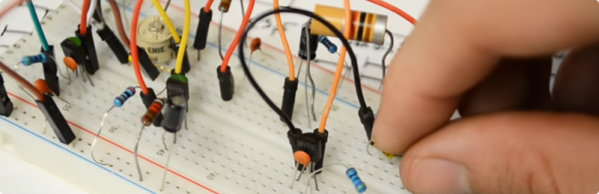
What’s an ADSR envelope generator? If you are a big music hacker, you probably know. If you are like the rest of us, you might need to read [Mich’s] post to find out that it is an attack-decay-sustain-release (ADSR) envelope generator. Still confused? It is a circuit used in music synthesis. You can see a demo of the device in the video below.

Before the Altair–which was sort of the first hobbyist computer you could actually buy–electronics magazines were full of music synthesizer projects that had a lot in common with the analog computers of old. A lot of people took that very seriously and then computers took over the collective consciousness and we found musical hackers started working with (digital) computer-based synthesizers. But the old analog synth designs just won’t die. [Mich’s] ADSR is based on an ancient design, and the amount of information and additions he provides makes it worth a read, even if you don’t fancy building one.

Continue reading “The Sound Of (Synthesized) Music”

[Daito Manabe] Interview: Shocking!

We’ve loved [Daito Manabe]’s work for a while now. Don’t know [Daito]? Read this recent interview with him and catch up. Is he a hacker’s artist, or an artist’s hacker?

My personal favorite hack of his is laser painting apparatus from 2011. The gimmick is that he uses the way the phosphors fade out to create a greyscale image. Saying that is one thing, but watching it all come together in time is just beautiful.

Maybe you’ve seen his facial-electrocution sequencer (words we never thought we’d write! YouTube link). He’s taken that concept and pushed it to the limit — setting up the same sequences on multiple people make them look eerily like the sacks of meat that they are, until everyone laughs at the end of the experiment and they’re all back to being human.

Anyway, if you didn’t know [Daito], check out the rest of his work. Have any other favorite tech artists that we’re missing? Drop us a line.

How To MIDI Interface Your Toys

There’s a great number toys in the world, many of which make all manner of pleasant or annoying noises for the entertainment of children. If you’re a musician, these toys may be of interest due to their unique or interesting sounds. However, due to their design being aimed at play rather than performance, it may be difficult to actually use the toy as a musical instrument. One way around this is to record the sounds of the toy into a sampler, but it’s not the only way. [little-scale] is here to demonstrate how to MIDI interface your toys. 

[little-scale] starts out by discussing the many ways in which one can interface with a toy. The article discusses how a simple button can be replaced with a relay, or a multiplexer, and be interfaced to all manner of other devices to control the toy. This is demonstrated by using a mobile phone toy which makes sounds when buttons are pressed.

A Teensy 3.6 is used to run the show, acting as a USB-MIDI interface so the toy can be controlled by music software like Abelton. It’s connected to the toy’s buttons through a multiplexer. The toy’s speaker is cut off and used as an audio output instead, allowing the toy to be easily connected to other audio hardware for performance or recording. It’s also fed through a digital pot so MIDI commands can control the volume. A resistor is used to control pitch in the toy, so this too was replaced with a digital pot as well, to allow sample pitch to be controlled.

The project is incredibly well documented, with [little-scale] first tearing down the toy and highlighting the points of interest, before stepping through each stage of interfacing the toy to the digital world. We’ve seen some of [little-scale]’s work before, too – namely, this MIDI DAC for controlling vintage synthesizers. Video after the break. Continue reading “How To MIDI Interface Your Toys”

12-Foot Guitar Takes The Stage

Musical festivals are fun and exciting. They are an opportunity for people to perform and show-off their art. The Boulevardia event held this June in Kansas City was one such event, where one of the interactive exhibits was a 12-foot guitar that could be played. [Chris Riebschlager] shares his experience making this instrument which was intended to welcome the visitors at the event.

The heart of this beautiful installation is a Bare Conductive board which is used to detect a touch on the strings. This information is sent over serial communication to a Raspberry Pi which then selects corresponding WAV files to be played. Additional arcade buttons enable the selection of playable chords from A through G, both major and minor and also give the option to put the guitar in either clean or dirty mode.

The simplicity of construction is amazing. The capacitive touch board is programmed using the Arduino IDE and the code is available as a Gist. The Raspberry Pi runs a Python script which makes the system behave like an actual guitar i.e. touching and holding the strings silences it while releasing the strings produces the relevant sound. The notes being played were exported guitar notes from Garage Band for better consistency.

The physical construction is composed of MDF and steel with the body and neck of the guitar milled on a CNC machine. Paint, finishing and custom decals give the finished project a rocking appearance. Check out the videos below for the fabrication process along with photos of the finished design.

This project is a great example of art enabled by technology and if you love guitars, then go ahead and check out Brian May’s Handmade Guitar. Continue reading “12-Foot Guitar Takes The Stage”

FabricKeyboard

FabricKeyboard Is Piano, Theremin And More

Two researchers of Responsive Environments, MIT Media Lab, have put to together a device that is an amazing array of musical instruments squeezed into one flexible package. Made using seven layers of fabrics with different electrical properties, the result can be played using touch, proximity, pressure, stretch, or with combinations of them. Using a fabric-based keyboard, ribbon-controller, and trackpad, it can be played as a one-octave keyboard, a theremin, and in ways that have no words, such as stretching while pressing keys. It can also be folded up and stuffed into a case along with your laptop, and care has even been taken to make it washable.

The FabricKeyboard layers

Layer one, the top layer, is a conductive fabric for detecting proximity and touch. The twelve keys can work independently with a MPR121 proximity touch controller or the controller can treat them all as one, extending the distance the hand can be and have it still work. Layer two is just a knit fabric but layers three to six detect pressure, consisting to two conductive layers with a mesh fabric and a piezo-resistive fabric in between. The piezo-resistive fabric is LTT-SPLA from eeonyx, a knit fabric coated with the conductive polymer, polypyrrole (PPy). Layer seven consists of two strips of knitted spandex fabric, also coated with PPy, and detects stretching. Two strips of this are sewn on the bottom, one horizontal and one vertical. You can see and hear the amazing sound this all produces in the video below.

Continue reading “FabricKeyboard Is Piano, Theremin And More”

Music-Loving BeagleBone

Robotic control can get very complicated when multiple actuators need to work in coordination with each other. A simple robotic arm will require each joint to be controlled in sequence to attain a particular position. The BeagleBone Blue comes armed with motor drivers, sensor inputs, and wireless and is built for robotics.

[Andy] has prepared a musical robot called the BeagleBone Blue Electro-Mechanical Glockenspiel using the single board computer. The hardware consists of eight servo motors each with a mallet stick attached to them. The motors themselves are mounted on 3D-printed brackets allowing them to be mounted at the correct height. The servos connect to the main board for position control, however, an external supply had to be used to supply the necessary current to all the motors.

The software side has programs to translate notes into servo positions as well as connect to a web brower via MQTT and websockets. The basic user interface is simple and has buttons to connect to and send the keystrokes. The code, as well as the OpenSCAD designs, can be downloaded from GitHub. Check out the video below for a demo.

This project could be extended to an autonomous robot that plays tunes from the Internet. We are reminded of the rock throwing glockenspiel which was pretty cool and hope there are some permutations to come from both. Continue reading “Music-Loving BeagleBone”

The Red Special: Brian May’s Handmade Guitar

Guitarists are a special breed, and many of them have a close connection with the instruments they play. It might be a specific brand of guitar, or a certain setup required to achieve the sound they’re looking for. No one has a closer bond with an instrument than Brian May to his Red Special. The guitar he toured with and played through his career with Queen and beyond had very humble beginnings. It was built from scratch by Brian and his father Harold May.

A young Brian May playing the brand new Red Special. Note the disk magnets of the original handmade pickups

It was the early 1960’s and a young teenaged Brian May wanted an electric guitar. The problem was that the relatively new instruments were still quite expensive — into the hundreds of dollars. Well beyond the means of the modest family’s budget. All was not lost though. Brian’s father Harold was an electrical engineer and a hacker of sorts. He built the family’s radio, TV, and even furniture around the house. Harold proposed the two build a new electric guitar from scratch as a father-son project. This was the beginning of a two-year odyssey that resulted in the creation of one of the world’s most famous musical instruments.

Brian was already an accomplished guitarist, learning first on his dad’s George Formby Banjo-ukulele, and graduating to an Egmond acoustic guitar. Brian’s first forays into electric guitars came from experimenting with that Egmond. If you look close, you can even see the influence it had on the final design of the Red Special.

Continue reading “The Red Special: Brian May’s Handmade Guitar”