PDP-8 Plays Period Popcorn Piece

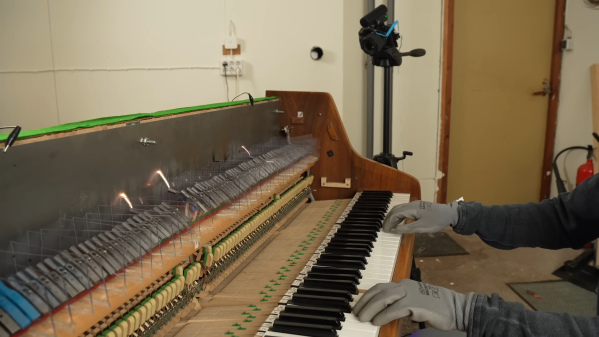
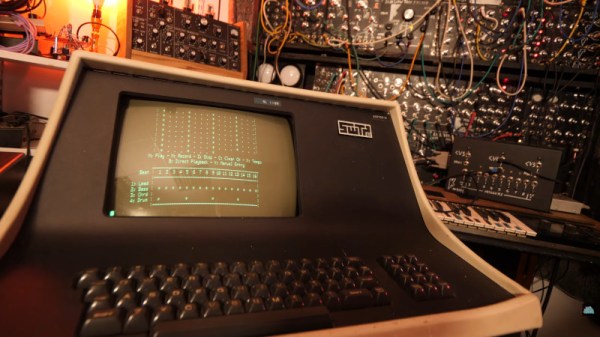
[Kyle Owen], collector of antique tech, decided to try his hand at music arrangement — for the PDP-8 computer, that is (listen to the video below the break). He’s using a program submitted by Richard Wilson to the Digital Equipment Corporation Users Society (DECUS) in 1976, appropriately named MUSIC. It runs on OS/8 and is written in the PDP-8 assembly language PAL8. Using the syntax of MUSIC, [Kyle] arranged Gershon Kingsley’s famous Moog synthesizer hit “Popcorn” (the Hot Butter version from 1972).

You might notice the lack of a disk or tape drive in his setup. That’s because [Kyle] is using an RK05 disk emulator he wrote back in 2014. It’s running on a Raspberry Pi and connects over serial, which he says is slower than an RK05 but faster than a tape drive. He has connected up a Cordovox amplifier cabinet for this demonstration, but the original means of listening to the MUSIC output was an AM radio held near the computer (hear the second video below the break). This worked by executing the PDP-8 CAF instruction at a desired frequency, say 440 Hz.

Thus, when this instruction is executed, logic all over the computer goes “zap”, clearing out various registers. Now, if a radio is held close to the computer, it will pick up some of this energy, and at 440 times a second, will deliver a pulse to the speaker. The result is that you will hear a tone from the radio — as a matter of fact, you will hear an A.

Continue reading “PDP-8 Plays Period Popcorn Piece”

There’s Nothing Square About This Rectangular Guitar

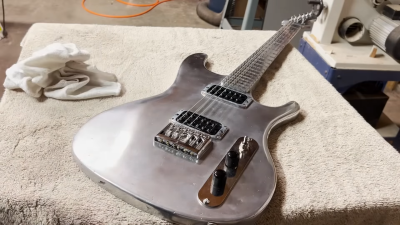
We kind of already knew this, but it seems that [Uri Tuchman] really can build absolutely anything. This fall, he was asked to compete in the Great Guitar Build-Off competition, which involves a fully-customizable kit guitar sent to each entrant as a starting point. In order to allow for maximum creativity, the wooden parts like the body and the headstock are square. And quite creatively, [Uri] kept them that way. Square, that is.

While yes, the body rising out of the squareness is in fact a Les Paul profile, there are a ton of details that make this a [Uri Tuchman] instead. For starters, everything is square, beginning with the custom brass knobs for the volume and tone potentiometers. We’re not sure if it came with humbuckers, but that sure is a happy accident if so. If only the neck blank had been square, [Uri] could have made a lap steel. Once it was finished, [Uri] took it to a luthier to have it set up, fine-tuned, and assessed for quality. Of course, it passed with flying Vs colors.

There are plenty of other [Uri] hallmarks, like the bird on the neck plate, and another hiding in the hand-drawn and hand-carved pickguard, so be sure to check it out after the break.

Continue reading “There’s Nothing Square About This Rectangular Guitar”

A EuroRack synthesizer module with an oscilloscope in the background showing a waveform

Recreating The Sounds Of The ’90s With A YM3812 Synthesizer

One reason the x86 PC became the dominant game platform in the early 1990s was the availability of affordable sound cards like the AdLib and Sound Blaster. These provided a quantum leap in sound quality compared to the PC speaker’s tinny beeps, thanks to Yamaha’s YM3812 chip, also known as OPL2. [Tyler] has made a detailed study of the various OPL series chips and wrote a comprehensive guide describing their operation.

[Tyler] begins by explaining the theory of FM synthesis. The basic idea is that you generate sine waves of different frequencies, combine them through mixing and modulation, and then adjust their strength over time. This way, a few simple operations on the chip’s nine sound channels can generate an astonishing variety of sounds from clear notes to chaotic noise. He then delves into the details of the YM3812 chip, including its 279 different register settings that enable all these operations.

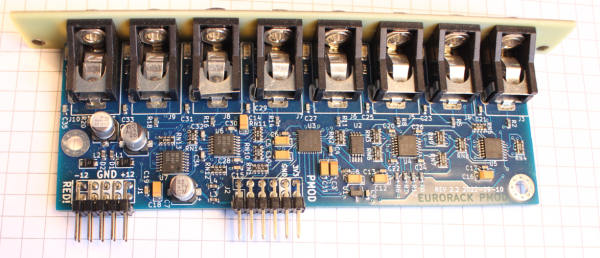
The final goal of [Tyler]’s research is the design of a YM3812 EuroRack module that fits inside standard modular synthesizers. He’ll go into detail on the board’s design and construction in future blog posts, but he already shows the finished product and demonstrates its features in the video embedded below. It’s a great introduction if you’re new to FM synthesis and want to recreate those magic DOS game sounds.

Of course, you can also just connect the OPL2 chip to your DOS computer, whether through a classic sound card or through a parallel port. The related YM2612 from the Sega Genesis also makes a fine synthesizer.

Continue reading “Recreating The Sounds Of The ’90s With A YM3812 Synthesizer”

I’ve Got Two Turntables And A Laser Engraver

Digital media provides us with a lot of advantages. For something like recording and playing back music, digital copies don’t degrade, they can have arbitrarily high quality, and they can be played in a number of different ways including through digital streaming services. That being said, a number of people don’t feel like the digital experience is as faithful to the original sound as it could be and opt for analog methods instead. Creating analog copies of music is a much tougher matter though, as [Marco] demonstrates by using a laser engraver to produce vinyl records.

[Marco] started this month-long project by assembling and calibrating the laser engraver. It has fine enough resolution to encode analog data onto a piece of vinyl, but he had to create the software. The first step was to generate the audio sample, then process it through a filter to remove some of the unwanted frequencies. From there, the waveform gets made into a spiral, accounting for the changing speed of the needle on the record as it moves to the center. Then the data is finally ready to be sent to the laser engraver.

[Marco] did practice a few times using wood with excellent success before moving on to vinyl, and after some calibration of the laser engraver he has a nearly flawless 45 rpm record ready to hit the turntable. It’s an excellent watch if not for anything than seeing a working wood record. We’ve actually seen a similar project before (without the wood prototyping), and one to play records from an image, but it’s been quite a while.

Thanks to [ZioTibia81] for the tip!

Continue reading “I’ve Got Two Turntables And A Laser Engraver”

Rope Core Drum Machine

One of our favorite musical hackers, [Look Mum No Computer] is getting dangerously close to building a computer. His quest was to create a unique drum machine, inspired by a Soviet auto-dialer that used rope core memory for number storage. Rope memory is the read-only sibling to magnetic core memory, the memory technology used to build some beloved computers back in the 60s and early 70s. Rope core isn’t programmed by magnetizing the ceramic donuts, but by weaving a wire through them. And when [Look Mum] saw the auto-dialer using the technology for a user-programmable interface, naturally, he just had to build a synth sequencer.
Continue reading “Rope Core Drum Machine”

A hand holding a paper cup pours orange resin into a mold. There are several different colors in a spiral inside a circular mold on a circular platform with holes around its perimeter sitting on a wooden table.

Reproducing Vinyl Records In Resin

While most are just plain, vinyl records can be found in a variety of colors, shapes, and some even glow in the dark. [Evan and Katelyn] decided to spruce up a plain old record by replicating it in bright, glow-in-the-dark resin.

By first making a silicone mold of the vinyl record and then pouring several different colors of resin into the resulting mold, [Evan and Katelyn] were able to make a groovy-looking record that still retained the texture necessary to transmit the original sounds of the record. The resulting piece has some static, but the music is still identifiable. That said, audiophiles would probably prefer to leave this up on the wall instead of in their phonograph.

Acrylic rings were laser cut and bolted together to build the form for the silicone mold with the original record placed at the bottom. To prevent bubbles, the silicone was degassed in a vacuum chamber before pouring over the record and the resin was cured in a pressure pot after pouring into the resulting mold.

If you’re interested in how records were originally made, check out this installment of Retrotechtacular. A more practical application of resin might be this technique to reproduce vintage plastic parts.

Continue reading “Reproducing Vinyl Records In Resin”

Dropping Marbles With Millisecond Accuracy

All eight version of the drop mechanism
The road to the perfect marble dropper

[Martin] of the band [Wintergatan] is on his third quest to build the ultimate musical marble machine, and that means dropping marbles with maximum reliability and precision timing. Working through several iterations, and returning to first principles, he engineered a marble gate that can drop marbles with a timing standard deviation of 0 ms.

[Wintergatan]’s first two machines, Marble Machine and Marble Machine X gained significant attention, but their complexity was their undoing. As it turns out, a Rube Goldberg machine that makes music has a lot of potential failure points, and both machines proved too temperamental for the live stage. The third version, Marble Machine XT (T for “touring”) needed to be re-engineered for simplicity and reliability to be practical on the road.

[Martin] broke the marble machine concept down to its key components, of which the marble drop gate is the most obvious. Using a pair of contact microphones to record the moment of release and impact, he can measure the timing with precision. The first design had a standard deviation of 3.91 ms, which is not nearly enough for us to detect by ear, but is not up to [Martin]’s standard for “tight music”. It used a clock-type escapement mechanism, where the wheel is the release gate. After reviewing his measurement software and compensating for drift between the software components of his setup, the measured standard deviation was reduced by 1 ms. Another breakthrough was to remove any guiding surfaces below the gate and let gravity do all the work. The 8th iteration proved to be the winner and used the escapement arm as the drop gate and wheel to hold back the queue of marbles.

Coming from an arts background, [Martin] had to learn a lot of engineering lessons the hard way. Looking at the videos on his YouTube channel, it seems like he is taking the lessons to heart, and we look forward to seeing the Marble Machine XT come to life.

Continue reading “Dropping Marbles With Millisecond Accuracy”