
Trouble With The Texas Power Grid As Cold Weather Boosts Demand, Knocks Out Generators

It comes as something of a shock that residents of the Lone Star State are suffering from rolling power blackouts in the face of an unusually severe winter. First off, winter in Texas? Second, isn’t it the summer heat waves that cause the rolling blackouts in that region?

Were you to mention Texas to a European, they’d maybe think of cowboys, oil, the hit TV show Dallas, and if they were European Hackaday readers, probably the semiconductor giant Texas Instruments. The only state of the USA with a secession clause also turns out to to have their own power grid independent of neighboring states.

An accurate and contemporary portrait of a typical Texan, as understood by Europeans. Carol M. Highsmith, Public domain.

Surely America is a place of such resourcefulness that this would be impossible, we cry as we watch from afar the red squares proliferating across the outage map. It turns out that for once the independent streak that we’re told defines Texas may be its undoing. We’re used to our European countries being tied into the rest of the continental grid, but because the Texan grid stands alone it’s unable to sip power from its neighbours in times of need.

Let’s dive into the mechanics of maintaining an electricity grid, with the unfortunate Texans for the moment standing in as the test subject.

 

Continue reading “Trouble With The Texas Power Grid As Cold Weather Boosts Demand, Knocks Out Generators”

The Rotary-X Engine Is A Revolution In Thermodynamics

If you’re running an army, chances are good that you need a lot of portable power for everything from communications to weapons control systems. When it comes to your generators, every ounce counts. The smaller and lighter you can get them, the better.

Connecticut-based company LiquidPiston is developing a high-powered generator for the US Army that uses the company’s own rotary x-engine — a small, light, and powerful beast that sounds like a dream come true. It can run on gasoline, diesel, natural gas, kerosene, or jet fuel, and is scalable from 1 to 1,000 horsepower (PDF).

Co-founder and CEO Alex Schkolnik describes the design as a combination of the best parts of the Otto and Atkinson cycle engines, the Diesel, and the Wankel rotary while solving the big problems of the latter two. That sounds impressive, but it doesn’t mean much unless you understand how each of these engines work and what their various advantages and disadvantages are. So let’s take a look under the hood, shall we?

Continue reading “The Rotary-X Engine Is A Revolution In Thermodynamics”

MIT Prints Robots With Lasers

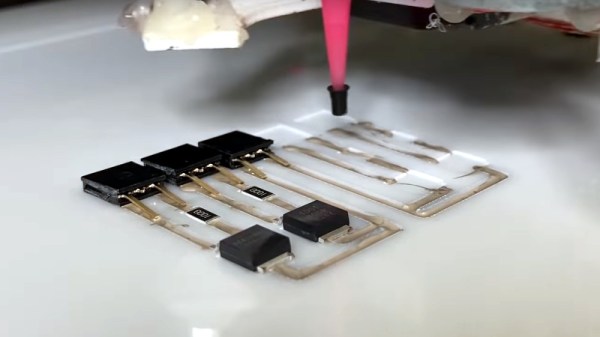
MIT’s Computer Science and Artificial Intelligence Lab (CSAIL) wants to convert laser cutters into something more. By attaching a head to a commercial laser cutter and adding software, they combine the functions of a cutter, a conductive printer, and a pick and place system. The idea is to enable construction of entire devices such as robots and drones.

The concept, called LaserFactory, sounds like a Star Trek-style replicator, but it doesn’t create things like circuit elements and motors. It simply picks them up, places them, and connects them using silver conductive ink. You can get a good idea of how it works by watching the video below.

Continue reading “MIT Prints Robots With Lasers”

This Week In Security: Morse Code Malware, Literal And Figurative Watering Holes, And More

Code obfuscation has been around for a long time. The obfuscated C contest first ran way back in 1984, but there are examples of natural language obfuscation from way earlier in history. Namely Cockney rhyming slang, like saying “Lady from Bristol” instead of “pistol” or “lump of lead” instead of “head”. It’s speculated that Cockney was originally used to allow the criminal class to have conversations without tipping off police.

Code obfuscation in malware serves a similar purpose — hiding from security devices and applications. There are known code snippets and blacklisted IP addresses that anti-malware software scans for. If that known bad code can be successfully obfuscated, it can avoid detection. This is a bit of a constant game of cat-and-mouse, as the deobfuscation code itself eventually makes the blacklist. This leads to new obfuscation techniques, sometimes quite off the wall. Well this week, I found a humdinger of an oddball approach. Morse Code.

Yep, dots and dashes. The whole attack goes like this. You receive an email, claiming to be an invoice. It’s a .xlsx.hTML file. If you don’t notice the odd file extension, and actually let it open, you’re treated to a web page. The source of that page is a very minimal JS script that consists of a morse code decoder, and a payload encoded in Morse. In this case, the payload is simply a pair of external scripts that ask for an Office 365 login. The novel aspect of this is definitely the Morse Code. Yes, our own [Danie] covered this earlier this week, but it was too good not to mention here. Continue reading “This Week In Security: Morse Code Malware, Literal And Figurative Watering Holes, And More”

Nanotube Yarn Makes Strong Bionic Muscles

What’s just a bit thicker than a human hair and has ten times the capability of a human muscle? Polymer-coated carbon nanotube yarn. Researchers at the University of Texas at Dallas created this yarn using carbon nanotubes coated with a polymer and coiled with a diameter of about 140 microns.

Passing a voltage through the fiber causes the muscle yarn to expand or contract. Previous similar fibers have to do both actions. That is, they expand and then contract in a bipolar movement. The polymer coating allows for unipolar fibers, critical to using the fibers as artificial muscles.

Continue reading “Nanotube Yarn Makes Strong Bionic Muscles”

Tesla Recalls Cars With EMMC Failures, Calls Part A ‘Wear Item’

It’s a problem familiar to anyone who’s spent a decent amount of time playing with a Raspberry Pi – over time, the flash in the SD card reaches its write cycle limits, and causes a cavalcade of confusing errors before failing entirely. While flash storage is fast, compact, and mechanically reliable, it has always had a writeable lifespan much shorter than magnetic technologies.

Flash storage failures in the computer behind Tesla’s famous touch screen are causing headaches for drivers.

Of course, with proper wear levelling techniques and careful use, these issues can be mitigated successfully. The surprising thing is when a major automaker fails to implement such basic features, as was the case with several Tesla models. Due to the car’s Linux operating system logging excessively to its 8 GB eMMC storage, the flash modules have been wearing out. This leads to widespread failures in the car, typically putting it into limp mode and disabling many features controlled via the touchscreen.

With the issue affecting important subsystems such as the heater, defroster, and warning systems, the NHTSA wrote to the automaker in January requesting a recall. Tesla’s response acquiesced to this request with some consternation, downplaying the severity of the issue. Now they are claiming that the eMMC chip, ball-grid soldered to the motherboard, inaccessible without disassembling the dash, and not specifically mentioned in the owner’s manual, should be considered a “wear item”, and thus should not be subject to such scrutiny. Continue reading “Tesla Recalls Cars With EMMC Failures, Calls Part A ‘Wear Item’”

Basic In 10 Lines Or Less

For the last 11 years [Gunnar Kanold] has run the annual BASIC 10 Liner contest, and the rules for the 2021 edition are now available. There are four categories and each category has specific definitions of what constitutes a line. All entries must run on an 8-bit computer system that can be emulated.

The first three categories are for games but differ in the line length allowed. You can elect to compete with 80 character lines, 120 character lines, or 256 character lines. There’s also a category for demos, tools, and other applications that must constrain lines to 256 characters.

Continue reading “Basic In 10 Lines Or Less”