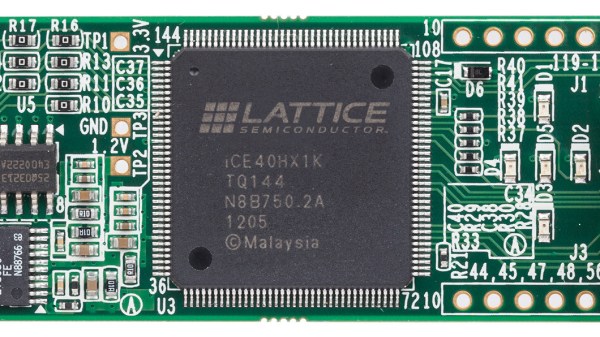
Yesterday we reported that Lattice Semiconductor had inserted a clause that restricted the reverse engineering of bitstreams produced by their FPGA toolchains. Although not explicitly stated, it’s assumed that this was directed toward several projects over the past five years that have created fully open source toolchains by reverse engineering the bitstream protocols of the Lattice ICE40 and ECP5 FPGA architectures. Late yesterday Lattice made an announcement reversing course.
To the open source community, thank-you for pointing out a new bitstream usage restriction in the Lattice Propel license. We are excited about the community’s engagement with Lattice devices and our intent is to not hinder the creation of innovative open source FPGA tools.
It’s refreshing then to see this announcement from Lattice Semiconductor. Even more so is the unexpected turn of speed with which they have done so, within a couple of days of it being discovered by the open-source community. We report depressingly often on boneheaded legal moves from corporations intent on curbing open source uses of their products. This announcement from Lattice removes what was an admonition opposing open source toolchains, can we hope that the company will continue yesterday’s gesture and build a more lasting relationship with the open source community?
The underlying point to this story is that in the world of electronics there has long been an understanding that hardware hackers drive product innovation which will later lead to more sales. Texas Instruments would for years supply samples of exotic semiconductors to impecunious students for one example, and maybe you have a base-model Rigol oscilloscope with a tacitly-approved software hack that gives it an extra 50MHz of bandwidth for another.
We can only congratulate Lattice on their recognition that open source use of their products is beneficial for them, and wish that some of the other companies triggering similar stories would see the world in the same way. Try interacting more with your open source fans; they know and love your hardware more than the average user and embracing that could mean a windfall for you down the road.
There’s an old joke that you can’t trust atoms — they make up everything. But until fairly recently, there was no real way to see individual atoms. You could infer things about them using X-ray crystallography or measure their pull on tiny probes using atomic force microscopes, but not take a direct image. Until now. Two laboratories recently used cryo-electron microscopy to directly image atoms in a protein molecule with a resolution of about 1.2 x 10⁻⁷ millimeters or 1.2 ångströms. The previous record was 1.54 ångströms.
Recent improvements in electron beam technology helped, as did a device that ensures electrons that strike the sample travel at nearly the same speeds. The latter technique resulted in images so clear, researchers could identify individual hydrogen atoms in the apoferritin molecule and the water surrounding it.
The topic of reverse engineering is highly contentious at best when it comes to software and hardware development. Ever since the configuration protocol (bitstream) for Lattice Semiconductor’s iCE40 FPGAs was published in 2015 through reverse engineering efforts, there has been a silent war between proponents of open bitstream protocols and FPGA manufacturers, with the Lattice ECP5’s bitstream format having been largely reverse-engineered at this point.
Update: About eight hours after this article was published, Lattice Semiconductor issued a statement retracting the EULA language that banned bitstream reverse engineering. Please check out Hackaday’s article about this reversal.
Most recently, it appears that Lattice has fired a fresh shot across the bow of the open source projects. A recently discovered addition to the Propel SDK, which contains tools to program and debug Lattice devices, specifically references bitstream reverse engineering. When logged in with an account on the company’s website the user must agree to the Lattice Propel License Agreement for Lattice Propel 1.0 prior to download. That document includes the following language:
In particular, no right is granted hereunder […] (3) for reverse engineering a bitstream format or other signaling protocol of any Lattice Semiconductor Corporation programmable logic device.
So first off, remember the Unc0ver vulnerability/jailbreak from last week? In the 13.5.1 iOS release, the underlying flaw was fixed, closing the jailbreak. If you intend to jailbreak your iOS device, make sure not to install this update. That said, the normal warning applies: Be very careful about running out-of-date software.
Apple Sign In
An exploit in Apple’s web authentication protocol was fixed in the past week . Sign In With Apple is similar to OAuth, and allows using an Apple account to sign in to other sites and services. Under the hood, a JSON Web Token (JWT) gets generated and passed around, in order to confirm the user’s identity. In theory, this scheme even allows authentication without disclosing the user’s email address.
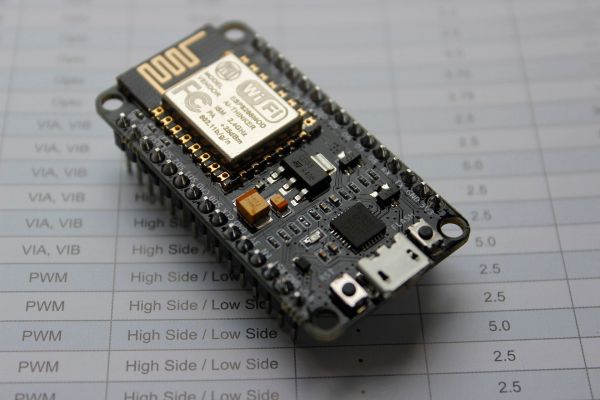
[Thoquz] wrote to us about an interesting GitHub project by [Valmantas Palikša] involving the porting of the Black Magic firmware to ESP8266. For those who are unaware, Black Magic Probe is firmware along with a range of official and third-party boards that targets the debugging of Cortex-M and Cortex-A MCUs and SoCs.
With this blackmagic-espidf project, one can use any ESP8266 board that has at least 2 MB of Flash program storage, though 1 MB should be possible if OTA updated are disabled. After flashing the firmware to the ESP8266 board, the GDB server can be reached on TCP port 2022 and UDP 2023, with a serial port available via TCP/23, UDP2323, or via the physical TX0/RX0 pins on the ESP8266.
The target board to be debugged is hooked up by default to GPIO0 (SWDIO) and GPIO2 (SWCLK) for Serial Wire Debugging, though JTAG is also said to be supported. If set up properly, next one should be able to pop into a fresh remote GDB session:
With the launch of the SpaceX Demo-2 mission, the United States has achieved something it hasn’t done in nearly a decade: put a human into low Earth orbit with a domestic booster and vehicle. It was a lapse in capability that stretched on far longer than anyone inside or outside of NASA could have imagined. Through a series of delays and program cancellations, the same agency that put boot prints on the Moon and built the iconic Space Shuttle had been forced to rely on Russia to carry its astronauts into space since 2011.
But America’s slow return to human spaceflight can’t be blamed on the CST-100, or even Boeing, for that matter. Since the retirement of the Space Shuttle, NASA has been hindered by politics and indecisiveness. With a constantly evolving mandate from the White House, the agency’s human spaceflight program has struggled to make significant progress towards any one goal.
So after a false start due to bad weather, the first crewed launch of a SpaceX Crew Dragon capsule with two astronauts on board has gone ahead. After playing catch-up with the ISS for around 27 hours they’re now safely aboard. At times it seems that space launches have become everyday occurrences, but they are still heroes who have risked their lives in the furtherment of mankind’s exploration of space. Their achievement, and that of all the scientists, engineers, and other staff who stand behind them, is immense.
I watched the drama unfold via the live video feed. Having heaved a huge sigh of relief once they were safely in orbit, the feed cut to the studio, and then moved on to interview the NASA administrator Jim Bridenstine. He was naturally elated at a successful launch, and enthused about the agency’s achievement. You can watch the full interview embedded below, but what caught my attention was his parting sentence:
And if this can inspire a young child to become the next Elon Musk, or the next Jeff Bezos, or the next Sir Richard Branson, then that’s what this is all about
I was slightly shocked and saddened to hear this from the NASA administrator, because to my mind the careers of Musk, Bezos, or Branson should not be the ones first brought to mind by a space launch. This isn’t a comment on those three in themselves; although they have many critics it is undeniable that they have each through their respective space companies brought much to the world of space flight. Instead it’s a comment on what a NASA administrator should be trying to inspire in kids.
Ask yourself how many billionaire masters-of-the-universe it takes for a successful space race compared to the number of scientists, engineers, mathematicians, technicians, physicists, et al. From the anecdote of the NASA administrator it takes about three, but if he is to make good on his goal of returning to the Moon in 2024 and then eventually taking humanity to Mars it will take a generation packed full of those other roles. To understand that we’ll have to take a trip back to the Apollo era, and how that generation of kids were inspired by the spacecraft on their screens.
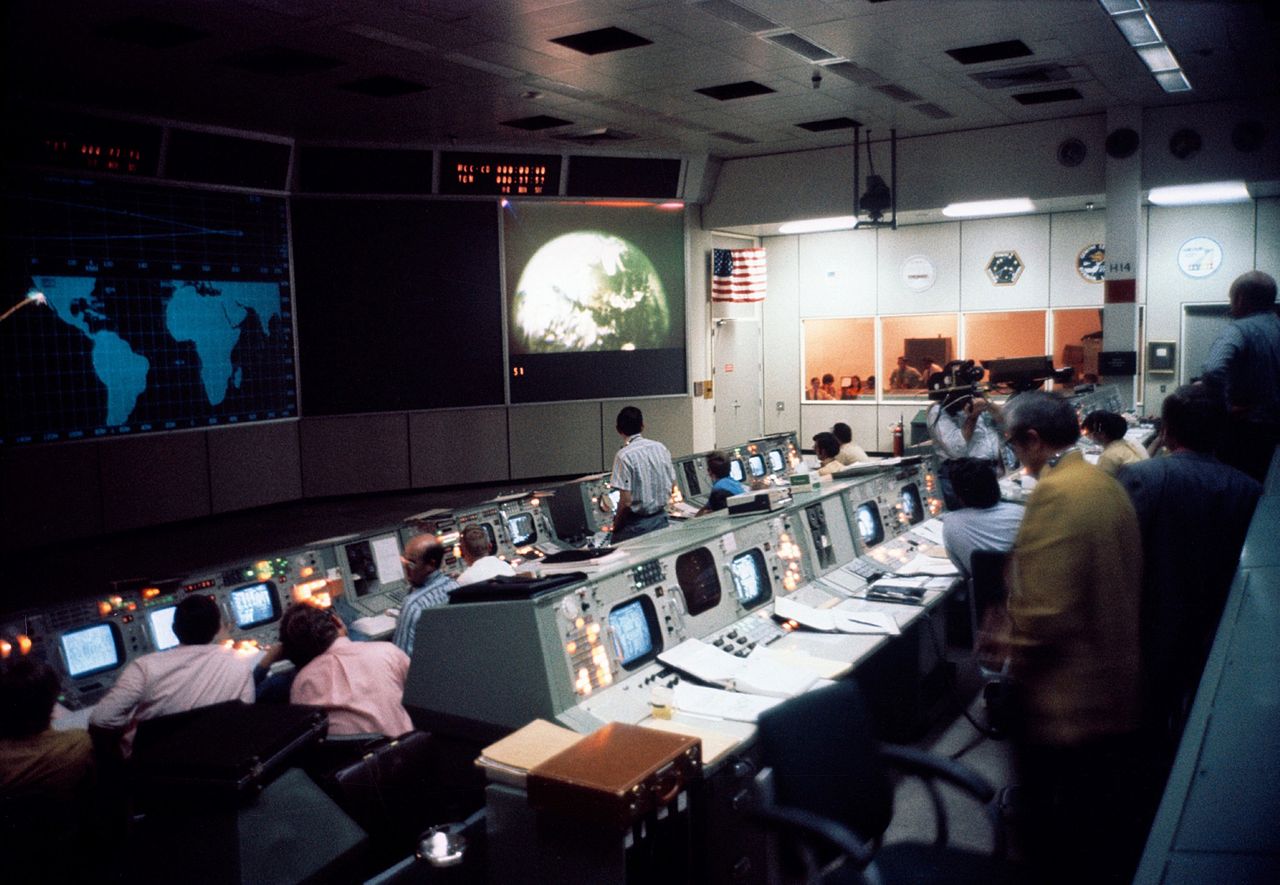
Inspiration from probably the coolest room in the world at the time, the Apollo mission control in Houston. NASA on The Commons / No restrictions
Fifty years ago, we were very much on the brink of becoming a spacefaring planet. American astronauts were taking their first steps on the Moon, and Soviet cosmonauts were occupying real space stations that would soon be capable of housing them for months at a time. Planetary probes were returning colour TV pictures from other worlds, and it was certain that in the immediate aftermath of the Apollo programme we’d be sending astronauts and probably cosmonauts too further afield. A Mars base in the 1980s perhaps, and following our fictional Star Trek heroes further afield thereafter.
We now know it didn’t quite work out that way, but a whole generation of tech-inclined kids grew up wanting nothing more than to be involved in space flight. The vast majority of us never made it, but with that inspiration we took our soldering irons and 8-bit home computers and ran with them. Those NASA folks were the coolest of role-models, and no doubt their Soviet equivalents were too for kids on the other side of the Iron Curtain.
With the best will in the world, the chances of any kid becoming the next Jeff Bezos is about as high as that of their becoming the next Neil Armstrong. Compared to the number of kids in the world, the number of billionaires and the number of astronauts both pale into statistical insignificance. But the chances of a kid becoming an engineer or a scientist is much higher, and in those careers their chances of having some of their work be involved with the space effort becomes not entirely unlikely.
I understand what the NASA administrator was trying to say, but can’t shake the feeling that if those are the people he rolls out to inspire kids watching a space launch, he’s missed an opportunity. Those are the names we all recognize, but shouldn’t we also elevate the people making the scientific breakthroughs so their names are equally recognized? Like Margaret Hamilton, Gene Kranz, and Sergei Korolev and many others before them, we should be making names like Tom Mueller and Margarita Marinova prominent examples of where a career in the sciences can take you. But to be honest, the real problem is we just don’t hear much about all the people doing this fascinating engineering and that’s a sad state of affairs.
Looks like it’s time for Hackaday to pursue a biography series based on the many great minds who are the ones delivering on the promise and vision of today’s (and tomorrow’s) space race. Get us started by talking about your favorite behind the scenes science folks in the comments below.