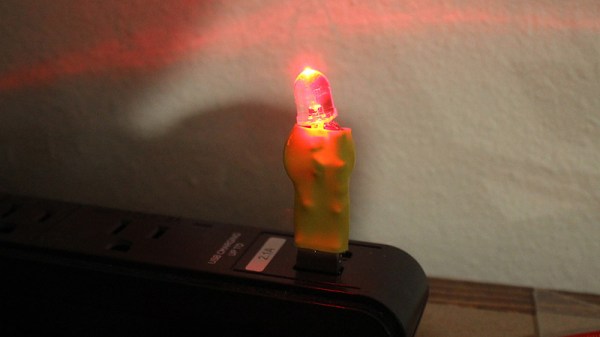
Sometimes the simplest hacks are the most useful ones, and they don’t come much simpler than the little supercapacitor LED flashlight from serial maker of cool stuff [Jeremy S. Cook]. Little more than an LED, a supercapacitor, USB plug, and couple of resistors, it makes a neat little flashlight that charges from any USB A power socket and delivers usable light for over half an hour.
It’s neat, but on its own there’s not much to detain the reader until it is revealed as a “Hello World” supercapacitor project from an article in which he delves into the possibilities of these still rather exotic components. Its point is to explore their different properties when compared to a battery, for example a linear voltage drop in contrast to the sharp drop-off of a chemical cell. In the video below the break we see him try a little boost regulator to deliver a constant voltage, with consequent severe loss of lighting time for the LED. It’s by this type of experimentation that we learn our way around a component unfamiliar to us, and the article and video are certainly worth a look if you’ve never used a supercapacitor before.
Second-hand farm machinery prices have made their way to the pages of Hackaday due to an ongoing battle between farmers and agricultural machinery manufacturers over who has the right to repair and maintain their tractors. The industry giant John Deere in particular uses the DMCA and end-user licensing agreements to keep all maintenance in the hands of their very expensive agents. It’s a battle we’ve reported on before, and continues to play out across the farmland of America, this time on the secondary market. Older models continue to deliver the freedom for owners to make repairs themselves, and the relative simplicity of the machines tends to make those repairs less costly overall.
Tractors built in the 1970s and 80s continue to be reliable and have the added perk of predating the digital shackles of the modern era. Aged-but-maintainable machinery is now the sweetheart of farm sales. It confirms a trend I’ve heard of anecdotally for a few years now, that relatively new tractors can be worth less than their older DMCA-free stablemates, and it’s something that I hope will also be noticed in the boardrooms. Perhaps this consumer rebellion can succeed against the DMCA where decades of activism and lobbying have evidently failed.
The news sites seem never to be without stories of Elon Musk and his latest ventures, be they rapid transit tube tubes in partial vacuum, space flight, or even personal not-a-flamethrowers. Famous for electric vehicles, Musks’s Tesla also has a line of solar products and offers the Powerwall home battery power system. These are tantalizing to anyone with solar panels, but the price tag for one isn’t exactly a dream.
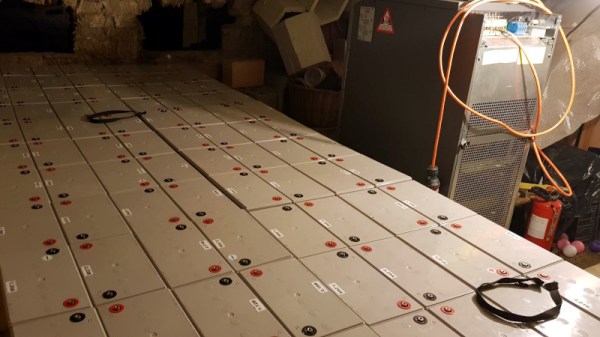
[Nathann]’s budget couldn’t stretch to a Powerwall, but he did have access to a hefty ex-datacentre uninterruptible power supply (UPS) and a large quantity of lead-acid cells. From this he built his own off-the-grid power in the cellar of the home. It’s not as elegant as a Powerwall, but it can power the house on moderate usage, so he claims, for up to ten days.
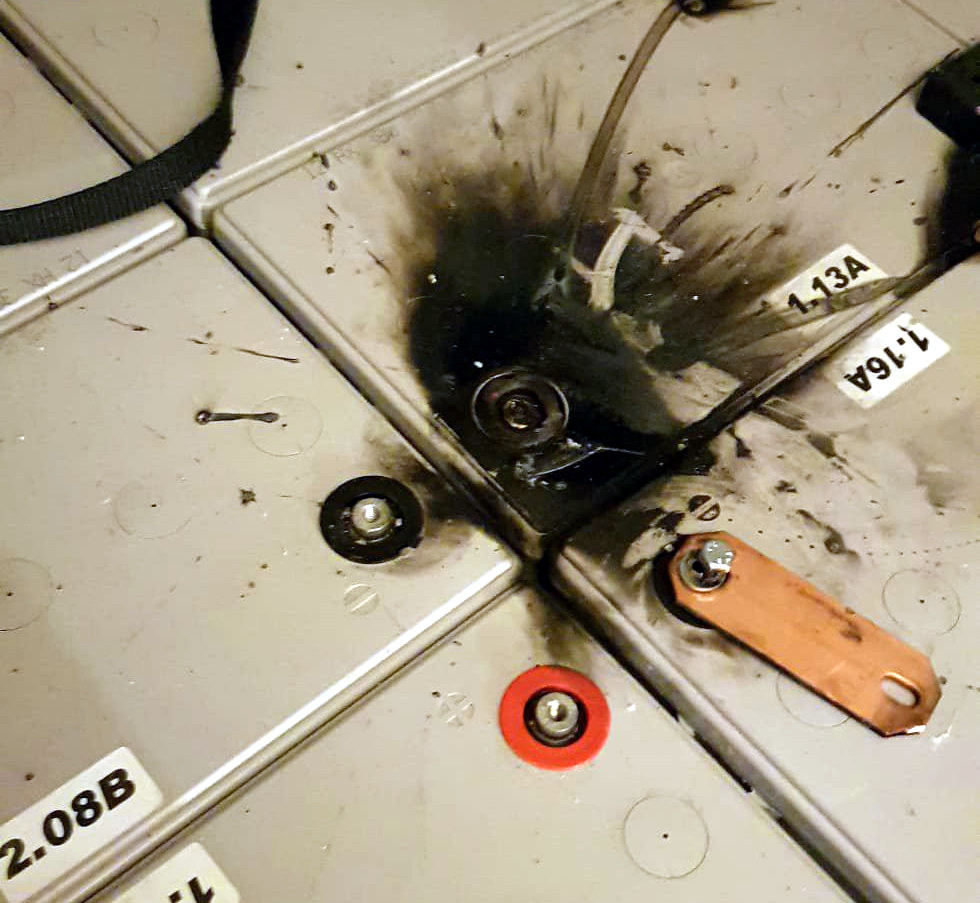
On one level the installation is more of a wiring job than one of high technology, but the logistics of dealing with nearly 100 lead-acid cells are quite taxing. The UPS takes four battery packs, each clocking in at 288 V. The cells are joined with copper straps, and the voltage and current involved is not for the faint-hearted. An accidental short vaporized a screw and a battery terminal; if this were our house we’d put fuses in the middle of the battery packs.
The batteries are stored on wooden pallets atop brick pillars in case the cellar floods. The basement installation now is ready for the addition of solar and wind-based off-grid sources. Maybe your battery power solution will be less hair-raising, but it’s unlikely to be cheaper. Meanwhile this isn’t the first such project we’ve seen, though others usually go for 18650 Li-Ion cells, the use of lead acid remains a viable and economical solution.
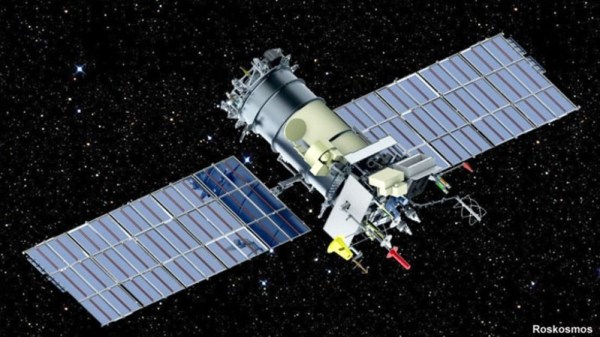
For humans and satellites alike, making a living in space is hard. First, there’s the problem of surviving the brief but energetic and failure-prone ride there, after which you get to alternately roast and freeze as you zip around the planet at 20 times the speed of sound. The latter fact is made all the more dangerous by the swarm of space debris, both natural and man-made, that whizzes away up there along with you, waiting to cause an accident.
One such accident has apparently led to the early demise of a Russian weather satellite. Just a few months after launch, Meteor-M 2-2 suffered a sudden orbital anomaly (link to Russian story; English translation). Analysis of the data makes it pretty clear what happened: the satellite was struck by something, and despite some ground-controller heroics which appear to have stabilized the spacecraft, the odds are that Meteor-M 2-2 will eventually succumb to its wounds.
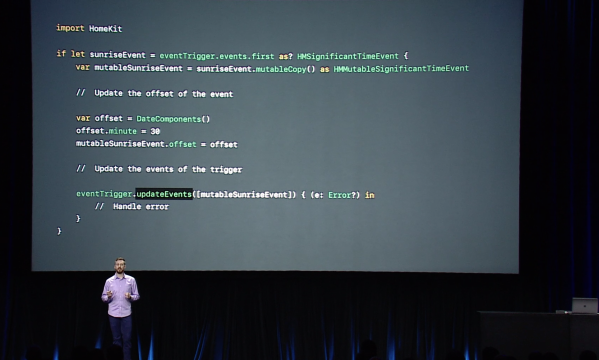
Every tech monopoly has their own proprietary smart home standard; how better to lock in your customers than to literally build a particular solution into their homes? Among the these players Apple is traditionally regarded as the most secretive, a title it has earned with decades of closed standards and proprietary solutions. This reputation is becoming progressively less deserved when it comes to HomeKit, their smart home gadget connectivity solution. In 2017 they took a big step forward and removed the need for a separate authentication chip in order to interact with HomeKit. Last week they took another and released a big chunk of their HomeKit Accessory Development Kit (ADK) as well. If you’re surprised not to have heard sooner, that might be because it was combined the the even bigger news about Apple, Amazon, the Zigbee Alliance, and more working together on more open, interoperable home IoT standards. Check back in 2030 to see how that is shaping up.
“The HomeKit ADK implements key components of the HomeKit Accessory Protocol (HAP), which embodies the core principles Apple brings to smart home technology: security, privacy, and reliability.”
– A descriptive gem from the README
Despite many breathless mentions in the press release it’s hard to tell what the ADK actually is. The README and documentation directory are devoid of answers, but spelunking through the rest of the GitHub repo gives us an idea. It consists of two primary parts, the HomeKit Accessory Protocol itself and the Platform Abstraction Layer. Together the HAP implements HomeKit itself, and the PAL is the wrapper that lets you plug it into a new system. It’s quite a meaty piece of software; the HAP’s main header is a grueling 4500 lines long, and it doesn’t take much searching to find some fear-inspiring 50 line preprocessor macros. This is a great start, but frankly we think it will take significantly more documentation to make the ADK accessible to all.
If it wasn’t obvious, most of the tools above are carefully licensed by Apple and intended for non-commercial use. While we absolutely appreciate the chance to get our hands on interfaces like this, we’re sure many will quibble over if this really counts as “open source” or not (it’s licensed as Apache 2.0). We’ll leave that for you in the comments.
Over the years, humans have come up with four forces that can be used to describe every single interaction in the physical world. They are gravity, electromagnetism, the weak nuclear force that causes particle decay, and the strong nuclear force that binds quarks into atoms. Together, these have become the standard model of particle physics. But the existence of dark matter makes this model seem incomplete. Surely there must be another force (or forces) that explain both its existence and the reason for its darkness.
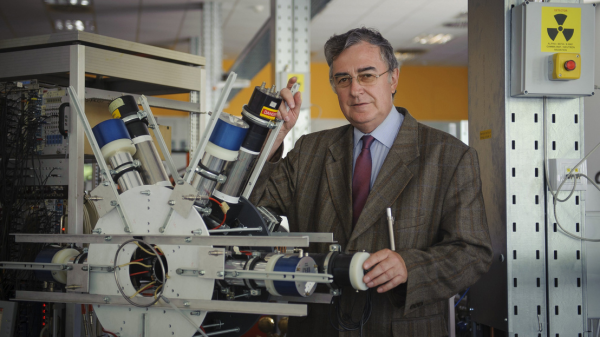
Hungarian scientists from the Atomki Nuclear Research Institute led by Professor Attila Krasznahorkay believe they have found evidence of a fifth force of nature. While monitoring an excited helium atom’s decay, they observed it emitting light, which is not unusual. What is unusual is that the particles split at a precise angle of 115 degrees, as though they were knocked off course by an invisible force.
The scientists dubbed this particle X17, because they calculated its mass at 17 megaelectronvolts (MeV). One electron Volt describes the kinetic energy gained by a single electron as it moves from zero volts to a potential of one volt, and so a megaelectronvolt is equal to the energy gained when an electron moves from zero volts to one million volts.
What Are Those First Four, Again?
Let’s start with the easy one, gravity. It gives objects weight, and keeps things more or less glued in place on Earth. Though gravity is a relatively weak force, it dominates on a large scale and holds entire galaxies together. Gravity helps us work and have fun. Without gravity, there would be no water towers, hydroelectric power plants, or roller coasters.
The electromagnetic force is a two-headed beast that dominates at the human scale. Almost everything we are and do is underpinned by this force that surrounds us like an ethereal soup. Electricity and magnetism are considered a dual force because they work on the same principle — that opposite forces attract and like forces repel.
This force holds atoms together and makes electronics possible. It’s also responsible for visible light itself. Each fundamental force has a carrier particle, and for electromagnetism, that particle is the photon. What we think of as visible light is the result of photons carrying electrostatic force between electrons and protons.
The weak and strong nuclear forces aren’t as easy to grasp because they operate at the subatomic level. The weak nuclear force is responsible for beta decay, where a neutron can turn into a proton plus an electron and anti-neutrino, which is one type of radioactive decay. Weak interactions explain how particles can change by changing the quarks inside them.
The strong nuclear force is the strongest force in nature, but it only dominates at the atomic scale. Imagine a nucleus with multiple protons. All those protons are positively charged, so why don’t they repel each other and rip the nucleus apart? The strong nuclear force is about 130x stronger than the electromagnetic force, so when protons are close enough together, it will dominate. The strong nuclear force holds both the nucleus together as well as the nucleons themselves.
The Force of Change
Suspicion of a fifth force has been around for a while. Atomki researchers observed a similar effect in 2015 when they studied the light emitted during the decay of a beryllium-8 isotope. As it decayed, the constituent electrons and positrons consistently repelled each other at another strange angle — exactly 140 degrees. They dubbed it a “protophobic” force, as in a force that’s afraid of protons. Labs around the world made repeated attempts to prove the discovery a fluke or a mistake, but they all produced the same results as Atomki.
Professor Attila Krasznahorkay and his team published their observations in late October, though the paper has yet to be peer-reviewed. Now, the plan at Atomki is to observe other atoms’ decay. If they can find a third atom that exhibits this strange behavior, we may have to take the standard model back to the drawing board to accommodate this development.
So what happens if science concludes that the X17 particle is evidence of a fifth force of nature? We don’t really know for sure. It might offer clues into dark matter, and it might bring us closer to a unified field theory. We’re at the edge of known science here, so feel free to speculate wildly in the comments.
For the majority of hacker and maker projects, the miniature computer of choice these last few years has been the Raspberry Pi. While the availability issues that seem to plague each new iteration of these extremely popular Single Board Computers (SBCs) can be annoying, they’ve otherwise proven to be an easy and economical way to perform relatively lightweight computational tasks. Depending on who you ask, the Pi 4 is even powerful enough for day-to-day desktop computing. Not bad for a device that consistently comes in under a $50 USD price point.
Intel NUC compared to the Raspberry Pi
But we all know there are things that the Pi isn’t particularly well suited to. If your project needs a lot of computing power, or you’ve got some software that needs to run on an x86 processor, then you’re going to want to look elsewhere. One of the best options for such Raspberry Pi graduates has been the Intel Next Unit of Computing (NUC).
NUCs have the advantage of being “real” computers, with upgradable components and desktop-class processors. Naturally this means they’re a bit larger than the Raspberry Pi, but not so much as to be impractical. If you’re working on a large rover for example, the size and weight difference between the two will be negligible. The same could be said for small form-factor cluster projects; ten NUCs won’t take a whole lot more space than the same number of Pis.
Unfortunately, where the Intel NUCs have absolutely nothing on the Raspberry Pi is price: these miniature computers start around $250, and depending on options, can sail past the $1,000 mark. Part of this sharp increase in price is naturally the vastly improved hardware, but we also can’t ignore that the lack of any strong competition in this segment hasn’t given Intel much incentive to cut costs, either. When you’re the only game in town, you can charge what you want.
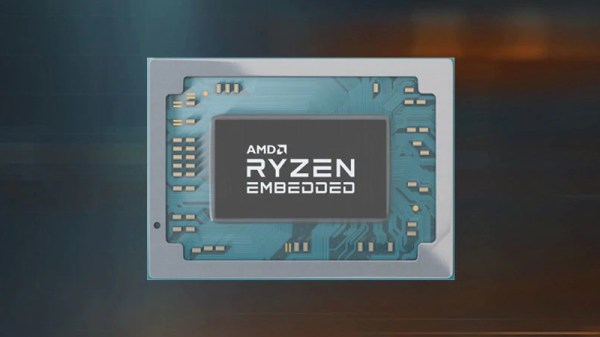
But that’s about to change. In a recent press release, AMD announced an “open ecosystem” that would enable manufacturers to build small form-factor computers using an embedded version of the company’s Ryzen processor. According to Rajneesh Gaur, General Manager of AMD’s Embedded Solutions division, the company felt the time was right to make a bigger push outside of their traditional server and desktop markets:
The demand for high performance computing isn’t limited to servers or desktop PCs. Embedded customers want access to small form factor PCs that can support open software standards, demanding workloads at the edge, and even display 4K content, all with embedded processors that have a planned availability of 10 years.