Cardboard Wall Is Surprisingly Well Built

We all built cardboard forts when we were kids. [Paintingcook] has taken it into adulthood with a hand built cardboard wall. He and his wife leased a loft apartment. Lofts are great — one giant space to work with. Plans changed a bit when they found out they had a baby on the way. A single living, working, and sleeping space definitely wouldn’t be good for a newborn, so the couple set about separating a section of the room with a wall.

Sheetrock and steel or wood lumber would be the normal path here. They instead decided to recycle their cardboard moving boxes into a wall. The boxes were formed into box beams, which created the framework of the wall. The two pillars were boxed in and incorporated into the wall itself. The skin of the wall is a random patchwork of cardboard pieces. Most of the construction is completed with 3/8 ” screws and masking tape. Tape won’t last forever, but this is a temporary wall after all.

You might be wondering about fire hazards — sure, cardboard burns more readily than gypsum board, but the apartment is outfitted with sprinklers, which should help on this front. A few commenters on [Paintingcook’s] Reddit thread asked about formaldehyde and other gasses emitting from the cardboard. Turns out he’s an inorganic chemist by trade. He says any outgassing happens shortly after the cardboard is manufactured. It should be safe for the baby.

Cardboard is a great material to work in. You can build anything from robots to computers to guns with it. So get hop the couch, grab that Amazon box, and get hacking!

You’ll Really Want An “Undo” Button When You Accidentally Send A Ballistic Missile Warning

Hawaiians started their weekend with quite a fright, waking up Saturday morning to a ballistic missile alert that turned out to be a false alarm. In between the public anger, profuse apologies from officials, and geopolitical commentary, it might be hard to find some information for the more technical-minded. For this audience, The Atlantic has compiled a brief history of infrastructure behind emergency alerts.

As a system intended to announce life-critical information when seconds count, all information on the system is prepared ahead of time for immediate delivery. As a large hodgepodge linking together multiple government IT systems, there’s no surprise it is unwieldy to use. These two aspects collided Saturday morning: there was no prepared “Sorry, false alarm” retraction message so one had to be built from scratch using specialized equipment, uploaded across systems, and broadcast 38 minutes after the initial false alarm. In the context of government bureaucracy, that was really fast and must have required hacking through red tape behind the scenes.

However, a single person’s mistake causing such chaos and requiring that much time to correct is unacceptable. This episode has already prompted a lot of questions whose answers will hopefully improve the alert system for everyone’s benefit. At the very least, a retraction is now part of the list of prepared messages. But we’ve also attracted attention of malicious hackers to this system with obvious problems in design, in implementation, and also has access to emergency broadcast channels. The system needs to be fixed before any more chaotic false alarms – either accidental or malicious – erode its credibility.

We’ve covered both the cold-war era CONELRAD and the more recent Emergency Broadcast System. We’ve also seen Dallas’ tornado siren warning system hacked. They weren’t the first, they won’t be the last.

(Image: Test launch of an unarmed Minuteman III ICBM via US Air Force.)

Imagine A Cluster Of ESP32s

When the ESP32 microcontroller first appeared on the market it’s a fair certainty that somewhere in a long-forgotten corner of the Internet a person said: “Imagine a Beowulf cluster of those things!”.

Someone had to do it, and it seems that the someone in question was [Kodera2t], who has made a mini-cluster of 4 ESP32 modules on a custom PCB. They might not be the boxed computers that would come to mind from a traditional cluster, but an ESP32 module is a little standalone computer with processing power that wouldn’t have looked too bad on your desktop only in the last decade. The WiFi on an ESP32 would impose an unacceptable overhead for communication between processors, and ESP32s are not blessed with wired Ethernet, so instead the board has a parallel bus formed by linking together a group of GPIO lines. There is also a shared SPI SRAM chip with a bus switchable between the four units by one of the ESp32s acting as the controller.

You might ask what the point is of such an exercise, and indeed as it is made clear, there is no point beyond interest and edification. It’s unclear what software will run upon this mini-cluster as it has so far only just reached the point of a first hardware implementation, but since ESP32 clusters aren’t exactly mainstream it will have to be something written especially for the platform.

This cluster may be somewhat unusual, but in the past we’ve brought you more conventional Beowulf clusters such as this one using the ever-popular Raspberry Pi.

LED Stand For Lego Saturn V Boldly Goes Where No Lego Has Gone Before

Hackers everywhere have spent the last couple of weeks building the remarkable Saturn V Lego models that they got for the holidays, but [Kat & Asa Miller] decided to go an extra step for realism: they built a stand with LED lights to simulate launch. To get the real feel of blast off, they used pillow stuffing, a clear acrylic tube and a string of NeoPixel LEDs. These are driven by an Adafruit Trinket running code that [Asa] wrote to create the look of a majestic Saturn V just lifting off the launchpad with the appropriate fire and fury.  They initially were not sure if the diminutive Trinket would have the oomph to drive the LEDs, but it seems to work fine, judging by the video that you can see after the break.

Continue reading “LED Stand For Lego Saturn V Boldly Goes Where No Lego Has Gone Before”

Meltdown Code Proves Concept

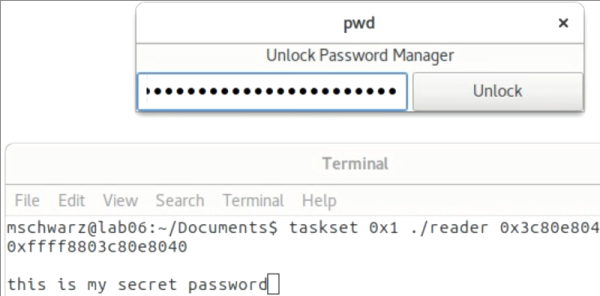
If you’ve read about Meltdown, you might have thought, “how likely is that to actually happen?” You can more easily judge for yourself by looking at the code available on GitHub. The Linux software is just proof of concept, but it both shows what could happen and — in a way — illustrates some of the difficulties in making this work. There are also two videos in the repository that show spying on password input and dumping physical memory.

The interesting thing is that there are a lot of things that will stop the demos from working. For example a slow CPU, a CPU without out-of-order execution, or an imprecise high-resolution timer. This is apparently especially problematic in virtual machines.

Continue reading “Meltdown Code Proves Concept”

Mbed Labs Chock Full Of Arm Goodies

One of the things we like about ARM processors is that there are a variety of options for library support. You can write your own code at the bare metal, of course, but you can also use many different abstraction libraries to make things easier. At the other end of the spectrum, there is Mbed, similar to the sort of libraries that Arduino supplies. Easy to use, although not always the best possible performance. Mbed now has an Mbed Labs site with a lot of extra goodies that go with the Mbed ecosystem, and it has quite a few interesting things.

You’ve always been able to write Mbed code in your browser — some people love that and some hate it and use locally-hosted tools like Platform.io. However, with the Mbed Lab, you can build and most importantly simulate your code in the browser (something we covered last year). There’s also a Javascript interpreter that runs on your chip, a small implementation of TensorFlow for deep learning, and a few other projects on the page.

Continue reading “Mbed Labs Chock Full Of Arm Goodies”

WiFi Alliance Announces Upcoming Fixes To WPA2

Last October, before Intel’s Management Engine was completely broken and the Spectre and Meltdown exploits drove Intel’s security profile further into the ground, we had a problem with wireless networking. WPA2 was cracked with KRACK, the Key Reinstallation Attack. The sky isn’t falling quite yet, but the fact remains that the best WiFi security currently available isn’t very secure at all.

This week, at the Consumer Electronics Show in Las Vegas, the WiFi Alliance announced they would introduce security enhancements in 2018. While it’s not said in the press release if this is a reaction to KRACK, the smart money says yes, this is indeed a reaction to KRACK.

Four new capabilities are outlined in the upcoming release of WPA3 this year. One feature will be protection for users who do not choose complex passwords. A second feature will simplify the process of configuring security on devices that have no display, ostensibly like that little button on your router that you’ve never pressed. The third feature will ‘strengthen user privacy in open networks’, while the fourth, the one we really care about, will add a 192-bit security suite which will, ‘further protect WiFi networks with higher security requirements’.

While most devices currently in service should have a patch for KRACK by now, there will always be thousands of unpatched devices, because, really, who is in charge of the router at your local coffee shop? We’re not sure about the timing of the WiFi Alliance’s announcement of upcoming security improvements: coming during CES when the entirety of the tech press is gawking at manned quadcopters and an endless variety of voice assistants. But we have to say better late than never.