If you listen to the radio bands in the United States, you might wonder if anyone at the FCC is paying attention, or if they are too busy selling spectrum and regulating the Internet. Apparently however, they are watching some things. The commission just levied a $180,000 fine on a company in Florida for selling audio/visual transmitters that use the ham bands as well as other frequencies.
The FCC charged that Lumenier Holdco LLC (formerly known as FPV Manuals LLC) was marketing uncertified transmitters some of which exceeded the 1-W power limit for ham transmitters used on model craft.
At the end of October, the US Patent and Trademark Office renewed a rule allowing anyone to ‘jailbreak’ a 3D printer to use unapproved filament. For those of you following along from countries that haven’t sent a man to the moon, a printer that requires proprietary filament is DRM, and exceptions to the legal enforceability DRM exist, provided these exceptions do not violate US copyright law. This rule allowing for the jailbreaking of 3D printers contains an exception so broad it may overturn the rule.
A few months ago, the US Copyright Office renewed a rule stating that using unapproved filament in a 3D printer does not violate US Copyright law. The language of this rule includes the wording:
‘The exemption shall not extend to any computer program on a 3D printer that produces goods or materials for use in commerce the physical production of which is subject to legal or regulatory oversight…”
This exception is extraordinarily broad; any 3D printers can produce aircraft parts (subject to FAA approval) and medical devices (subject to FDA approval). In effect, if a 3D printer has the ability to produce objects subject to regulatory oversight, the exception allowing the use of filament not approved by the manufacturer does not apply. Additionally, it should be noted that any object produced on a 3D printer that is subject to regulatory oversight is already regulated — there’s no reason to drag the Copyright Office into the world of 3D printed ventilation masks or turbine blades.
When most of us think about 3D printing, we usually think about a machine that melts plastic filament and extrudes it through a nozzle. But we all know that there are other technologies out there that range from cutting and laminating paper, to printing with molten metal or glass. Many of those are out of range for the common hacker. Probably the second most common method uses photo resin and some light source to build the layers in the resin. Researchers at Lawrence Livermore National Laboratory (LLNL) and several universities are experimenting with a new technique that exposes photo resin using three lasers, printing an entire object at one time. You can see a cube formed using the technique in the video below.
In all fairness, the process really isn’t holography but LLNL refers to it as “hologram-like.” In fact, it appears the lasers project more like an oblique projection (you know, like in drafting) which is considerably simpler. Simple enough, that we can’t help but wonder if the hacker community couldn’t develop machines based on this principle. The key would be arranging for the resin to only cure where laser light overlaps.
It’s a trope of horror movies that demonic foes always return. No sooner has the bad guy been dissolved in a withering hail of holy water in the denoeument of the first movie, than some foolish child in a white dress at the start of the next is queuing up to re-animate it with a careless drop of blood or something. If parents in later installments of popular movie franchises would only keep an eye on their darn kids, it would save everybody a whole lot of time!
The relevant passage can be found in section 1092(d) of the National Defense Authorization Act, on page 329 of the mammoth PDF containing the full text, and reads as follows:
(d) RESTORATION OF RULES FOR REGISTRATION AND MARKING OF UNMANNED AIRCRAFT
.—The rules adopted by the Administrator
of the Federal Aviation Administration in the matter of registration
and marking requirements for small unmanned aircraft (FAA-2015-
7396; published on December 16, 2015) that were vacated by the
United States Court of Appeals for the District of Columbia Circuit
in Taylor v. Huerta (No. 15-1495; decided on May 19, 2017) shall
be restored to effect on the date of enactment of this Act.
This appears to reverse the earlier decision of the court, but does not specify whether there has been any modification to the requirements to prevent their being struck down once more by the same angle of attack. In particular, it doesn’t change any of the language in the FAA Modernization Act of 2012, which specifically prevents the Agency from regulating hobby model aircraft, and was the basis of Taylor v. Huerta. Maybe they are just hoping that hobby flyers get fatigued?
We took a look at the registration system before it was struck down, and found its rules to be unusually simple to understand when compared to other aviation rulings, even if it seemed to have little basis in empirical evidence. It bears a resemblance to similar measures in other parts of the world, with its 250 g weight limit for unregistered machines. It will be interesting both from a legal standpoint to see whether any fresh challenges to this zombie law emerge in the courts, and from a technical standpoint to see what advances emerge from Shenzhen as the manufacturers pour all their expertise into a 250 g class of aircraft.
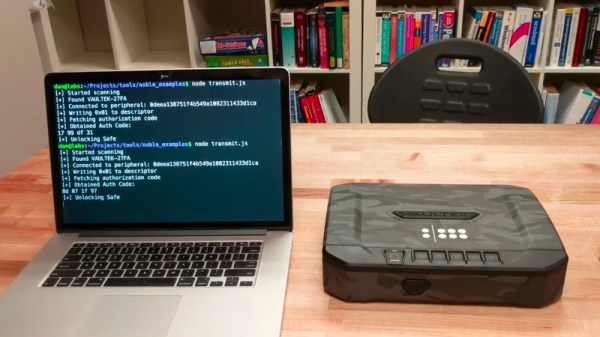
Believe it or not, there are quite a few people out there who have purchased gun safes that can be remotely unlocked by Bluetooth. Now we can understand why somebody might think this was a good idea: the convenience of being able to hit a button on your phone and have your weapon available in the heat of the moment is arguably a big selling point for people who are purchasing something like this for home defense. But those with a more technical mind will likely wonder if the inherent risks of having your firearm (or other valuables) protected by a protocol that often relies on security by obscurity outweighs the convenience of not needing to enter in a combination on the keypad.
[Two Six Labs] has not publicly released the complete source code of the software demonstrated in their YouTube video for very obvious reasons, but the page on their site does go into fantastic detail on how they uncovered the multiple vulnerabilities that allowed them to write it. Even if you’re not the kind of person who would ever need a gun safe, the information contained in their documentation about analyzing Bluetooth communications is fascinating reading.
It was discovered that the PIN for the safe was actually being transmitted by the accompanying smartphone application in plain-text, which would be bad enough normally. But after further analysis, it became clear that the safe wasn’t even bothering to check the PIN code anyway.
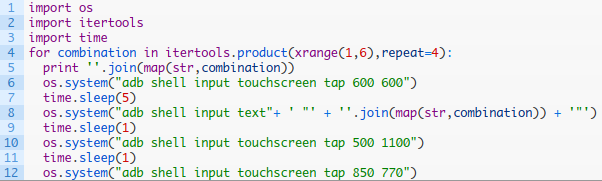
Scripting app interactions with ADB and Python
For extra style points, [Two Six Labs] also show a way to brute force the PIN using the Vaultek Android application by writing a Python script that punches in codes sequentially until it hits on the right one; the developers didn’t even bother to put in limits on failed attempts.
For a device that is ostensibly designed to contain a deadly weapon, the security flaws the team at [Two Six Labs] discovered are absolutely inexcusable. But there is a positive outcome, as the manufacturer has vowed to update the vulnerable safes and make a better effort in the future to more rigorously design and test their Bluetooth implementation. This is the goal of responsible disclosure, and we’re encouraged to see the manufacturer doing the right thing
Readers of a certain age will remember a time when the Christmas season in the US officially kicked off after Thanksgiving. That was when advertisers began saturation bombing the communal mind with holiday-themed TV commercials night and day. Broadcast TV no longer holds sway like it did back then, and advertisers now start their onslaught in September, but you can put a little retro-commercialism back to Christmas with this 90s Christmas commercial-playing ornament for your tree.
The idea came to [SeanHodgins] after stumbling upon a collection of Christmas commercials from the 1990s on YouTube. With his content identified, he set about building a tree-worthy display from a Pi Zero W and a TFT LCD display. An audio amp and tiny speaker from an old tablet and a LiPo battery and charger form the guts of [Sean]’s TV, which were stuffed into a 3D-printed TV case, appropriately modeled after the TV from The Simpsons. The small fresnel lens that mimics the curved screens of yore is a nice touch. The software has some neat tricks, such as an HTTP server that accepts the slug of a YouTube video, fetches the MP4, and automatically plays it. We prefer our Christmas tree ornaments a little quieter, so a volume control would have been nice, but aside from that this looks like a ton of fun.
Over the last decade, Intel has been including a tiny little microcontroller inside their CPUs. This microcontroller is connected to everything, and can shuttle data between your hard drive and your network adapter. It’s always on, even when the rest of your computer is off, and with the right software, you can wake it up over a network connection. Parts of this spy chip were included in the silicon at the behest of the NSA. In short, if you were designing a piece of hardware to spy on everyone using an Intel-branded computer, you would come up with something like the Intel Managment Engine.
Last week, researchers [Mark Ermolov] and [Maxim Goryachy] presented an exploit at BlackHat Europe allowing for arbitrary code execution on the Intel ME platform. This is only a local attack, one that requires physical access to a machine. The cat is out of the bag, though, and this is the exploit we’ve all been expecting. This is the exploit that forces Intel and OEMs to consider the security implications of the Intel Management Engine. What does this actually mean?