Turn Your Motorola Android Phone Into A Raspberry Pi

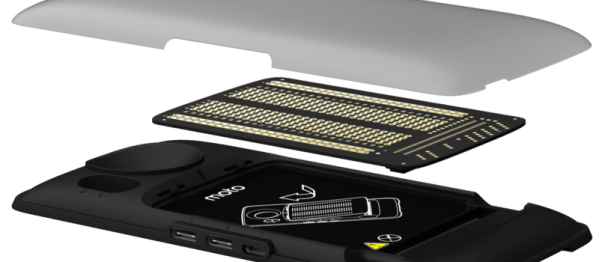
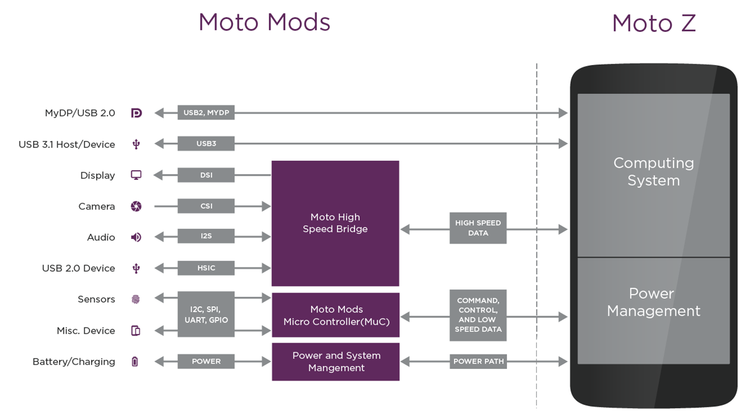
In the surest sign that hardware hacking is the new hotness, Motorola and Farnell/Element 14 have developed an add-on board and SDK that will let you connect virtually anything to your mobile phone. Motorola is calling it the “Moto Mods” system, and it looks like its going to be a dedicated microcontroller that interfaces with the computer inside the phone and provides everything from GPIOs to DSI (video). Naturally, I2C, I2S, SPI, UART, even two flavors of USB are in the mix.
dev-config-diagram-5

The official SDK, ahem Mods Development Kit (MDK), is based on the open Greybus protocol stack (part of Google’s Project Ara open phone project) and it’s running on an ARM Cortex-M4F chip. It’s likely to be itself fairly hackable, and even if the suggested US $125 price is probably worth it for the convenience, we suspect that it’ll be replicable with just a few dollars in parts and the right firmware. (Yes, that’s a challenge.)

The initial four adapter boards range from a simple breadboard to a Raspberry-Pi-hat adapter (hence the title). It’s no secret that cell phones now rival the supercomputers of a bygone era, but they’ve always lacked peripheral interfaces. We wish that all of the old smartphones in our junk box had similar capabilities. What do you say? What would you build with a cellphone if you could break out all sorts of useful comms?

Via HackerBoards, and thanks to [Tom] for the tip!

Google Unveils Their Experimental Plan For Wireless Broadband Service

Two years ago, the FCC, with interested parties in Microsoft, Google, and many startups, created the Citizens Band Radio Service (CBRS), a rule that would open up the 3550-3650 MHz band  to anyone, or any company, to create their own wireless backbone between WiFi access points. It is the wireless solution to the last-mile problem, and last year the FCC enthusiastically endorsed the creation of the CBRS.

In a recently released FCC filing, Google has announced their experimental protocol for testing the new CBRS. This isn’t fast Internet to a lamp pole on the corner of the street yet, but it lays the groundwork for how the CBRS will function, and how well it will perform.

Google will be testing the propagation and interference of transmissions in the 3.5 GHz band in places around the US. Most of the Bay Area will be covered in the tests, as well as Boulder, CO, Kansas City, Omaha, Raleigh, NC, Provo, UT, and Reston, VA. Tests will consist of a simple CW tone broadcast in the 3.5 GHz band.

The 3.5 GHz band is already allocated to shipborne navigation and military radar systems, posing an obvious problem to any wireless broadband system using this spectrum. To this end, the FCC is proposing a novel solution to the problem of coexistence between the CBRS and the military. Instead of simply banning transmissions in the spectrum, FCC Chairman Wheeler proposes, “computer systems can act like spectrum traffic cops.” A computer is able to direct the wireless traffic much more effectively than a blanket ban, and will allow better utilization of limited spectrum.

Google’s FCC filing is just for testing propagation and interference, and we have yet to hear anything about how a network built on 3.5 GHz spectrum will be laid out. One thing is for certain, though: you will not have a 3.5 GHz USB networking dongle for the same reason you don’t have a Google Fiber input on your desktop.

Ion Trap Makes Programmable Quantum Computer

The Joint Quantum Institute published a recent paper detailing a quantum computer constructed with five qubits formed from trapped ions. The novel architecture allows the computer to accept programs for multiple algorithms.

Quantum computers make use of qubits and trapped ions–ions confined with an electromagnetic field–are one way to create them. In particular, a linear radio frequency trap and laser cooling traps five ytterbium ions with a separation of about 5 microns. To entangle the qubits, the device uses 50 to 100 laser pulses on individual or pairs of ions. The pulse shape determines the actual function performed, which is how the device is programmable. The operations depend on the sequence of laser pulses that activate it. Continue reading “Ion Trap Makes Programmable Quantum Computer”

Pimoroni Wash Their Hands Of Arduino

One of the big stories of last year was the fracture of the official Arduino supply into two competing organisations at daggers drawn, each headed by a different faction with its origins in the team that gave us the popular single board computers. Since then we’ve had Arduinos from Arduino LLC (the [Massimo] Arduino.cc, arguably the ‘original’, and Arduino trademark holder in the United States) and Arduino SRL (the [Musto] Arduino.org, and owner of the Arduino trademark everywhere except the US) , two websites, two forks of the IDE, and “real” Arduino boards available under a couple of names depending on where in the world you live due to a flurry of legal manoeuvres. Yes. it’s confusing.

Today came news of a supplier throwing its hands up in despair  at the demands imposed on them as part of this debacle. Pimoroni, famous as supplier of Raspberry Pi goodies, has put up a blog post explaining why they will henceforth no longer be selling Arduinos. They took the side of Arduino LLC, and the blog post details their extensive trials and delays in making contact with the company before eventually being told they would have to agree to purchase substantial stocks both Arduino and Genuino branded versions of identical products and agree to sell them through separate supply channels for both Europe and the rest of the world before they could proceed. This is not a practical proposition for a small company, and the Pimoroni people deliver a very pithy explanation of exactly why towards the bottom of their post.

We’ve covered the Arduino versus Arduino debacle extensively in the past, this is simply the latest in a long line of stories. Pimoroni have hit the nail on the head when they make the point that the customers and suppliers really don’t care about spats between the various inheritors of the Arduino legacy, they just want an Arduino. And with so many other Arduino-compatible boards available they don’t have to look very hard to find one if the right shade of blue solder-resist or the shape of the map of Italy on the back isn’t a special concern. Can we be the only ones wishing something like this might knock a bit of sense into the various parties?

Electroloom Throws In The Towel

The once successful Kickstarter and National Science Foundation (NSF) research grant winner Electroloom is saying “Thanks and Farewell” to its backers, supporters, and sponsors. The startup ran out of funding while developing printer-like machine that uses electrospinning to automatedly produce ready-to-use garments.

Electroloom has been an ambitious project to explore if electrospinning could be made viable for garment manufacturing. The process that uses a high voltage to transform a resinous liquid into non-woven fabric was originally invented for textile fabrication, although its low throughput has always been a limiting factor. The method was mostly used in laboratory and medical applications. In 2014, Electroloom began developing a process that would bring the technology back to its fibrous roots, building an amazing prototype machine that could print an entire shirt in one piece. Electroloom’s Kickstarter campaign was funded in 2015, and earlier this year, an NSF research grant was awarded to the startup.

Continue reading “Electroloom Throws In The Towel”

Star Track: A Lesson In Positional Astronomy With Lasers

[gocivici] threatened us with a tutorial on positional astronomy when we started reading his tutorial on a Arduino Powered Star Pointer and he delivered. We’d pick him to help us take the One Ring to Mordor; we’d never get lost and his threat-delivery-rate makes him less likely to pull a Boromir.

As we mentioned he starts off with a really succinct and well written tutorial on celestial coordinates that antiquity would have killed to have. If we were writing a bit of code to do our own positional astronomy system, this is the tab we’d have open. Incidentally, that’s exactly what he encourages those who have followed the tutorial to do.

The star pointer itself is a high powered green laser pointer (battery powered), 3D printed parts, and an amalgam of fourteen dollars of Chinese tech cruft. The project uses two Arduino clones to process serial commands and manage two 28byj-48 stepper motors. The 2nd Arduino clone was purely to supplement the digital pins of the first; we paused a bit at that, but then we realized that import arduinos have gotten so cheap they probably are more affordable than an I2C breakout board or stepper driver these days. The body was designed with a mixture of Tinkercad and something we’d not heard of, OpenJsCAD.

Once it’s all assembled and tested the only thing left to do is go outside with your contraption. After making sure that you’ve followed all the local regulations for not pointing lasers at airplanes, point the laser at the north star. After that you can plug in any star coordinate and the laser will swing towards it and track its location in the sky. Pretty cool.

Continue reading “Star Track: A Lesson In Positional Astronomy With Lasers”

Unexpected Betrayal From Your Right Hand Mouse

Some people really enjoy the kind of computer mouse that would not be entirely out of place in a F-16 cockpit. The kind of mouse that can launch a browser with the gentle shifting of one of its thirty-eight buttons ever so slightly to the left and open their garage door with a shifting to the right of that same button. However, can this power be used for evil, and not just frustrating guest users of their computer?

We’ve heard of the trusted peripheral being repurposed for nefarious uses before. Sometimes they’ve even been modified for more benign purposes. All of these have a common trend. The mouse itself must be physically modified to add the vulnerability or feature. However, the advanced mice with macro support can be used as is for a vulnerability.

The example in this case is a Logitech G-series gaming mouse. The mouse has the ability to store multiple personal settings in its memory. That way someone could take the mouse to multiple computers and still have all their settings available. [Stefan Keisse] discovered that the 100 command limit on the macros for each button are more than enough to get a full reverse shell on the target computer.

Considering how frustratingly easy it can be to accidentally press an auxiliary button on these mice, all an attacker would need to do is wait after delivering the sabotaged mouse. Video of the exploit after the break.

Continue reading “Unexpected Betrayal From Your Right Hand Mouse”