HardwareX Is A Scientific Journal For Open Hardware

Disruption is a basic tenet of the Open Hardware movement. How can my innovative use of technology disrupt your dinosaur of an establishment to make something better? Whether it’s an open-source project chipping away at a monopoly or a commercial start-up upsetting an industry with a precarious business model based on past realities, we’ve become used to upstarts taking the limelight.

As an observer it’s interesting to see how the establishment they are challenging reacts to the upstart. Sometimes the fragility of the challenged model is such that they collapse, other times they turn to the courts and go after the competitor or even worse, the customers, in an effort to stave off the inevitable. Just occasionally though they embrace the challengers and try to capture some of what makes them special, and it is one of these cases that is today’s subject.

A famously closed monopoly is the world of academic journals. A long-established industry with a very lucrative business model hatched in the days when its product was exclusively paper-based, this industry has come under some pressure in recent years from the unfettered publishing potential of the Internet, demands for open access to public-funded research, and the increasing influence of the open-source world in science.

Elsevier, one of the larger academic publishers, has responded to this last facet with HardwareX, a publication which describes itself as “an open access journal established to promote free and open source designing, building and customizing of scientific infrastructure“. In short: a lot of hardware built for scientific research is now being created under open-source models, and this is their response.

Some readers might respond to this with suspicion, after all the open-source world has seen enough attempts by big business to embrace its work and extend it into the proprietary, but the reality is that this is an interesting opportunity for all sides. The open access and requirement for all submissions to be covered under an open hardware licence mean that it would be impossible for this journal to retreat behind any paywalls. In addition the fact of it being published in a reputable academic journal will bring open-source scientific hardware to a new prominence as it is cited in papers appearing in other journals. Finally the existence of such a journal will encourage the adoption of open-source hardware in the world of science, as projects are released under open-source licences to fulfill the requirements for submission.

So have the publishing dinosaurs got it right, and is this journal an exciting new opportunity for all concerned? We think it has that potential, and the results won’t be confined to laboratories. Inevitably the world of hackers and makers will benefit from open-source work coming from scientists, and vice versa.

Thanks [Matheus Carvalho] for the tip.

Bookbinding workshop image: By Nasjonalbiblioteket from Norway [No restrictions], via Wikimedia Commons.

Microsoft Live Account Credentials Leaking From Windows 8 And Above

Discovered in 1997 by Aaron Spangler and never fixed, the WinNT/Win95 Automatic Authentication Vulnerability (IE Bug #4) is certainly an excellent vintage. In Windows 8 and 10, the same bug has now been found to potentially leak the user’s Microsoft Live account login and (hashed) password information, which is also used to access OneDrive, Outlook, Office, Mobile, Bing, Xbox Live, MSN and Skype (if used with a Microsoft account).

Continue reading “Microsoft Live Account Credentials Leaking From Windows 8 And Above”

Modest Motor Has Revolutionary Applications

Satellites make many of our everyday activities possible, and the technology continues to improve by leaps and bounds. A prototype, recently completed by [Arda Tüysüz]’s team at ETH Zürich’s Power Electronics Systems Lab in collaboration with its Celeroton spinoff, aims to improve satellite attitude positioning with a high speed, magnetically levitated motor.

Beginning as a doctoral thesis work led by [Tüysüz], the motor builds on existing technologies, but has been arranged into a new application — with great effect. Currently, the maneuvering motors on board satellites are operated at a low rpm to reduce wear, must be sealed in a low-nitrogen environment to prevent rusting of the components, and the microvibrations induced by the ball-bearings in the motors reduces the positioning accuracy. With one felling swoop, this new prototype motor overcomes all of those problems.

Continue reading “Modest Motor Has Revolutionary Applications”

Mergers And Acquisitions: Analog And Linear

Analog Devices and Linear Technology have announced today they will combine forces to create a semiconductor company worth $30 Billion.

This news follows the very recent acquisition of ARM Holdings by Japan’s SoftBank, and the later mergers, purchases or acquisitions of On and Fairchild, Avago and Broadcom, NXP and Freescale, and Microchip and AtmelIntel and Altera, and a few more we’re forgetting at the moment.

Both Analog and Linear address similar markets; Analog Devices is best known for amps, interface, and power management ICs. Linear, likewise, isn’t known for ‘fun’ devices, but without their products the ‘fun’ components wouldn’t work. Because the product lines are so complimentary, the resulting company will stand to save $150 Million annually after the deal closes.

Analog and Linear are only the latest in a long line of semiconductor mergers and acquisitions, but it will certainly not be the last. The entire industry is consolidating, and the only way to grow is by teaming up with other companies. This leads the question if there will eventually only be one gigantic semiconductor company in the future. You’ll get different answers to that question from different people. Hughes, Fairchild, Convair, Douglas, McDonnell Douglas, North American, Grumman, Northrop, Northrop Grumman, Bell, Cessna, Schweizer and Sikorsky would say yes. Lockheed Martin and Boeing would say no. It’s the same thing.

BST-1 Car Shortwave Receiver

Commuting is a pain. Luckily, nearly every car has some sort of radio or other audio player to while away the hours stuck in traffic. However, most of those radios sport AM and FM bands, along with a weather band and–maybe–a long wave band. What if you prefer shortwave?

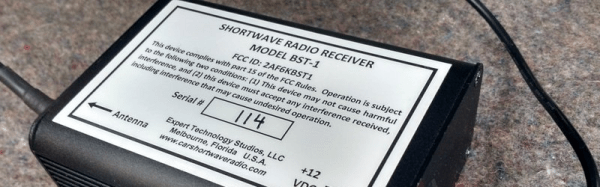
[Thomas] posted a review of the BST-1, a car-friendly shortwave receiver. The device is made to mount out of sight–presumably near an external antenna. It beams the shortwave signal to the car’s FM radio. The control is a small key fob and even if you aren’t interested in the radio itself, the user interface design is somewhat interesting.

Continue reading “BST-1 Car Shortwave Receiver”

Hacklet 117 – NFC Projects

Near Field Communication (NFC) is something we take for granted these days. Nearly all smartphones have it. We even have NFC interfaces for all our favorite development boards. NFC’s history goes back all the way to 1997, when an early version was used in Star Wars special edition toys. Radio Frequency Identification (RFID), which NFC builds on, goes back even further. The patent citation trail leads all the way back to 1983 in a patent awarded to [Charles Walton]. NFC is much more than RFID though. The idea of two way communication between devices opens up tons of possibilities for projects and hacks. This week on the Hacklet we’re checking out some of the best NFC projects on Hackaday.io!

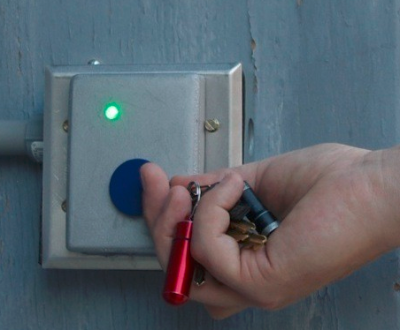
ctrl0We start with [Patrick] and Ctrl-O. Somewhere in the hackerspace bible there is a clause that states “Thou shalt build an electronic access control system”. In [Patrick’s] case, a door lock became a complex membership subscription management database. Members who have paid can use an NFC tag to gain access to the hackerspace. The system consists of a Raspberry Pi with an NFC interface. A relay allows the Pi to control the door lock. The Pi can be manually configured through a web interface. It connects to Paypal to verify that each user’s membership has actually been paid. Of course a project like this is never done. The last we heard from [Patrick], he was planning future upgrades such as startup company memberships with multiple people.

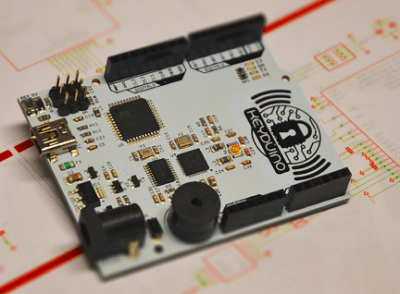
keyduinoNext up is [Pierre Charlier] and KeyDuino. KeyDuino is an Arduino compatible board with all the NFC hardware baked right in. The board is based upon the Arduino Leonardo, with an ATmega32u4 processor. [Pierre] must be on to something, because the KeyDuino had a successful Kickstarter back in 2015. It’s also open source hardware, so you can build your own whenever you want. The real gem is checking out [Pierre’s] other projects. He’s documented all his KeyDuino example projects right on Hackaday.io. These include an NFC Controlled infinity mirror coffee table, a locking wooden gift box, and NFC controlled car door locks, just to name a few.

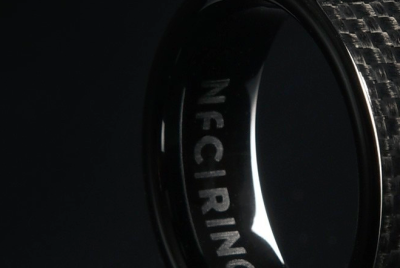
nfcringNext we have [John McLear] with 2016 NFC Ring. [John] jumped into wearable technology with one of the toughest form factors imaginable – a ring. Between the tiny amount of space and the lack of batteries, you might think there isn’t much you can do with a ring. Undaunted, [John] managed to fit two NXP NFC chips and their antennas inside a standard ring. This is the upgraded 2016 version of the ring. [John] was nice enough to supply several hundred of the earlier models to hackers at the Hackaday Supercon back in 2015. [John’s] rings would be hard for the average hacker to reproduce. [Sean Hodgins] comes to the rescue here with his own project, DIY NFC Bentwood Ring.

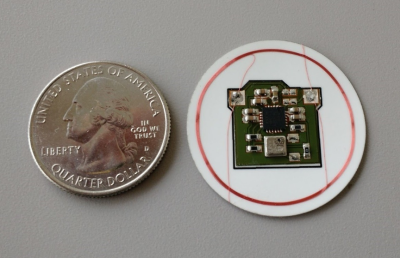
pressureFinally, we have [CaptMcAllister] with RFID air pressure sensor. As the name implies, this sensor measures air pressure. It could be in open air, a tire, or even a football used by the New England Patriots. Sure, cars all have Tire Pressure Monitoring Systems (TPMS) sensors which do something similar. [CaptMcAllister’s] design has one important difference – it has no batteries. The heart of the system is a Texas Instruments RF430FRL15X, a device with the NFC radio and a low power MSP430 microcontroller in one chip. The system is energy harvesting, being powered by an external reader. As you can imagine, tuning the antenna was critical to this design. You can read all about it in [CaptMcAllister’s] 24 project logs.

If you want to see more NFC projects and hacks, check out our new near field communication projects list. See a project I might have missed? Don’t be shy, just drop me a message on Hackaday.io. That’s it for this week’s Hacklet, As always, see you next week. Same hack time, same hack channel, bringing you the best of Hackaday.io!

The Music Of A Sunset

What would you do if you suddenly went blind and could never again see the sun set? How would you again experience this often breathtaking phenomenon? One answer is music, orchestrated by the sun and the Weather Warlock.

Built by the musician [Quintron] (builder and inventor of insane electronic instruments), the Weather Warlock is an analog synthesizer controlled by — you guessed it — the weather. It translates temperature, moisture, wind and sunlight into tones and harmonics with an E major root chord. UV, light, moisture, and temperature sensors combined with an anemometer set up outside feed the weather data to a synthesizer that has [Quintron] dialing knobs and toggling switches. The Weather Warlock steams 24/7 to the website weatherfortheblind.org so that the visually impaired are able to tune in and experience the joy of sunrise and sunset through music. Continue reading “The Music Of A Sunset”