If you have an interest in audio there are plenty of opportunities for home construction of hi-fi equipment. You can make yourself an amplifier which will be as good as any available commercially, and plenty of the sources you might plug into it can also come into being on your bench.
There will always be some pieces of hi-fi equipment which while not impossible to make will be very difficult for you to replicate yourself. Either their complexity will render construction too difficult as might be the case with for example a CD player, or as with a moving-coil loudspeaker the quality you could reasonably achieve would struggle match that of the commercial equivalent. It never ceases to astound us what our community of hackers and makers can achieve, but the resources, economies of scale, and engineering expertise available to a large hi-fi manufacturer load the dice in their favour in those cases.
The subject of this article is a piece of extreme high-end esoteric hi-fi that you can replicate yourself, indeed you start on a level playing field with the manufacturers because the engineering challenges involved are the same for them as they are for you. Electrostatic loudspeakers work by the attraction and repulsion of a thin conductive film in an electric field rather than the magnetic attraction and repulsion you’ll find in a moving-coil loudspeaker, and the resulting very low mass driver should be free of undesirable resonances and capable of a significantly lower distortion and flatter frequency response than its magnetic sibling. Continue reading “Electrostatic Loudspeakers: High End HiFi You Can Build Yourself”→
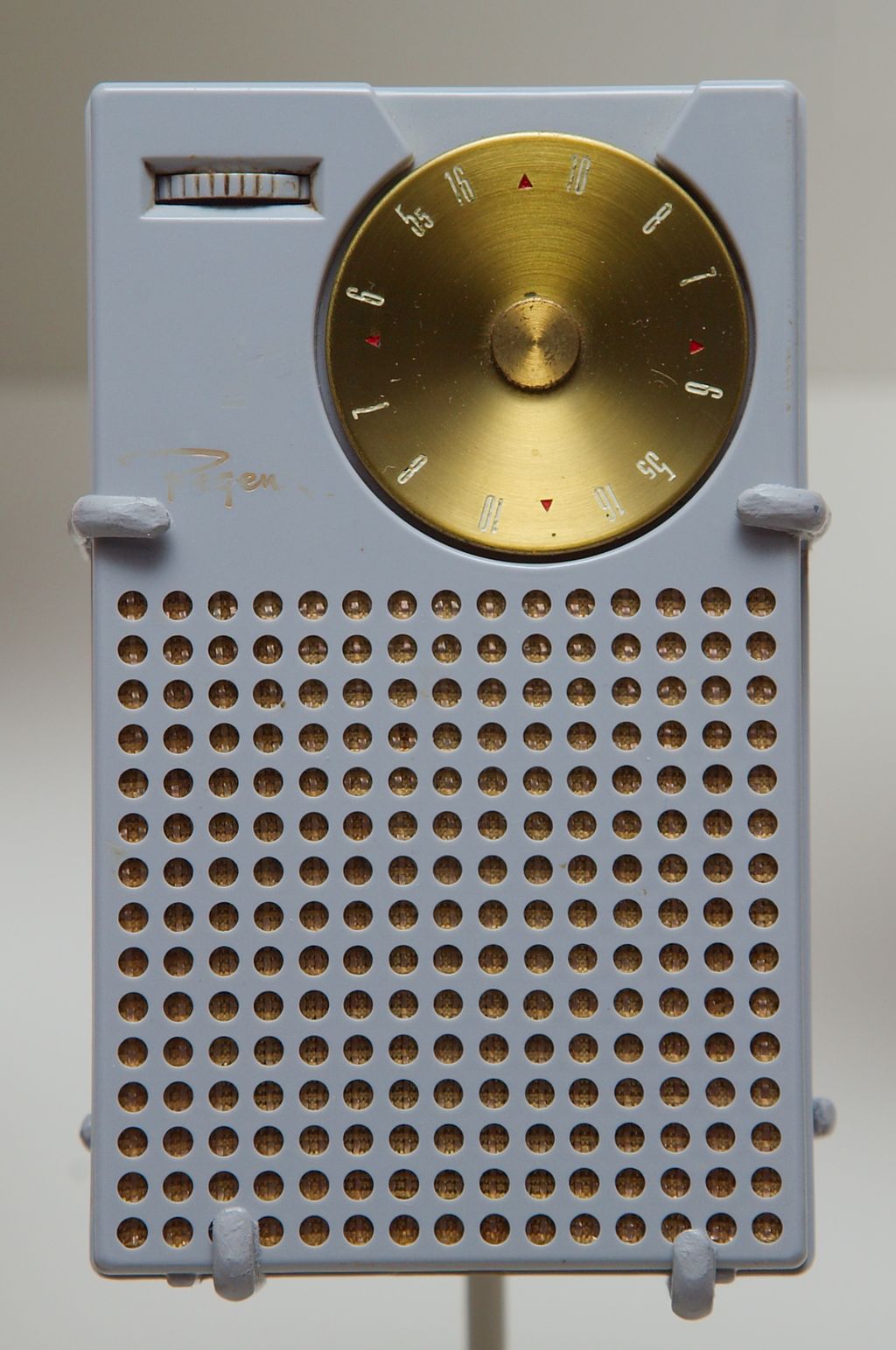
Transistors have come a long way. Like everything else electronic, they’ve become both better and cheaper. According to a recent IEEE article, a transistor cost about $8 in today’s money back in the 1960’s. Consider the Regency TR-1, the first transistor radio from TI and IDEA. In late 1954, the four-transistor device went on sale for $49.95. That doesn’t sound like much until you realize that in 1954, this was equivalent to about $441 (a new car cost about $1,700 and a copy of life magazine cost 20 cents). Even at that price, they sold about 150,000 radios.
Part of the reason the transistors cost so much was that production costs were high. But another reason is that yields were poor. In some cases, 4 out of 5 of the devices were not usable. The transistors were not that good even when they did work. The first transistors were germanium which has high leakage and worse thermal properties than silicon.
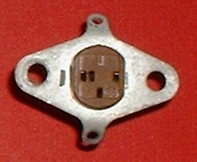
Early transistors were subject to damage from soldering, so it was common to use an alligator clip or a specific heat sink clip to prevent heat from reaching the transistor during construction. Some gear even used sockets which also allowed the quick substitution of devices, just like the tubes they replaced.
When the economics of transistors changed, it made a lot of things practical. For example, a common piece of gear used to be a transistor tester, like the Heathkit IT-121 in the video below. If you pulled an $8 part out of a socket, you’d want to test it before you spent more money on a replacement. Of course, if you had a curve tracer, that was even better because you could measure the device parameters which were probably more subject to change than a modern device.
Of course, germanium to silicon is only one improvement made over the years. The FET is a fundamentally different kind of transistor that has many desirable properties and, of course, integrating hundreds or even thousands of transistors on one integrated circuit revolutionized electronics of all types. Transistors got better. Parameters become less variable and yields increased. Maximum frequency rises and power handling capacity increases. Devices just keep getting better. And cheaper.
A Brief History of Transistors
The path from vacuum tube to the Regency TR-1 was a twisted one. Everyone knew the disadvantages of tubes: fragile, power hungry, and physically large, although smaller and lower-power tubes would start to appear towards the end of their reign. In 1925 a Canadian physicist patented a FET but failed to publicize it. Beyond that, mass production of semiconductor material was unknown at the time. A German inventor patented a similar device in 1934 that didn’t take off, either.
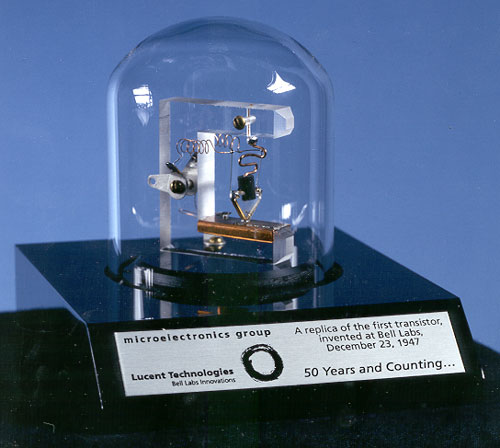
Replica of the First Transistor
Bell labs researchers worked with germanium and actually understood how to make “point contact” transistors and FETs in 1947. However, Bell’s lawyers found the earlier patents and elected to pursue the conventional transistor patent that would lead to the inventors (John Bardeen, Walter Brattain, and William Shockley) winning the Nobel prize in 1956.
Two Germans working for a Westinghouse subsidiary in Paris independently developed a point contact transistor in 1948. It would be 1954 before silicon transistors became practical. The MOSFET didn’t appear until 1959.
Of course, even these major milestones are subject to incremental improvements. The V channel for MOSFETs, for example, opened the door for FETs to be true power devices, able to switch currents required for motors and other high current devices.
VCF West is happening this Saturday and Sunday at the Computer History Museum in Mountain View, CA. This on of our favorite events; a celebration of the hardware that paved the way for our modern world. VCF attracts an impressive amount of rare and interesting computers and other technology items. That hardware doesn’t make it to the festival on its own. The people at VCF — exhibitors, speakers, attendees, etc — are themselves an incredible collection of stories from salvage and restoration to the inside story on the teams that made the computers in the first place. Check out some of Brian Benchoff’s coverage of VCF East earlier this year.
I ran into Vintage Computer Federation President Evan Koblentz ten days ago and he shared an interesting anecdote I think you’ll enjoy. Bil Herd was a featured speaker at VCF East a few years back. He was the Senior Design Engineer behind the Commodore C128 — obviously a fascinating person to headline the event. The year after Bil spoke at the festival, Evan as surprised to run into him wandering around the event again. Bil didn’t just want to speak, he wanted to see all the cool stuff and has attended, spoken, and conducted workshops at several of the festivals since.
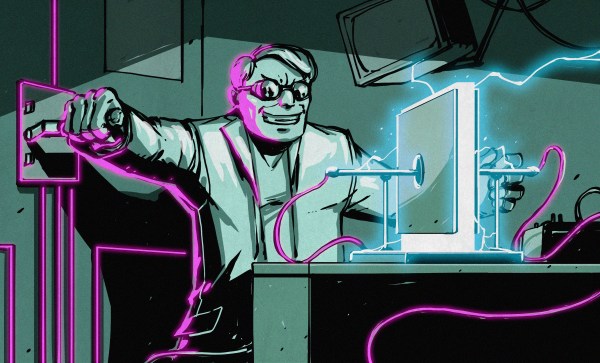
Who will show up this year is anyone’s guess. But we know this event is incredible and you will be amazed at who you run into. It is important to recognize where our technology comes from, to celebrate those who made it happen, and to encourage young people to start on the path to becoming a computer engineering wizard. For all of these reasons we are happy to be sponsoring VCF West. On the inside cover of every festival program you’ll find this epic art by our Illustrator, Joe Kim. You can also click the image on the right to embiggen.
Joshua Vasquez will on hand for Hackaday at VCF West. He’s looking for the best bits to feature on our front page. If you want get a hold of him to show off your wares, or to grab some excellent Hackaday stickers, hit him up on Hackaday.io.
At frustratingly regular intervals, the debate around gun control crops up, and every time there is a discussion about smart guns. The general idea is to have a gun that will not fire unless authenticated and authorized. There’s usually a story about a young person who invents a smart controller and another company that is struggling because they just can’t get “Big Guns” to buy into the idea. We aren’t going to focus on the politics; we’re going to look at whether the technology is realistic, and why a lot of the news stories about new tech never pan out.
Let’s start with an example of modern technology creeping into established machines: the car. These are giant hunks of metal with nearly constant explosions, controlled by sophisticated electronics that are getting smarter and more connected every day. Industry is adopting it with alacrity, and the vehicles are getting more efficient and powerful because of it. So why can’t firearms?
The pioneering years in the history of capacitors was a time when capacitors were used primarily for gaining an early understanding of electricity, predating the discovery even of the electron. It was also a time for doing parlor demonstrations, such as having a line of people holding hands and discharging a capacitor through them. The modern era of capacitors begins in the late 1800s with the dawning of the age of the practical application of electricity, requiring reliable capacitors with specific properties.
Leyden Jars
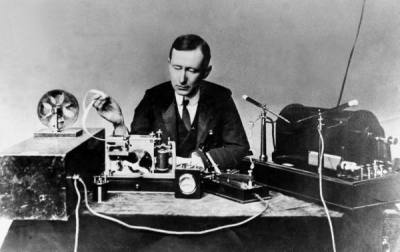
Marconi with transmitting apparatus, Published on LIFE [Public domain], via Wikimedia CommonsOne such practical use was in Marconi’s wireless spark-gap transmitters starting just before 1900 and into the first and second decade. The transmitters built up a high voltage for discharging across a spark gap and so used porcelain capacitors to withstand that voltage. High frequency was also required. These were basically Leyden jars and to get the required capacitances took a lot of space.
Mica
In 1909, William Dubilier invented smaller mica capacitors which were then used on the receiving side for the resonant circuits in wireless hardware.
Early mica capacitors were basically layers of mica and copper foils clamped together as what were called “clamped mica capacitors”. These capacitors weren’t very reliable though. Being just mica sheets pressed against metal foils, there were air gaps between the mica and foils. Those gap allowed for oxidation and corrosion, and meant that the distance between plates was subject to change, altering the capacitance.
In the 1920s silver mica capacitors were developed, ones where the mica is coated on both sides with the metal, eliminating the air gaps. With a thin metal coating instead of thicker foils, the capacitors could also be made smaller. These were very reliable. Of course we didn’t stop there. The modern era of capacitors has been marked by one breakthrough after another for a fascinating story. Let’s take a look.
Psst… Wanna make a canning jar diode? A tennis ball triode? How about a semiconductor transistor? Or do you just enjoy sitting back and following along an interesting narrative of something being made, while picking up a wealth of background, tips and sparking all sorts of ideas? In my case I wanted to make a cuprous oxide semiconductor diode and that lead me to H.P. Friedrichs’ wonderful book Instruments of Amplification. It includes such a huge collection of amplifier knowledge and is a delight to read thanks to a narrative style and frequent hands-on experiments.
My well worn copy of Instruments of Amplifications
DIY point-contact semiconductor transistor
Friedrichs first authored another very popular book, The Voice of the Crystal, about making crystal radios, and wanted to write a second one. For those not familiar with crystal radios, they’re fun to make radios that are powered solely by the incoming radio waves; there are no batteries. But that also means the volume is low.
Readers of that book suggested a good follow-up would be one about amplifier circuits, to amplify the crystal radio’s volume. However, there were already an abundance of such books. Friedrichs realized the best follow-up would be one on how to make the amplifying components from scratch, the “instruments of amplification”. It would be unique and in the made-from-scratch spirit of crystal radios. The book, Instruments of Amplification was born.
The book includes just the right amount of a history, giving background on what an amplifier is and how they first came in the electrical world. Telegraph operators wanted to send signals over greater and greater distances and the solution was to use the mix of electronics and mechanics found in the telegraph relay. This is the springboard for his first project and narrative: the microphonic relay.
The microphonic relay example shown on the right places a speaker facing a microphone; the speaker is the input with the microphone amplifying the output. He uses a carbon microphone salvaged from an old telephone headset, housing everything in an enclosure of copper pipe caps, steel bar stock, nuts and bolts mounted on an elegant looking wood base. All the projects are made with simple parts, with care, and they end up looking great.
Do you dream of opening a hackerspace, makerspace, or co-working space? Maybe it’s in the works and you’re already scoping out locations, intoxicated by visions of all the projects that will emerge from it. Here’s a sobering thought: makerspaces are a great big pile of risk. If the doors of your ‘space are already open, perhaps you’ve come to realize that the initial insurance policy you signed doesn’t really fit the needs of your particular creative paradise. Even if it does, the protection you need will change as you acquire new toys.
So why should you even get insurance? For one thing, your landlord will probably require it. If you own the building, you should insure it to protect yourself and anyone who uses the space. Do it for the same reason you’d insure a car, your house, or your collection of vintage pinball machines: to mitigate risk. It takes a lot of hard work to open a makerspace, perform the day-to-day operations, and keep it growing and getting better. Whenever the unthinkable happens, insurance will protect your investment as well as the people who make it a great place to be.
In researching this article, I contacted several well-established makerspaces in the United States as well as most of the major insurance providers to get both sides of the story. My intent was not to make a how-to guide, but to simply explore the topic and provide a view of the process and the struggle.