The 286 Gives Up One Of Its Final Secrets

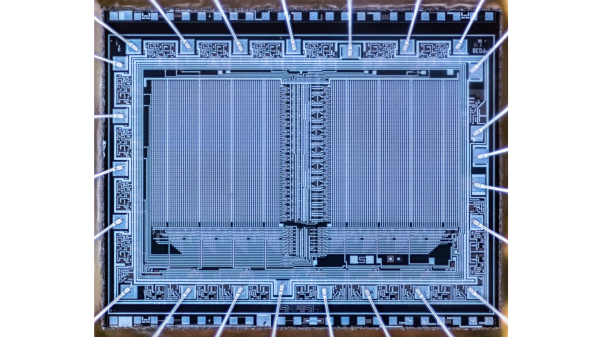
Though it is largely forgotten today, the Intel 80286 was for a while in the 1980s the processor of choice and designated successor to the 8086 in the world of PCs. It brought a new mode that could address up to 16 Mb of memory, and a welcome speed boost over machines using an 8086 or 8088. As with many microprocessors, it has a few undocumented features, and it’s a couple of these that [rep lodsb] takes a look at. Along the way we learn a bit about the 286, and about why Intel had some of these undocumented instructions in the first place.

If you used a 286 it was probably as an end-user sitting in front of a PC-AT or clone. During manufacture and testing though, the processor had need of some extra functions, both for testing the chip itself and for debugging designs using it. It’s in these fields that the undocumented instructions sit, and they relate to an in-circuit emulator, a 286 with a debug port on some of its unused pins, which would have sat on a plug-in daughterboard for systems under test. The 286 was famous for its fancy extended mode taking rather a long time to switch to, and these instructions relate to loading and saving states before and after the switch.

The 286s time as the new hotness was soon blasted away by the 386 with its support for virtual memory, so for most of us it remains as simply a faster way that we ran 8086 code for a few years. They appear from time to time here, even being connected to the internet.

286 image: Thomas Nguyen (PttNguyen.net), CC BY-SA 4.0.

Want To Use A Classic Mac Mouse On A Modern Computer? No? Here’s How To Do It Anyway

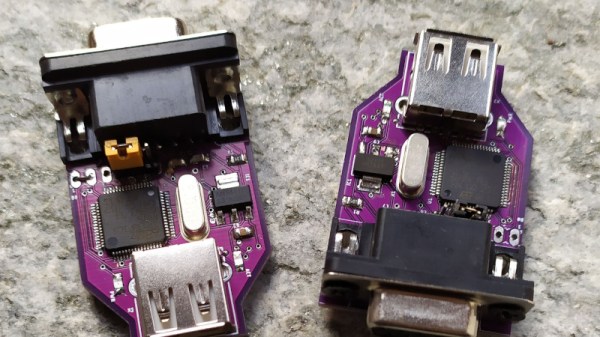
Need to hook a classic Mac mouse up to your modern machine with the help of a DIY USB adapter? [John Floren] has you covered. [John]’s solution uses a board with an ATmega32U4 microcontroller on it to connect to the Mac mouse on one end, and emulate a USB HID (Human Interface Device) on the other. A modern machine therefore recognizes it like it would any other USB input device.

Why is this necessary? The connector on the classic Mac mouse may look like a familiar DE-9 connector, but it is not an RS-232 device and wouldn’t work if it were plugged into a 9-pin serial port. The classic Mac mouse uses a different pinout, and doesn’t have much for brains on the inside. It relies on the host computer to read its encoders and button states directly.

This project is actually a bit of an update to a piece of earlier work [John] did in making a vintage Depraz mouse work with modern systems. He suspected that it wouldn’t take much to have it also work with a classic Mac mouse, and he was right — all it took was updating the pin connections and adding some pull-up resistors. The source code and design files are on GitHub.

Even if one does not particularly want to use a classic Mac mouse for daily work, there’s definitely value in this kind of thing for those who deal in vintage hardware: it allows one to function-check old peripherals without having to fire up a vintage machine.

Continue reading “Want To Use A Classic Mac Mouse On A Modern Computer? No? Here’s How To Do It Anyway”

Was There A Programmable PONG Chip?

Students of game console history will reach back into the 1970s for the primordial machines, tracing from the Magnavox Odyssey onwards, and thence via the Fairchild Channel F into the world of microprocessors and the chain of machines that lead us to those we enjoy today. In the early days there was a parallel evolution for a few years of dedicated video game consoles with no interchangeable cartridges or microprocessors, these took their inspiration from the legendary PONG arcade game and used dedicated non-programmable hardware in custom chips to create their video. But was there a programmable PONG chip lurking among all the others? [Old VCR] takes a look.

Many readers will be familiar with MOS Technology as the originator of the 6502 processor used in so many 8-bit home computers. But perhaps many of our attention spans will have passed over another of their products, the MOS 7600 and 7601. These were the chip company’s entry into the surprisingly congested mid-70s PONG-in-a-chip market, and the article investigates the question of whether they might in fact be mask-programmed microcontrollers masquerading as dedicated chips.

It’s a fascinating tour through the mid-70s in terms of games consoles, MOS, and through their eventual takeover, Commodore. The possibility of a mask-programmed PONG chip is explored in detail and discounted, though like [Old VCR], we’d love to see one decapped and reverse engineered. For us a stronger line of evidence comes in asking why MOS would stop at PONG if they had a mask-programmed microcontroller in their catalogue, and that our not having seen MOS microcontrollers appearing all over Commodore’s subsequent products suggests that it may be simply another dedicated PONG chip like all the others.

We’ve seen quite a few variants of this iconic game over the years, but few as impressive as one made from discrete components.

Laptoppin’ Like 1975

When we first saw the PZ1 laptop — a 6502 laptop-style computer with a small display and 512K of RAM — we couldn’t help but think of the old AIM 65 computer from Rockwell, although that only had 1K of memory. The other thing the AIM didn’t have was an ancillary microcontroller to help out that is way more powerful than the main processor.

There are actually several versions of the PZ1 and you can find some very detailed information over on Hackaday.io and GitHub. Recently, [Adam] release version 2.0 and tested some PC boards that are working well.

Continue reading “Laptoppin’ Like 1975”

The GameTank Is The Latest And Greatest 8-bit Game Console

The NES, Atari 2600, the Apple II, the Commodore 64 and the TurboGrafx-16 are just some of the many game consoles and home computers built around the 6502 CPU. And while the 6502 has been pretty much obsolete since the mid-’90s, that hasn’t stopped hackers from building new systems with it in the 21st century. Today we can even show you an entirely new 6502-based game console: the GameTank, designed and built by [Clyde Shaffer].

The GameTank was designed to be easy to build by anyone, and is therefore largely constructed from DIP chips that can be bought new at any component distributor. The main CPU is a WD65C02 running at 3.5 MHz, assisted by a 6522 I/O controller and 32 kB of RAM. Composite video is generated by a clever circuit made out of discrete logic chips. The video card comes with DMA for fast transfers and even includes a blitter, which enables it to move images around the screen quickly without loading the CPU.

For the controllers, [Clyde] decided to go for the more-or-less industry standard DE-9 connector gamepads as used on the Sega Genesis and various Atari consoles. He also made his own controller, a 3D printed one with four directional buttons, three action buttons and a start button. The buttons are implemented with Cherry MX Clear switches — an unusual choice for a gamepad perhaps, but they’re apparently very comfortable for long gaming sessions.

The console itself is also housed in a printed enclosure with a design reminiscent of the Nintendo 64. Game cartridges are inserted at the top and contain an EEPROM chip that can be written with a special programmer. The cartridge port also brings out several internal signals and can therefore be used as an expansion port, similar to the way Super NES cartridges could accommodate enhancement chips.

Games currently available include Tetris, the office-themed platformer Cubicle Knight, a Zelda-style adventure named Accursed Fiend, and a remake of the classic viral animation Bad Apple. [Clyde] provides a comprehensive stack of tools and example code and invites anyone interested to help develop more software for the platform. There’s also a hardware-accurate emulator, which is not only useful if you’re writing new code for the system but also if you simply want to try out the existing games in your browser.

Rolling your own 6502 system is great fun, and we’ve seen several examples over the years: some are built with huge bundles of wire, some are come with a clever programming language, some are so tiny they fit on your wrist, and some are simply beautifully made.

Continue reading “The GameTank Is The Latest And Greatest 8-bit Game Console”

Re-reclaimed From Nature: Resurrecting A DT80 Terminal

When Datamedia announced their new DT80 terminal as a VT100 killer back in 1979, they were so confident of its reliability, they threw in a full one-year warranty. Now, decades later, that confidence is once more put to the touch after [RingingResonance] fished one such terminal out of a creek by an old illegal dumping site. Not knowing what to expect from the muck-ridden artifact, his journey of slowly breathing life back into the device began.

Brings new meaning to the term “rooted”

Considering the layers of mud and roots already growing all over the main board, one can only assume how long the terminal has actually been in there. But cleaning it from all that was only the beginning: some components were missing, others turned out to be broken, including some of the ROMs, which [RingingResonance] speculates may have been caused by lightning which determined the DT80’s fate in the first place.

That’s when the adventure really started though, digging deep into the terminal’s inner life, eventually writing a debugger and own firmware for it. That code, along with all other research, notes, and links to plenty more pictures can be found in the GitHub repository, and is definitely worth checking out if you’re into the technologies of yesteryear.

Despite the DT80’s claimed superiority, the VT100 prevailed and is the terminal that history remembers — and emulates, whether as tiny wearable or a full look-alike. But this fall into oblivion was also part of [RingingResonance]’s motivation to keep going forward restoring the DT80. Someone had to. So if you happen to have anything to contribute to his endeavours or share with him, we’re sure he will appreciate you reaching out to him.

Continue reading “Re-reclaimed From Nature: Resurrecting A DT80 Terminal”

A TRS-80 with a small PCB attached

Hackaday Prize 2022: Modern Plug-in Gives TRS-80 Its Voice Back

Like artificial intelligence, speech synthesis was one of those applications that promised to revolutionize computing in the 1980s, only to fizzle out after people realized that a robotic voice reading out predefined sentences was not actually that useful. Nevertheless, computer manufacturers didn’t want to miss out on the hype and speech synthesizers became a relatively common add-on for a typical home computer.

Those add-ons were usually built around a custom voice-synthesis chip. If that chip fails, you’re out of luck: many were made in limited quantities by small companies and are impossible to find today. So if you’ve got a Tandy TRS-80 Voice Synthesizer with a dodgy SC-01-A chip, you’ll definitely want to check out [Michael Wessel]’s Talker/80 project. It’s a plug-in module for the TRS-80 that’s software compatible with the original Voice Synthesizer, but built from modern components. Synthesis is still performed by a custom IC, but now it’s using the more common Epson S1V30120 text-to-speech chip.

A speech synthesis PCB for a TRS-80The Talker/80 also has an ATmega644, which connects to the TRS-80’s expansion port on one side and to the Epson chip on the other. It can either emulate the original SC-01-A, in which case it expects text to be split into separate phonemes, or it can be set to an “advanced” mode in which it can directly process normal English text. In either case the voice sounds quite different from what original, although the new voice is arguably a little clearer.

We’ve seen modern speech synthesizers made for several classic computers: you can hook up the same Epson chip to an Amstrad CPC, or an ESP8266 to a VIC-20. If you’ve got an actual working SC-01-A but no vintage computer to use it with, you can also control it with an Arduino.

Continue reading “Hackaday Prize 2022: Modern Plug-in Gives TRS-80 Its Voice Back”