New Raspberry Pi Camera With Global Shutter

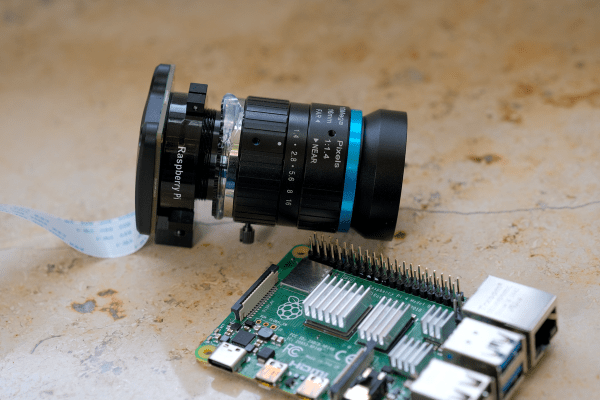
Raspberry Pi has just introduced a new camera module in the high-quality camera format. For the same $50 price you would shell out for the HQ camera, you get roughly eight times fewer pixels. But this is a global shutter camera, and if you need a global shutter, there’s just no substitute. That’s a big deal for the Raspberry Pi ecosystem.

Global vs Rolling

Most cameras out there today use CMOS sensors in rolling shutter mode. That means that the sensor starts in the upper left corner and rasters along, reading out exposure values from each row before moving down to the next row, and then starting up at the top again. The benefit is simpler CMOS design, but the downside is that none of the pixels are exposed or read at the same instant.

Continue reading “New Raspberry Pi Camera With Global Shutter”

The Future Of RISC-V And The VisionFive 2 Single Board Computer

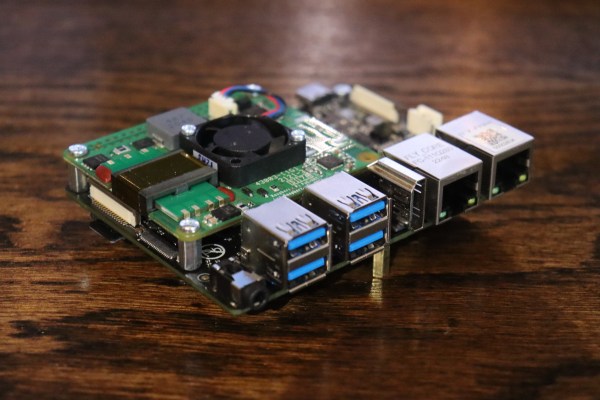
We’ve been following the open, royalty-free RISC-V ISA for a while. At first we read the specs, and then we saw RISC-V cores in microcontrollers, but now there’s a new board that offers enough processing power at a low enough price point to really be interesting in a single board computer. The VisionFive 2 ran a successful Kickstarter back in September 2022, and I’ve finally received a unit with 8 GB of ram. And it works! The JH7110 won’t outperform a modern desktop, or even a Raspberry Pi 4, but it’s good enough to run a desktop environment, browse the web, and test software.

And that’s sort of a big deal, because the RISC-V architecture is starting to show up in lots of places. The challenge has been getting real hardware that’s powerful enough to run Linux and compile software on, that doesn’t cost an arm and a leg. If ARM is an alternative architecture, then RISC-V is still an experimental one, and that is an issue when trying to use the VF2. That’s a theme we’ll repeat a few times, but the thing to remember here is that getting more devices in the wild is the first step to fixing things. Continue reading “The Future Of RISC-V And The VisionFive 2 Single Board Computer”

Do You Need The Raspberry Pi Camera Module V3?

This month came the announcement of some new camera modules from Raspberry Pi. All eyes were on version 3 of their standard camera module, but they also sneaked out a new version of their high quality camera with an M12 lens mount. The version 3 module is definitely worth a look, so I jumped on a train to Cambridge for the Raspberry Pi Store, and bought myself one for review.

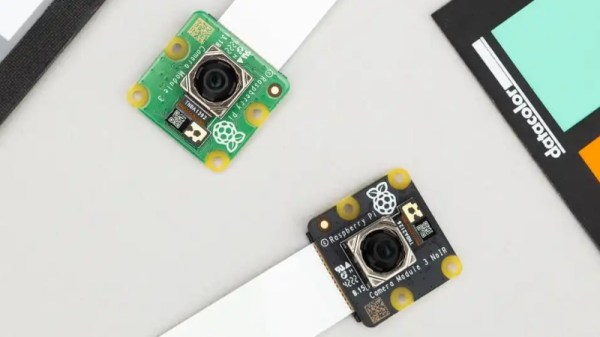
There’s nothing new about a Pi camera module as they’ve been available for years in both official and third party forms, so to be noteworthy the new one has to offer something a bit special. It uses a 12 megapixel sensor, and is available both in autofocus and wide angle versions in both standard and NoIR variants. Wide angle and autofocus modules may be new in the official cameras, but these are both things which have been on the third-party market for years.

So if an autofocus camera module for your Pi isn’t that new, what can we bring to a review that isn’t simply exclaiming over the small things? Perhaps it’s better instead to view the new camera in the context of the state of the Pi camera ecosystem, and what better way to do that than to turn a Pi and some modules into a usable camera! Continue reading “Do You Need The Raspberry Pi Camera Module V3?”

Your Own Santa? Thermal Camera Roundup

With Christmas and other end-of-year celebrations, there are gifts. The problem is that your loved ones don’t really know what to get you. Who can blame them? Do you want an Arduino, a Raspberry Pi, or a Blue Pill? Is that 3D printer on sale better than the one you have? Do you even want a second printer? They don’t know. In the best case, they’ll give you gift cards. But sometimes you just have to buy yourself something nice. [Wired] has a suggestion: a phone-based thermal camera. Which one? They have four suggestions ranging from about $150 to $200.

Different people have different reasons for wanting a thermal camera. You can see hot spots in electronics, for example. Or pick out hot water pipes behind walls. The resolution is limited. The highest in the [Wired] review is only 206×136. For the digital camera buffs, that’s 0.028 megapixels! Some cameras have even less resolution. For example, one of the cameras has an 80×60 resolution but uses an optical camera to give the illusion of a higher resolution.

Continue reading “Your Own Santa? Thermal Camera Roundup”

Arduboy Mini Is A Fresh Take On An 8-bit Favorite

We’ve always been big fans of the Arduboy here at Hackaday. When creator Kevin Bates showed us the original prototype back in 2014, the idea was to use his unique method of mounting components inside routed holes in the PCB to produce an electronic business card that was just 1.6 mm thick. But the Internet quickly took notice of the demos he posted online, and what started as a one-off project led to a wildly successful Kickstarter for a sleek handheld gaming system that used modern components and manufacturing techniques to pay homage to the 8-bit retro systems that came before it.

The original Arduboy prototype in 2014

It’s the sort of hacker success story that we live for around here, but it didn’t end there. After the Kickstarter, the Arduboy community continued to grow, thanks in no small part to Kevin never forgetting the open source principles the product was built on.

He took an active role in the growing community, and when some Arduboy owners started tinkering with adding external storage to their systems so they could hold hundreds of games at a time, he didn’t chastise them for exploring. Instead, he collaborated with them to produce not only a fantastic add-on modification for the original Arduboy, but a new version of the Arduboy that had the community-inspired modifications built in.

Now Kevin is back with the Arduboy Mini, which not only retains everything that made the original a success, but offers some exciting new possibilities. There’s little doubt that he’s got another success on his hands as well as the community’s backing — at the time of this writing, the Kickstarter campaign for the $29 USD Mini has nearly quadrupled its funding goal.

But even still, Kevin offered us a chance to go hands-on with a prototype of the Arduboy Mini so that anyone on the fence can get a third party’s view on the new system. So without further ado, let’s take a look at how this micro machine stacks up to its full-sized counterparts.

Continue reading “Arduboy Mini Is A Fresh Take On An 8-bit Favorite”

Say The Magic Word, And The TinySA Goes Ultra

We’ve looked at the TinySA spectrum analyzer in the past. However, the recent Ultra edition offers an increase in range from 800 MHz to 6 GHz. How does it work? [IMSAI Guy] tells us in a recent video that you can watch below. In addition to an increased frequency range, the new device offers a larger display and enhancements to the signal generator and bandpass filtering. It also has an optional LNA. All this, of course, is at a price since the Ultra sells at a little more than twice the original unit’s price. Still, $120 or so for a 6 GHz spectrum analyzer isn’t bad.

For some reason, you have to put a passcode in to enable the Ultra mode, although the passcode appears to be common knowledge and available on the device’s wiki. You can presume they could, at some point, make this feature or others require a paid passcode, but for now, it is just a minor inconvenience. Reminds us of a certain oscilloscope that’s become quite popular in our community.

One thing you should be aware of, however, is that the Ultra mode uses a mixer to downconvert the incoming signal to the ordinary 800 MHz range. That means, as you can see in the video, that the local oscillator puts out some signal at the input. The level is relatively low, but still something to be aware of if you are trying to make a precision measurement.

The video compares the device to an HP 8591E spectrum analyzer. It tops out at 1.8 GHz and runs about $2,500 new. Even on eBay, you can expect to pay between $500 and $1000 for one of these. The results seem to be comparable, for the most part.

We looked at the device’s predecessor back in 2020. We also did a full-blown review a little bit later.

Continue reading “Say The Magic Word, And The TinySA Goes Ultra”

Review: Inkplate 2 Shrinks Down, Adds Color

Regular Hackaday readers may recall the Inkplate family of devices: open source all-in-one development boards that combine the power and versatility of the ESP32 with electronic paper displays salvaged from commercial e-readers. By taking the sharp, high-speed, displays intended for readers such as Amazon’s Kindle and bundling it together with all the hardware and software you need to make it work, the Inkplate provided a turn-key platform for anyone looking to get serious with e-paper.

Given the fact that their screens were pulled from recycled readers, it’s no surprise the previous Inkplate entries came in familiar 6 and 10 inch variants. There was even an upgraded 6 inch model that benefited from newer reader technology by adopting a touch-sensitive backlit panel, which we took a close look at last year. Their large displays make them excellent for wall mounted applications, such as a household notification center or constantly-changing art display. Plus, as you might expect, the Inkplate is an ideal choice for anyone looking to roll their own custom e-reader.

But of course, not every application needs so much screen real estate. In fact, for some tasks, such a large display could be considered a liability. Seeing a void in their existing product lineup, the folks at Soldered Electronics (previously e-radionica) have recently unveiled the diminutive Inkplate 2. This new miniature Inkplate uses the same software library as its larger predecessors, but thanks to its 2.13 inch three-color display, lends itself to a wider array of potential projects. Plus it’s considerably cheaper than the larger Inkplate models, at just $35 USD.

Considering the crowd sourced funding campaign for the Inkplate 2 blew past its goal in just 72 hours, it seems clear there’s plenty of interest in this new smaller model. But if you’re still not sure if it’s the e-paper solution you’ve been waiting for, maybe we can help — the folks at Soldered sent along a pre-production version of the Inkplate 2 for us to play around with, so let’s take it for a test drive and see what all the fuss is about.

Continue reading “Review: Inkplate 2 Shrinks Down, Adds Color”