There is no question that poaching has become an existential threat to the five species of rhinoceros alive today. Even the wildlife reserves where most rhinos live struggle to provide protection from the wanton and cruel poaching of the world’s last remaining rhinos.
Poachers are generally looking to sell the horns which consist of pure keratin, the same material that makes up our fingernails and hair. Rhino horns have seen a big rise in demand the past decades, with a black market in Vietnam representing the biggest buyers, primarily for use in fever and other medicines, as well as for processing into carved trinkets. This has contributed to a further rhino population collapse. Statistics from 2017 show about 18,000 white rhinos and fewer than 5,500 black rhinos remaining. Recently, the northern white rhino population in Africa went effectively extinct with the death of the last known male individual.
Clearly, if we wish to prevent extinction, we need to deal with poaching. The latest suggestion here is part of the Rhisotope project. This would make rhino horns radioactive, but how exactly would doing so prevent poaching? Let’s take a look.
For anyone that’s fiddled around with a magnifying glass, it’s pretty easy to understand how optical microscopes work. And as microscopes are just an elaboration on a simple hand lens, so too are electron microscopes an elaboration on the optical kind, with electrons and magnets standing in for light and lenses. But atomic force microscopes? Now those take a little effort to wrap your brain around.
Luckily for us, [Zachary Tong] over at the Breaking Taps YouTube channel recently got his hands on a remarkably compact atomic force microscope, which led to this video about how AFM works. Before diving into the commercial unit — but not before sharing some eye-candy shots of what it can do — [Zach] helpfully goes through AFM basics with what amounts to a macro version of the instrument.
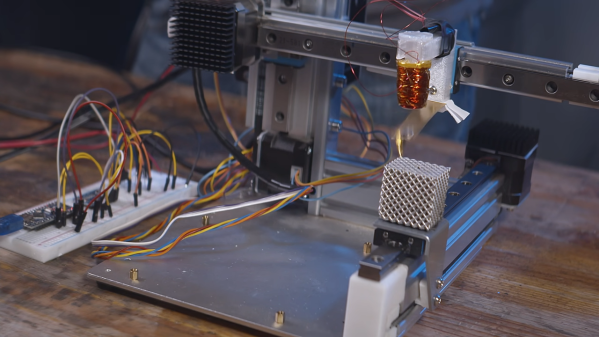
His macro-AFM uses an old 3D-printer as an X-Y-Z gantry, with a probe head added to the printer’s extruder. The probe is simply a sharp stylus on the end of a springy armature, which is excited into up-and-down oscillation by a voice coil and a magnet. The probe rasters over a sample — he looked at his 3D-printed lattices — while bouncing up and down over the surface features. A current induced in the voice coil by the armature produces a signal that’s proportional to how far the probe traveled to reach the surface, allowing him to map the sample’s features.
The actual AFM does basically the same thing, albeit at a much finer scale. The probe is a MEMS device attached to — and dwarfed by — a piece of PCB. [Zach] used the device to image a range of samples, all of which revealed fascinating details about the nanoscale realm. The scans are beautiful, to be sure, but we really appreciated the clear and accessible explanation of AFM.
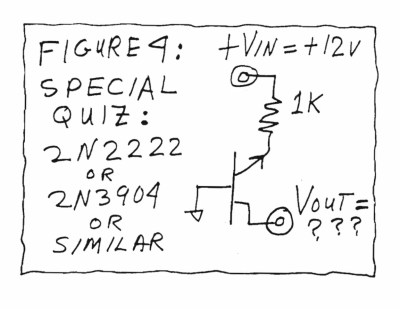
Back in 1996, Bob Pease posed an experiment in an April Fools column. “Take an ordinary NPN transistor, ground the base, pull the emitter up to 12 V with a 1 KΩ resistor and measure the collector voltage referenced to ground.” Do the experiment, and you might be surprised to find a small negative voltage present on the collector. [Filip Piorski] has always loved the riddle, and has explained how it works in a Youtube video.
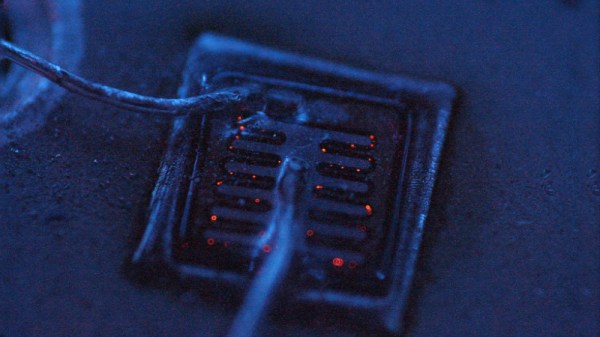
The key to the trick is the breakdown voltage of the transistor; normally somewhere around 7-8 volts for a typical small NPN transistor. At this point, where the base-emitter junction enters the breakdown regime, it begins to emit light. This light actually travels through the silicon lattice, where it reaches the base-collector junction, which acts like a photodiode under the right conditions. This generates the negative voltage seen at the collector under these conditions.
[Filip] goes on to try the experiment with a TO-3 transistor with the top cut off so he could visualise the effect in action. His photos, taken in a dark room, show tiny flecks of light appearing at spots on the silicon die. If you’ve got more insight on the effect in action, drop a comment below.
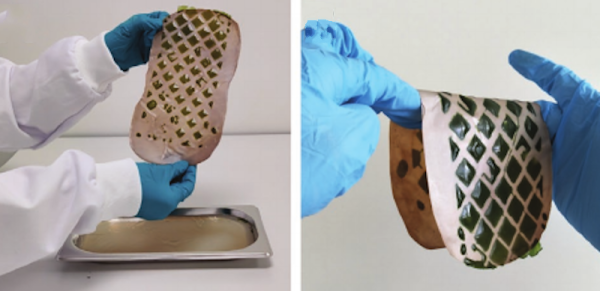
There’s a famous scene in the movie version of Frankenstein — but not in the book — where the doctor exclaims: “It’s alive!” We wonder if researchers at TU Delft had the same experience after printing living structures using algae. Of course, they aren’t creating life or even reanimating it. They are simply depositing living cells in artificial structures using a bio-compatible substrate. According to the paper, the living cells or bio ink can build up layers in a 3D printing fashion and the structures are “self-standing.”
There are some advantages, for example that the algae get their energy from sunlight. Of course they also have to eat, so unless you provide some snacks, your print will die off in about 3 days.
The International Space Station is humanity’s most expensive gym membership.
Since the earliest days of human spaceflight, it’s been understood that longer trips away from Earth’s gravity can have a detrimental effect on an astronaut’s body. Floating weightless invariably leads to significantly reduced muscle mass in the same way that a patient’s muscles can atrophy if they spend too much time laying in bed. With no gravity to constantly fight against, an astronauts legs, back, and neck muscles will weaken from disuse in as little as a week. While this may not pose an immediate problem during spaceflight, astronauts landing back on Earth in this physically diminished state are at a higher risk of injury.
Luckily this problem can be largely mitigated with rigorous exercise, and any orbiting vessel spacious enough to hold human occupants for weeks or months will by necessity have enough internal volume to outfit it with basic exercise equipment such as a treadmill or a resistance machine. In practice, every space station since the Soviet Union’s Salyut 1 in 1971 has featured some way for its occupants to workout while in orbit. It’s no replacement for being on Earth, as astronauts still return home weaker than when they left, but it’s proven to be the most practical approach to combating the debilitating aspects of long duration spaceflight.
Early NASA concept for creating artificial gravity.
Of course, there’s an obvious problem with this: every hour spent exercising in space is an hour that could be better spent doing research or performing maintenance on the spacecraft. Given the incredible cost of not just putting a human into orbit, but keeping them there long-term, time is very literally money. Which brings us back to my original point: astronauts spending two or more hours each day on the International Space Station’s various pieces of exercise equipment just to stave off muscle loss make it the world’s most expensive gym membership.
The ideal solution, it’s been argued, is to design future spacecraft with the ability to impart some degree of artificial gravity on its passengers through centripetal force. The technique is simple enough: just rotate the craft along its axis and the crew will “stick” to the inside of the hull. Unfortunately, simulating Earth-like gravity in this way would require the vessel to either be far larger than anything humanity has ever launched into space, or rotate at a dangerously high speed. That’s a lot of risk to take on for what’s ultimately just a theory.
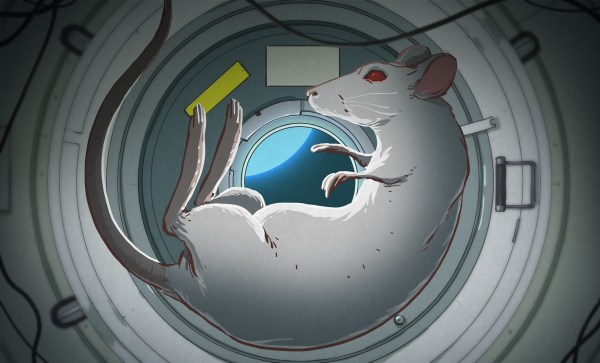
But a recent paper from the University of Tsukuba in Japan may represent the first real steps towards the development of practical artificial gravity systems aboard crewed spacecraft. While their study focused on mice rather than humans, the results should go a long way to codifying what until now was largely the stuff of science fiction.
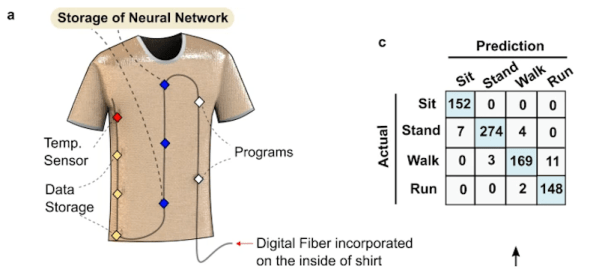
[Yoel Fink] and his team at MIT have announced their creation of a fiber that can sense and store data. In addition, they can use data from a shirt made of the material to infer the wearer’s activity with high accuracy. The fiber contains hundreds of microscale silicon chips into a preform used to create a polymer fiber that connects the chips using four 25 micron tungsten wires. You can read the paper directly in Nature Communications.
The fiber contains temperature sensors and enough memory (24CW1280X chips) to store a short movie for two months without power. It also contains 1,650 neural network elements, which means the fiber can train to infer activity itself without additional help.
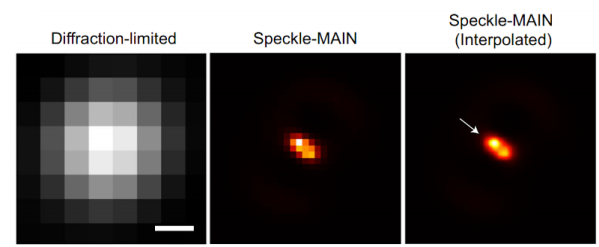
The technique also requires image processing. Light passing through the metamaterial breaks into speckles that produce low-resolution images that can combine to form high-resolution images. This so-called structured illumination technique isn’t exactly new, but previous techniques allowed about 100-nanometer resolution, much less than what the researchers were able to find using this material.


 The key to the trick is the breakdown voltage of the transistor; normally somewhere around 7-8 volts for a typical small NPN transistor. At this point, where the base-emitter junction enters the breakdown regime, it begins to emit light. This light actually travels through the silicon lattice, where it reaches the base-collector junction, which acts like a photodiode under the right conditions. This generates the negative voltage seen at the collector under these conditions.