Swine Of The Times: Pig-to-Human Organ Transplants On Track For 2021

Every day in the US, seventeen people die because they couldn’t get a organ transplant in time. An American biotech company called United Therapeutics is looking to pick up the lifesaving slack by producing a line of genetically-modified pigs for the purpose of harvesting their organs, among other therapeutic uses. United Therapeutics’ pig-farming subsidiary Revivicor is a spin-off of PPL Therapeutics, the company that gave us Dolly the cloned sheep back in 1996. They intend to start transplanting pig organs into humans as early as this year.

Baby Fae after transplant surgery. Image by Duane Miller-AP via Time Magazine

Although it sounds like science fiction, the idea of transplanting animal cells, organs, and tissue into humans has been around for over a hundred years. The main problem with xenotransplantation is that it usually triggers severe immune system reactions in the recipient’s body. In one of the more noteworthy cases, a baby girl received a baboon heart in 1984, but died a few weeks later because her body rejected the organ.

The leading cause of xenotransplant rejection is a sugar called alpha-gal. This sugar appears on the cell surfaces of all non-primate mammals. Alpha-gal is problematic for other reasons, too: a condition called alpha-gal syndrome usually begins when a Lone Star tick bites a person and transmits alpha-gal cells from the blood of animals they have bitten. From that point on, the person will experience an allergic reaction when eating red meat such as beef, pork, and lamb.

Continue reading “Swine Of The Times: Pig-to-Human Organ Transplants On Track For 2021”
3D Printing An Ion Propulsion System

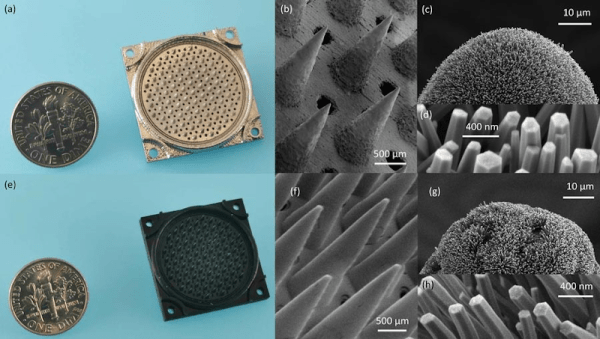
As much as we love Star Trek, we have to admit there are some continuity problems. For example, in Spock’s Brain, the alien-of-the-week’s ion drive gave Scotty engineering envy. However, in The Menagerie, the computer identifies a Starfleet shuttlecraft as having ion propulsion. Either way, ion propulsion is real and NASA has toyed with it for ages and many satellites use it for maintaining orbit. Now researchers from MIT and the Monterrey Institute of Technology and Higher Studies 3D printed tiny ion engines.

The engine is about the size of a dime and, like all ion engines, produces tiny amounts of thrust. In fact, the researchers liken it to half the weight of one sesame seed from a hamburger bun. However, in space, these tiny thrusts add up and over time can produce significant acceleration.

Continue reading “3D Printing An Ion Propulsion System”

NASA Challenge Offers Prizes For Sprouting Astronaut Food Systems

Humans have unfortunately not yet evolved the ability to photosynthesize or recharge from an electricity source, which is why astronauts well into the future of spaceflight will need to have access to food sources. Developing ways to grow food in space is the focus of the new Deep Space Food Challenge that was just launched by NASA and Canada’s Space Agency (CSA).

With a total of twenty $25,000 USD prizes for US contestants and ten $30,000 CAD prizes for the Canucks in Phase 1 of the challenge, there’s some financial incentive as well. In Phase 2, the winning teams of the concept phase have to show off their kitchen skills, and in the final Phase 3 (deadline by Fall 2023) the full food growing system has to be demonstrated.

The possible systems here would likely involve some kind of hydroponics, aeroponics or even aquaponics, to save the weight of lugging kilograms of soil into space. None of this is truly new technology, but cramming it into a package that would be able to supply a crew of four with enough food during a three-year mission does seem fairly challenging.

The NASA rules are covered in their Phase 1 Rules PDF document. While international teams are also welcome to compete, they cannot receive any prizes beyond recognition, and Chinese citizens or companies with links to China are not to allowed to compete at all.

Do Androids Search For Cosmic Rays?

We always like citizen science projects, so we were very interested in DECO, the Distributed Electronic Cosmic-ray Observatory. That sounds like a physical location, but it is actually a network of cell phones that can detect cosmic rays using an ordinary Android phone’s camera sensor.

There may be some privacy concerns as the phone camera will take a picture and upload it every so often, and it probably also taxes the battery a bit. However, if you really want to do citizen science, maybe dedicate an old phone, put electrical tape over the lens and keep it plugged in. In fact, they encourage you to cover the lens to reduce background light and keep the phone plugged in.

Continue reading “Do Androids Search For Cosmic Rays?”

Unknown Quantum Effect Makes Insulator Oscillate

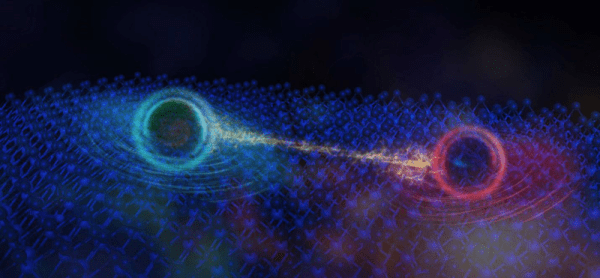
If there are two classes of matter that electronics people can agree on, its conductors and insulators. Electrically, conductors and insulators don’t have much in common. The same has held true in the quantum physics world until some research at Princeton has suggested that quantum oscillation — a phenomenon associated with metals — is taking place in an insulator. Scientists aren’t sure what’s really happening yet, but it may suggest there is a new quantum particle yet to be discovered.

In metals, electrons are very mobile which allows a relatively easy flow of electrical current. However, at low temperatures, a magnetic field can shift electrons to a quantum state causing its resistance to change in an oscillating pattern. Insulators generally do not exhibit this effect.

Researchers made a monolayer of tungsten ditelluride using the same kind of adhesive tape process you see to create graphene. In bulk, the material is a conductor but in a monolayer, tungsten ditelluride is an insulator.

Continue reading “Unknown Quantum Effect Makes Insulator Oscillate”

Handheld Slayer Exciter Wand Makes For Easy High Voltage Magic

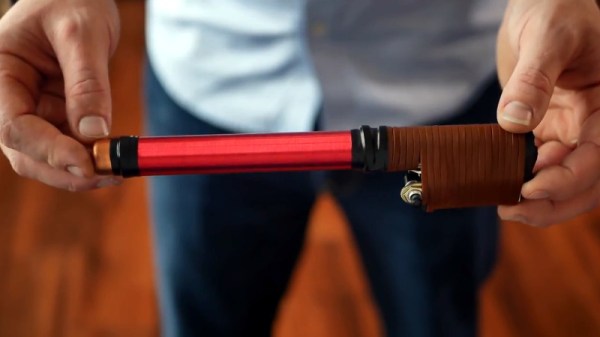
It’s often said that any sufficiently advanced technology is indistinguishable from magic, and when a DIY device lets you light up fluorescent bulbs with a flick of the wrist, it’s certainly not hard to see why. The latest creation from [Jay Bowles], this high voltage wand is actually a Slayer Exciter coil that’s able to boost the output of a standard 9 V alkaline or rechargeable battery high enough to perform some of the wireless power tricks we usually associate with the more complex Tesla coil.

We really can’t overstate how simple it is to build one of these yourself. Sure you’ll still need to wind the coil, but if you can chuck the 1/2 inch acrylic tube into a electric drill you should be able to make short work of it. Once you’ve wound your secondary coil from 32 gauge magnet wire, you only need a couple turns of common doorbell wire to make up the primary.

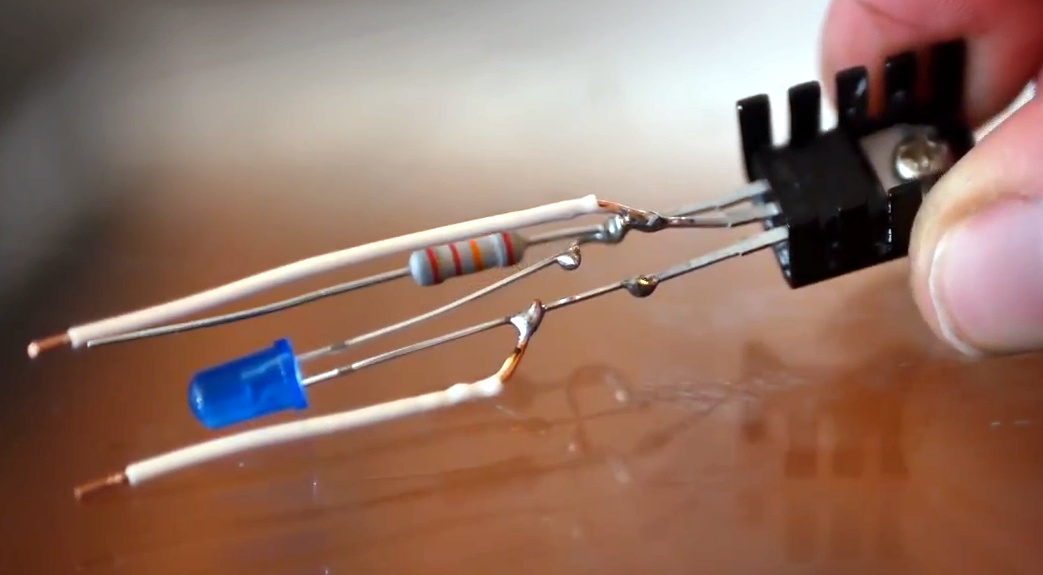
Think there must be some complex electronics hiding in the handle? Far from it. All that’s hidden by that faux-leather wrapping is a transistor to do the high-speed switching, an LED functioning as both the power indicator and the circuit’s diode, and a resistor. [Jay] put it all together dead bug style, but you could do it on a scrap of perfboard if you’d like something a little more robust.

Being a big believer in STEM education, [Jay] says the wand was designed to be as kid-friendly as possible so he could gift it to his young niece and nephew. Inspiring the next generation is certainly something we respect around these parts, though we think there’s plenty of adults who wouldn’t have been disappointed if they unwrapped a gadget like this over the holidays.

If you’d like to play around with a Slayer but aren’t into the whole Harry Potter motif, you might be interested in the larger and more capable version [Jay] built earlier in the year.

Continue reading “Handheld Slayer Exciter Wand Makes For Easy High Voltage Magic”

Visualizing Ionizing Radiation With DIY Plastic Scintillators

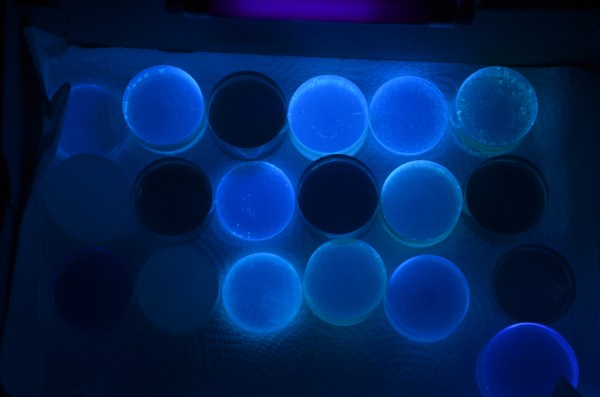
Although most types of radiation are invisible, except for the visible part of the EM spectrum, there are many ways that we can make various types of radiation visible. One of these methods is called ‘scintillation’, which can be used to make ionizing radiation visible. Recently [Lukas Springer] demonstrated how to make scintillators out of what is essentially plastic: bisphenol-A (E45, ‘epoxy’) resin with hardener and other additives.

The essential principle of operation behind a scintillator is its sensitivity to ionizing radiation, along with the tendency to absorb the energy and re-emit it in the form of light, i.e. luminescence. This is akin to the luminescence of LEDs, except that in their case the underlying principle is that of electro-luminescence. In the case of a plastic scintillator, the scintillating material is suspended in the solid polymer matrix base.

As [Lukas] points out, plastic scintillators are hardly ideal when it comes to their sensitivity to ionizing radiation, but they compensate for this by being easy to shape and produce, while being very durable. For this experiment, he used regular epoxy as the scintillator matrix, p-Terphenyl as primary scintillator and Coumarin 102 as the wavelength shifter. These three compounds act as a reaction chain, with the matrix absorbing the radiation and transferring it to the primary scintillator, which in turns emits the energy as light.

As the primary scintillator tends to radiate in the deep UV part of the EM spectrum, a wavelength shifter (i.e. secondary scintillator) which ‘shifts’ the emitted UV radiation into the visible part of the spectrum.

After producing a batch of plastic scintillators following the above recipe, [Lukas] irradiated them with gamma radiation, and found them to perform worse than some already not remarkable Russian PS-based scintillators. [Lukas’s] guess is that the matrix may be absorbing the primary scintillator’s output, or a mismatch between the primary and second scintillator.

While tricky to get right, it does seem like a fun hobby if one has some interesting in chemistry. [Lukas] (@GigaBecquerel on Twitter) provides a basic recipe as well as many other compounds to use for the primary and secondary scintillator, as well as the matrix compound. Enough to get started with.