HF Propagation And Earthquakes

For all the successes of modern weather forecasting, where hurricanes, blizzards, and even notoriously unpredictable tornadoes are routinely detected before they strike, reliably predicting one aspect of nature’s fury has eluded us: earthquakes. The development of plate tectonic theory in the middle of the 20th century and the construction of a worldwide network of seismic sensors gave geologists the tools to understand how earthquakes happened, and even provided the tantalizing possibility of an accurate predictor of a coming quake. Such efforts had only limited success, though, and enough false alarms that most efforts to predict earthquakes were abandoned by the late 1990s or so.

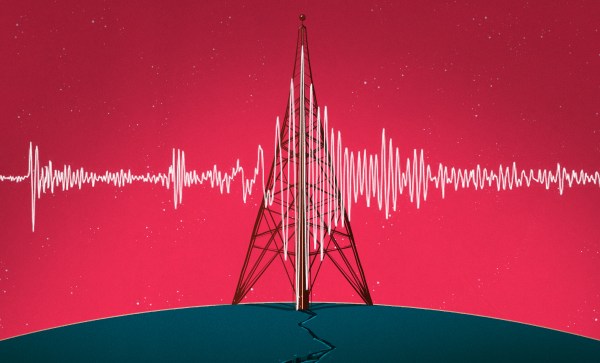
It may turn out that scientists were looking in the wrong place for a reliable predictor of coming earthquakes. Some geologists and geophysicists have become convinced that instead of watching the twitches and spasms of the earth, the state of the skies above might be more fruitful. And they’re using the propagation of radio waves from both space and the ground to prove their point that the ionosphere does some interesting things before and after an earthquake strikes.
Continue reading “HF Propagation And Earthquakes”

Hiring From A Makerspace Pays Off

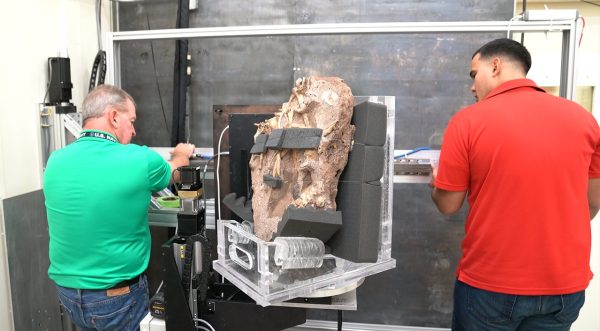
A makerspace is a great place to use specialty tools that may be too expensive or large to own by oneself, but there are other perks that come with participation in that particular community. For example, all of the skills you’ve gained by using all that fancy equipment may make you employable in some very niche situations. [lukeiamyourfather] from the Dallas Makerspace recently found himself in just that situation, and was asked to image a two-million-year-old fossil.

The fossil was being placed into a CT machine for imaging, but was too thick to properly view. These things tend to be fragile, so he spent some time laser cutting an acrylic stand in order to image the fossil vertically instead of horizontally. Everything that wasn’t fossil had to be non-conductive for the CT machine, so lots of fishing line and foam was used as well. After the imaging was done, he was also asked to 3D print a model for a display in the museum.

This is all going on at the Perot Museum of Nature and Science if you happen to be in the Dallas area. It’s interesting to see these skills put to use out in the wild as well, especially for something as rare and fragile as studying an old fossil. Also, if you’d like to see if your local makerspace measures up to the Dallas makerspace, we featured a tour of it back in 2014, although they have probably made some updates since then.

3D Printing Batteries

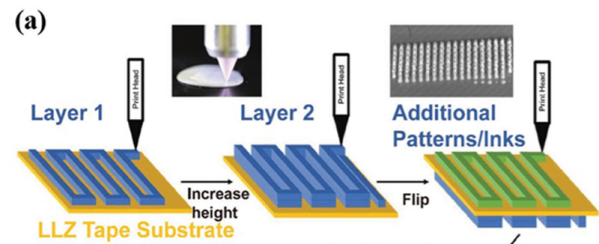
We’ve all gotten pretty adept at 3D printing keychains and enclosures. Some people can even 3D print circuit boards to an extent. But the real goal is a Star Trek-style replicator that just pushes out finished products. Printing different components would be a key technology and unless you want to supply external power, one of those components better be a battery or other power source like a solar cell. A recent paper entitled Additive Manufacturing of Batteries explores this technology. The paper is behind a paywall, but you can probably find a copy if you are persistent.

Some of the techniques are pretty exotic. For example, holographic lithography can produce high-performance lithium-ion batteries. However, some of the processes didn’t sound much different than some of the more common printing techniques employed by desktop printers, although with more exotic materials. For example, some batteries can be made with inkjet printing and even fused deposition printing. Continue reading “3D Printing Batteries”

Liquid Methane Rocket Is Set To Soar

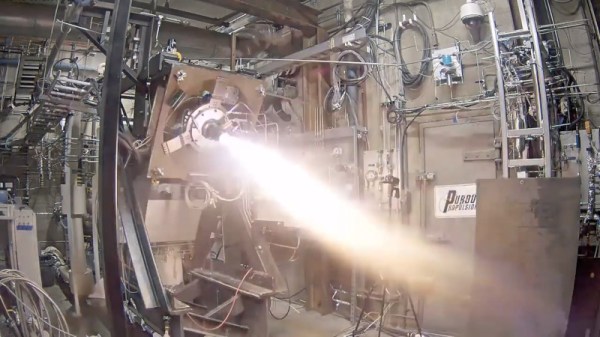
Solid rockets are a fun way to get started in rocketry. Brewing up a batch of rocket candy is something achievable even in the home lab, and anyone can give it a go with the right materials. Building a flight-capable liquid-fuelled rocket engine is another thing entirely, but the Purdue Space Program is up to the task.

The result of their hard work is Boomie Zoomie, a rocket which stands 15ft tall and weighs 130lbs. With peak thrust of 800 lbs, it’s got plenty of grunt to help get things off the ground. It’s fuelled by liquid methane, a first for a university-built rocket. The craft is constructed out of 6″ aluminium pipe sections, which were a best-case trade-off between weight, cost, and machinability. Special care was taken during the design process to make things modular, to both allow for future design revisions and ease of field prep. This allows different parts of the team to work independently, streamlining the process of preparing the rocket for launch.

Aiming to compete in the FAR MARS liquid rocket competition, the rocket has undergone two successful hotfires. The team estimates that the first launch should happen in the next few months. Preparations are continuing on the launch trailer and ancilliary support equipment to get things up and running. The aim is to reach a lofty altitude of 45,000 feet.

For those interested in a career in rocketry, Purdue may just be the place to be, with over 300 members in its space program. We’ve seen other top-notch collegiate rocket programs, too – such as this Boston University effort that aims to reach space. Video after the break.

Continue reading “Liquid Methane Rocket Is Set To Soar”

Investigating Retroreflectors With One Heck Of A Microscope

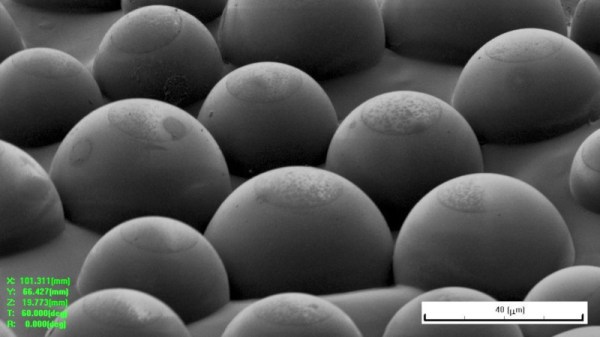
Retroreflectors are interesting materials, so known for their nature of reflecting light back to its source. Examples include street signs, bicycle reflectors, and cat’s eyes, which so hauntingly pierce the night. They’re also used in the Tilt Five tabletop AR system, for holographic gaming. [Adam McCombs] got his hands on a Tilt Five gameboard, and threw it under the microscope to see how it works.

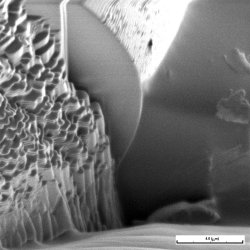
Using the ion beam, a trench was dug around the side of one of the spheres, revealing the interface between the adhesive and the sphere itself.

[Adam] isn’t mucking around, fielding a focused ion beam microscope for the investigation. This scans a beam of galium metal ions across a sample for imaging. With the added kinetic energy of an ion beam versus a more typical electron beam, the sample under the microscope can be ablated as well as imaged. This allows [Adam] to very finally chip away at the surface of the retroreflector to see how it’s made.

The analysis reveals that the retroreflecting spheres are glass, coated in metal. They’re stuck to a surface with an adhesive, which coats the bottom of the spheres, and acts as an etch mask. The metal coating is then removed from the sphere’s surface sticking out above the adhesive layer. This allows light to enter through the transparent part of the sphere, and then bounce off the metal coating back to the source, creating a sheet covered in retroreflectors.

[Adam] does a great job of describing both the microscopy and production techniques involved, before relating it to the fundamentals of the Tilt Five AR technology. It’s not the first time we’ve heard from [Adam] on the topic, and we’re sure it won’t be the last!

How Smart Are AI Chips, Really?

The best part about the term “Artificial Intelligence” is that nobody can really tell you what it exactly means. The main reason for this stems from the term “intelligence”, with definitions ranging from the ability to practice logical reasoning to the ability to perform cognitive tasks or dream up symphonies. When it comes to human intelligence, properties such as self-awareness, complex cognitive feats, and the ability to plan and motivate oneself are generally considered to be defining features. But frankly, what is and isn’t “intelligence” is open to debate.

What isn’t open to debate is that AI is a marketing goldmine. The vagueness has allowed for marketing departments around the world to go all AI-happy, declaring that their product is AI-enabled and insisting that their speech assistant responds ‘intelligently’ to one’s queries. One might begin to believe that we’re on the cusp of a fantastic future inhabited by androids and strong AIs attending to our every whim.

In this article we’ll be looking at the reality behind these claims and ponder humanity’s progress towards becoming a Type I civilization. But this is Hackaday, so we’re also going to dig into the guts of some AI chips, including the Kendryte K210 and see how the hardware of today fits into our Glorious Future. Continue reading “How Smart Are AI Chips, Really?”

The Blessings And Destruction Wrought By Lead Over Millennia

Everyone one of us is likely aware of what lead — as in the metal — is. Having a somewhat dull, metallic gray appearance, it occupies atomic number 82 in the periodic table and is among the most dense materials known to humankind. Lead’s low melting point and malleability even when at room temperature has made it a popular metal since humans first began to melt it out of ore in the Near East at around 7,000 BC in the Neolithic period.

Although lead’s toxicity to humans has been known since at least the 2nd century BC and was acknowledged as a public health hazard in the late 19th century, the use of lead skyrocketed in the first half of the 20th century. Lead saw use as a gasoline additive beginning in the 1920s, and the US didn’t abolish lead-based paint until 1978, nearly 70 years after France, Belgium and Austria banned it.

With the rise of consumer electronics, the use of lead-based solder became ever more a part of daily life during the second part of the 20th century, until an increase in regulations aimed at reducing lead in the environment. This came along with the World Health Organization’s fairly recent acknowledgment that there is truly no safe limit for lead in the human body.

In this article I’ll examine the question of why we are still using lead, and if we truly must, then how we can use this metal in the safest way possible.

Continue reading “The Blessings And Destruction Wrought By Lead Over Millennia”