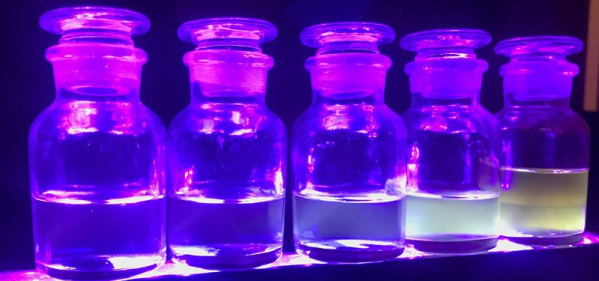
Make Your Own Quantum Dots

Quantum dots certainly sound as if they should be something cool, but carry the hazardous baggage of being sometimes made from cadmium which can be dangerous. What are they? In essence, they are nanometer-scale particles, so small that when high energy light hits them, the photons will be absorbed and re-emitted at a lower energy state. You can easily make non-toxic quantum dots in your kitchen. Apart from the cool factor, they can be used as fluorescent dyes, inks, and possibly paints. [StrangelyAmusing] explains how in the video below.

You don’t need much in the way of equipment. A microwave oven, a Pyrex (borosilicate) container, and gloves. You’ll also need plastic pipettes and a blacklight — possibly the most exotic two items on the list. The ingredients are equally mundane: vinegar, baking soda, water, and sugar.
Continue reading “Make Your Own Quantum Dots”

You’re Listening To Quantum Radio

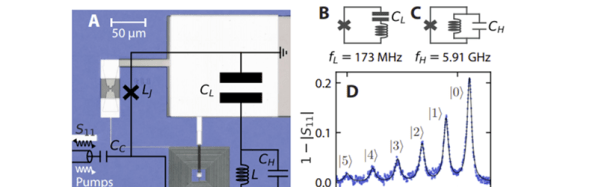
Researchers at Delft University of Technology have created a detector that enables the detection of a single photon’s worth of radio frequency energy. The chip is only 10 mm square and the team plans to use it to explore the relationship of mass and gravity to quantum theory.

The chip has immediate applications in MRI and radio astronomy. Traditionally, detecting a single photon at radio frequencies is difficult due to the significance of thermal fluctuations. At lower frequencies, cryogenic cooling can reduce the issue, but as frequency increases the fluctuations are harder to tame.

The trick requires a qubit that samples the radio frequency energy. While the radio source is at 173 MHz, the qubit is at 1 GHz, allowing a fine time resolution. Coupling of the two is via an LC circuit that uses a Josephson junction which, of course, requires very cold temperatures. Continue reading “You’re Listening To Quantum Radio”

Graphene Desalinates Sea Water

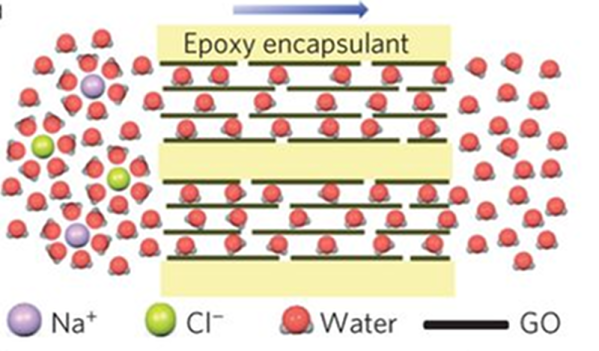
Even though the majority of the Earth is covered in water, a surprising number of people around the world don’t have easy access to clean drinking water. The oceans of course are full of salt, and it is difficult to filter that salt out. Researchers at the University of Manchester have found a way to improve a graphene-based filter mechanism that could help convert sea water to potable water.

Pure graphene can do the job, but it is difficult to manufacture in commercial quantities. In addition, the membrane requires the creation of tiny holes, further complicating the production. The new method uses graphene oxide, which is very simple to make and deploy.

Continue reading “Graphene Desalinates Sea Water”

Ask Hackaday: Earth’s Magnetic Field Shifting Rapidly, But Who Will Notice?

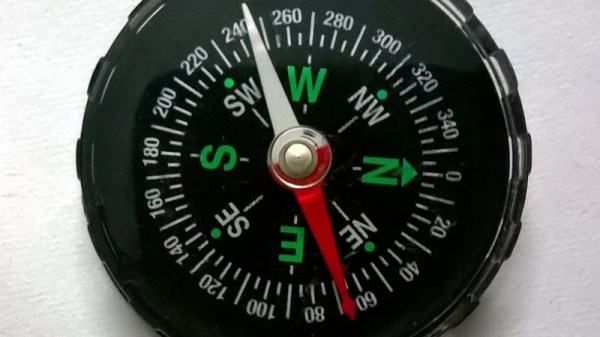
Just when you though it was safe to venture out, the National Oceanic and Atmospheric Administration released an unexpected update. Magnetic North is on the move — faster than expected. That’s right, we know magnetic north moves around, but now it’s happened at a surprising rate. Instead of waiting for the normal five year interval before an update on its position, NOAA have given us a fresh one a bit earlier.

There are some things that we can safely consider immutable, reliable, they’llĀ always be the same. You might think that direction would be one of them. North, south, east, and west, the points of the compass. But while the True North of the Earth’s rotation has remained unchanged, the same can not be said of our customary method of measuring direction.

Earth’s magnetic field is generated by a 2,000 km thick outer core of liquid iron and nickel that surrounds the planet’s solid inner core. The axis of the earth’s internal magnet shifts around the rotational axis at the whim of the currents within that liquid interior, and with it changes the readings returned by magnetic compasses worldwide.

The question that emerged at Hackaday as we digested news of the early update was this: as navigation moves inexorably towards the use of GPS and other systems that do not depend upon the Earth’s magnetic field, where is this still relevant beyond the realm of science?

Continue reading “Ask Hackaday: Earth’s Magnetic Field Shifting Rapidly, But Who Will Notice?”

Grape Plasma Explained

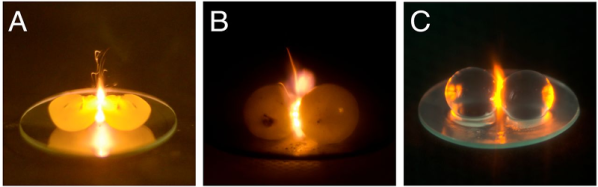
You’ve probably seen the videos of a grape — cut almost totally in half — in a microwave creates a plasma. A recent physics paper studies the phenomenon with a lot of high-tech gear and now the actual mechanism is known. [Veritasium] interviews the scientists and explains the grape plasma phenomenon in plain language. You can see the video below or read the paper directly.

Turns out the grape is about 1/10 of the microwave frequency and the refractive index of the grape at microwave frequencies might be as much as ten. A whole grape can get all the microwaves trapped inside, but two grapes — or two halves — that touch create fields strong enough to ionize the air.

Continue reading “Grape Plasma Explained”

12 Year Old Builds Successful Fusor At Home

Nuclear fusion, as a method of power generation, continues to elude humanity. It promises cheap, virtually limitless energy, if only we could find a way to achieve it. On the other hand, achieving nuclear fusion of a few atoms just for the fun of it is actually quite doable, even in the home lab. [Jackson Oswalt] is one of the youngest to pull it off, having built a working fusor at home at the age of 12.

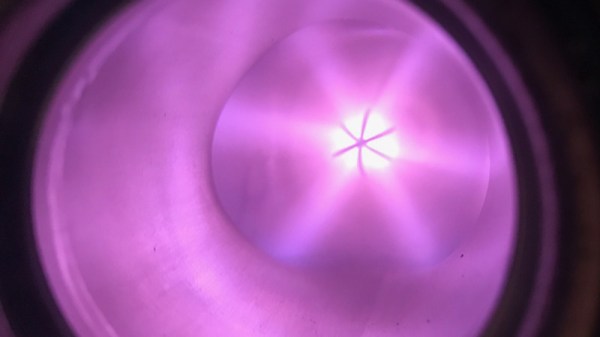
The fusor consists of a cross-shaped chamber, which is pumped down to a high vacuum to enable the fusion reaction to occur. Deuterium is then pumped into the chamber, and confined by an applied electric field from a power supply in the vicinity of 50 kV. With the right combination of geometry, vacuum and other factors, it’s possible to fuse atoms and observe the characteristic glow of the reaction taking place.

In order to be recognised as having achieved fusion by the Open Source Fusor Research Consortium, one must typically have proof of the release of neutrons from the fusion reaction. [Jackson] showed this with a neutron detector setup, by inserting and removing it during a run to demonstrate the fusor was the source of the signal. Photos of the glowing fusor don’t go astray, either, and [Jackson] was more than happy to deliver.

We’ve seen fusor builds before – [Erik]’s build got him into the Plasma Club back in 2016.

[via Fox News]

Noise: It Turns Out You Need It

We don’t know whether quantum physics proves the universe is truly a strange place or that we are living in a virtual reality simulation, but we know it turns a lot of common sense into garbage. Take noise, for example. Noise — as in random electrical noise — is bad, right? We spend a lot of time designing to minimize noise. Researchers in Austria, Germany, and Australia recently published a paper that shows that noise can actually improve the flow of energy. While the paper is behind a paywall, the Focus article is available and, of course, you can probably find a copy of the paper if you want to read the entire thing.

The paper, titled “Environment-Assisted Quantum Transport in a 10-qubit Network” uses trapped calcium atoms to study an effect suspected of being a key factor in high-efficiency energy transfer such as the transfer observed in optical fibers and photosynthesis.

Continue reading “Noise: It Turns Out You Need It”