Scientists Create Speech From Brain Signals

One of the things that makes us human is our ability to communicate. However, a stroke or other medical impairment can take that ability away without warning. Although Stephen Hawking managed to do great things with a computer-aided voice, it took a lot of patience and technology to get there. Composing an e-mail or an utterance for a speech synthesizer using a tongue stick or by blinking can be quite frustrating since most people can only manage about ten words a minute. Conventional speech averages about 150 words per minute. However, scientists recently reported in the journal Nature that they have successfully decoded brain signals into speech directly, which could open up an entirely new world for people who need assistance communicating.

The tech is still only lab-ready, but they claim to be able to produce mostly intelligible sentences using the technique. Previous efforts have only managed to produce single syllables, not entire sentences.

Continue reading “Scientists Create Speech From Brain Signals”
Making Microfluidics Simpler With Shrinky Dinks

It’s as if the go-to analogy these days for anything technical is, “It’s like a series of tubes.” Explanations thus based work better for some things than others, and even when the comparison is apt from a physics standpoint it often breaks down in the details. With microfluidics, the analogy is perfect because it literally is a series of tubes, which properly arranged and filled with liquids or gasses can perform some of the same control functions that electronics can, and some that it can’t.

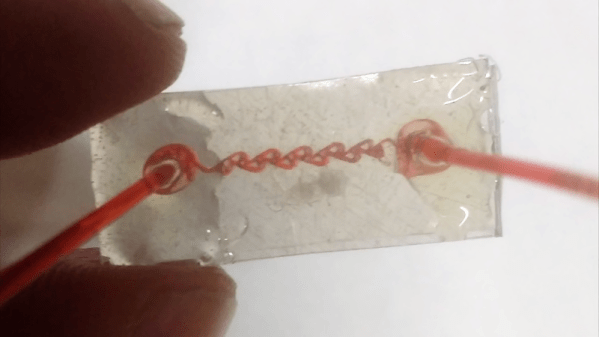
But exploring microfluidics can be tough, what with the need to machine tiny passages for fluids to flow. Luckily, [Justin] has turned the process into child’s play with these microfluidic elements made from Shrinky Dinks. For those unfamiliar with this product, which was advertised incessantly on Saturday morning cartoon shows, Shrinky Dinks are just sheets of polystyrene film that can be decorated with markers. When placed in a low oven, the film shrinks about three times in length and width while expanding to about nine times its pre-shrunk thickness. [Justin] capitalized on this by CNC machining fine grooves into the film which become deeper after shrinking. Microfluidics circuits can be built up from multiple layers. The video below shows a mixer and a simple cell sorter, as well as a Tesla valve, which is a little like a diode.

We find [Justin]’s Shrinky Dink microfluidics intriguing and can’t wait to see what kind of useful devices he comes up with. He’s got a lot going on, though, from spider-powered beer to desktop radio telescopes. And we wonder how this technique might help with his CNC-machined microstrip bandpass filters.

Continue reading “Making Microfluidics Simpler With Shrinky Dinks”

Forget Artificial Intelligence; Think Artificial Life

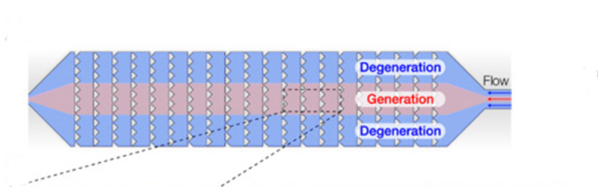
If you are a science fiction fan, you are probably aware of one of the genre’s oddest dichotomies. A lot of science fiction is concerned about if a robot, alien, or whatever is a person. However — sometimes in the same story — finding life is as easy as asking the science officer with a fancy tricorder. If you go to Mars and meet Marvin, it is pretty clear he’s alive, but faced with a bunch of organic molecules, the task is a bit harder. Now it is going to get harder still because Cornell scientists have created a material that has an artificial metabolism and checks quite a few boxes of what we associate with life. You can read the entire paper if you want more detail.

Three of the things people look for to classify something as alive is that it has a metabolism, self-arranges, and reproduces. There are other characteristics, depending on who you ask, but those three are pretty crucial.

Continue reading “Forget Artificial Intelligence; Think Artificial Life”

Graphene Is So Yesterday — Meet Borophene

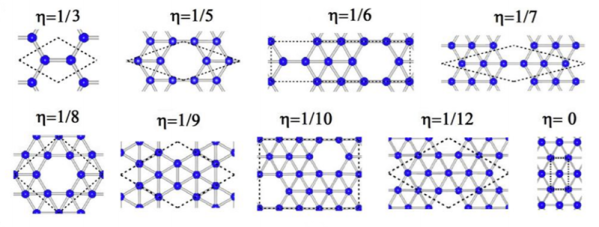
It wasn’t long ago that graphene seemed to take the science and engineering communities by storm. You can make bits of it with a pencil and some sticky tape, yet it had all sorts of wonderful properties. The key, of course, is that it is a single layer of atoms. Now scientists have done the same trick with boron to form borophene, and it looks to be even more exciting than graphene. You can read a pretty dense paper about the material if you want to dig deeper.

The new material is stronger and more flexible than graphene. It appears too that it could boost the performance of lithium-ion batteries. Computer simulations showed that borophene was possible back in 1990, but it wasn’t until 2015 that anyone was able to make any. The material is a good conductor of electricity and heat. It also exhibits superconductivity. Another exciting prospect is that it can be created in different arrangements, each with a unique set of properties. So you may be able to build borophene to be, for example, especially conductive or particularly strong.

Continue reading “Graphene Is So Yesterday — Meet Borophene”

Schrödinger Quantum Percolator Makes Half Decent Coffee

I couldn’t decide between normal and decaffeinated coffee. So to eliminate delays in my morning routine, and decision fatigue,  I’ve designed the Schrödinger Quantum Percolator — making the state of my coffee formally undecidable until I drink it.

At its core, the Quantum Percolator contains a novel quantum event detector that uses electron tunneling to determine whether to use caffeinated or decaffeinated coffee. The mechanical components are enclosed in an opaque box, so I can’t tell which type of coffee is being used.

The result is coffee that simultaneously contains and does not contain caffeine – at least until you collapse the caffeination probability waveform by drinking it. As the expression goes, you can’t have your quantum superposition of states and drink it too!

Continue reading “Schrödinger Quantum Percolator Makes Half Decent Coffee”

Sensor-Laden Pigeons Gather Data For Urban Weather Modeling

When it comes to gathering environmental data in real-world settings, urban environments have to be the most challenging. Every city has nooks and crannies that create their own microenvironments, and placing enough sensors to get a decent picture of what’s going on in all of them is a tough job. But if these sensor-laden pigeons have anything to say about it, the job might get a bit easier.

The idea for using pigeons as biotelemetry platforms comes to us from the School of Geography, Earth, and Environmental Sciences at the University of Birmingham in the UK. [Rick Thomas], lead investigator on the “CityFlocks” project, explains that meteorological models are hampered by a lack of data about the air in the urban canyons formed by tall buildings. Placing a lot of fixed sensors has a prohibitive cost, and using drones to do the job would probably cause regulatory problems, especially given recent events. But pigeons are perfect for the job once they’re outfitted with an “Avian-Meteorology Instrumentation Package (AvMIP)”. From the photographs we’re guessing the AvMIP is a pretty simple data logger with GPS and inputs for the usual sensors, all powered by a small LiPo pack. Luckily, the pigeons used are all domesticated racing birds that return to the nest, so no radio transmitter is needed, but if other urban avians such as peregrine falcons and seagulls are used then a future AvMIPS might leverage pervasive WiFi networks to upload data.

It’s not the first time we’ve seen mobile platforms used to fill in gaps in weather data, of course. And if this at all puts you in mind of that time pigeons were used to guide bombs, relax – no pigeons were harmed in the making of this research project.

Thanks to [Itay Ramot] for the tip [via Gizmodo].

Maybe You Really Can Sense Magnetic Fields

We’ve known for years that many animals can somehow sense magnetic fields. Birds apparently use the Earth’s magnetic field to navigate. Dogs can find a box containing a magnet better than they can find a similar box with a food treat in it. But humans, apparently, can’t visualize magnetic fields without help. Several scientists at California, New Jersey, and Japan have done experiments that seem to show that people’s brains do have changes when a magnetic field rotates. If the paper, titled “Transduction of the Geomagnetic Field as Evidenced from Alpha-band Activity in the Human Brain” is a bit much for you, might enjoy the video from Veritasium, below, which is much easier to parse than the paper.

To see it work, a subject sits in a dark isolated room with an electrode cap that picks up the subject’s EEG. The study shows that different people have different sensitivity to the field. Also, picking up a magnetic field in an isolated chamber is different from picking it up on the sidewalk and using it to navigate with. Continue reading “Maybe You Really Can Sense Magnetic Fields”