FDM Filament Troubles: Keeping Hygroscopic Materials From Degrading

Despite the reputation of polymers used with FDM 3D printing like nylon, ABS, and PLA as being generally indestructible, they do come with a whole range of moisture-related issues that can affect both the printing process as well as the final result. While the concept of ‘baking’ such 3D printing filaments prior to printing to remove absorbed moisture is well-established and with many commercial solutions available, the exact extent to which these different polymers are affected, and what these changes look like on a molecular level are generally less well-known.

Another question with such hygroscopic materials is whether the same issues of embrittlement, swelling, and long-term damage inflicted by moisture exposure that affects filaments prior to printing affects these materials post-printing, and how this affects the lifespan of FDM-printed items. In a 2022 paper by Adedotun D. Banjo and colleagues much of what we know today is summarized in addition to an examination of the molecular effects of moisture exposure on polylactic acid (PLA) and nylon 6.

The scientific literature on FDM filaments makes clear that beyond the glossy marketing there is a wonderful world of materials science to explore, one which can teach us a lot about how to get good FDM prints and how durable they will be long-term.

Continue reading “FDM Filament Troubles: Keeping Hygroscopic Materials From Degrading” →

Show Us Your Minimalist Games, And Win

Sometimes the tightest constraints inspire the highest creativity. The 2024 Tiny Games Challenge invites you to have the most fun with the most minimal setup. Whether that’s tiny size, tiny parts count, or tiny code, we want you to show us that big fun can come in small packages.

The Tiny Games Challenge starts now and runs through September 10th, with the top three entries receiving a $150 gift certificate courtesy of DigiKey.

Continue reading “Show Us Your Minimalist Games, And Win” →

Smart Ball Technology Has Reached Football, But The Euros Show Us It’s Not Necessarily For The Better

Adidas brought smart balls to Euro 2024, for better or worse. Credit: Adidas

The good old fashioned game of football used to be a simple affair. Two teams of eleven, plus a few subs, who were all wrangled by a referee and a couple of helpful linesmen. Long ago, these disparate groups lived together in harmony. Then, everything changed when VAR attacked.

Suddenly, technology was being used to adjudicate all kinds of decisions, and fans were cheering or in uproar depending on how the hammer fell. That’s only become more prevalent in recent times, with smart balls the latest controversial addition to the world game. With their starring role in the Euro 2024 championship more than evident, let’s take a look at what’s going on with this new generation of intelligent footballs.

Continue reading “Smart Ball Technology Has Reached Football, But The Euros Show Us It’s Not Necessarily For The Better” →

Congratulations To The 2024 Business Card Challenge Winners!

When you ask a Hackaday crowd to design a business card, you should expect to be surprised by what you get. But still, we were surprised by the breadth of entries! Our judges wracked their brains to pick their top ten, and then we compared notes, and three projects rose to the top, but honestly the top ten could have all won. It was a tight field. But only three of the entries get to take home the $150 DigiKey gift certificates, so without further ado…

Continue reading “Congratulations To The 2024 Business Card Challenge Winners!” →

Illustrated Kristina with an IBM Model M keyboard floating between her hands.

Keebin’ With Kristina: The One With The 24-Hour Macro Pad

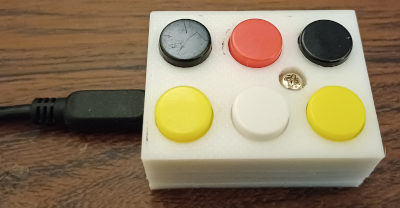
They say Rome wasn’t built in a day, but this great little music-controlling macro pad by [nibbler] actually was. Why? Because as Hackaday’s own [Donald Papp] reminded us, we all need a win sometimes, especially as projects drag on and on without any end in sight.

A small macro pad with six buttons.
Image by [nibbler] via Toxic Antidote
As [nibbler] points out, what really constitutes a win? Set the bar too low and it won’t feel like one at all. Too high, and you may become too discouraged to cross the finish line. With that in mind, [nibbler] set the bar differently, limiting themselves to what could be done in the one day per week they have to devote time to electronic matters.

One-day turnaround usually means using parts on hand and limiting oneself to already-learned skills and techniques. No problem for [nibbler], who, armed with an Arduino Leonardo Tiny and a some colorful push buttons, set about designing a suitable enclosure, and then putting it all together. Was this a win? [nibbler] says yes, and so do I.

Continue reading “Keebin’ With Kristina: The One With The 24-Hour Macro Pad” →

Hackaday Links Column Banner

Hackaday Links: July 14, 2024

We’ve been going on at length in this space about the death spiral that AM radio seems to be in, particularly in the automotive setting. Car makers have begun the process of phasing AM out of their infotainment systems, ostensibly due to its essential incompatibility with the electronics in newer vehicles, especially EVs. That argument always seemed a little specious to us, since the US has an entire bureaucracy dedicated to making sure everyone works and plays well with each other on the electromagnetic spectrum. The effort to drop AM resulted in pushback from US lawmakers, who threatened legislation to ensure every vehicle has the ability to receive AM broadcasts, on the grounds of its utility in a crisis and that we’ve spent billions ensuring that 80% of the population is within range of an AM station.

Continue reading “Hackaday Links: July 14, 2024” →

It’s Not Unusual To Love Hacking

Most of what we do here at Hackaday is look out for cool projects and then write them up so that you all know about them. Nothing is better than being really stoked about a clever hack and then being able to share it with tens of thousands of like-minded folks. Sure, it’s our job, but we really do it because we love to share. And it’s clear that you all do too! After all, we write up the hacks that you document for us.

We recently featured a hack where the guy who did the work in question said that he didn’t think it was “worthy of Hackaday”. (Of course, it was!) And I don’t like that sentiment at all, honestly, because a hack that you enjoyed doing is a hack worth sharing, even if just for sharing the joy of doing it, and that came across fully.

Of course we gladly feature the ultra-bravado hacks where the nearly impossible is made real. But there’s equal value in the simple hacks that inspire others to pursue one odd path or another. Or even pieces where there’s no hack involved, but simply the sharing of something cool.

This week, [Arya Voronova] wrote a piece about her experience using MicroPython on embedded devices, and it apparently resonated with a lot of our readers. It’s not a deep-dive into MicroPython, or a mind-bending abuse of the language. Instead, it’s a simple “this is what I love about doing things this way”, and that’s a great perspective that often gets lost when we get deep in the technical weeds.

I had the same realization a few months back at Hackaday Europe. In the lightning talks, most everyone gave talks about cool projects that they are working on, and they’re absolutely worth watching for that. [Jaap Meijers] gave a wonderful talk about making animated QR codes, but it wasn’t about how he invented animated QR codes, because he was just using someone else’s project. Instead, it was about how neat he thought someone else’s work was, and how he really wanted to share it with us. (And now you know too.)

Epic hacks are fantastic, no question. But the simple expression of the love of hacking, whether in words or in the doing, is equally important. Show us your work, but don’t forget to show us your joy along the way.