Snails, Sensors, And Smart Dust: The Michigan Micro Mote

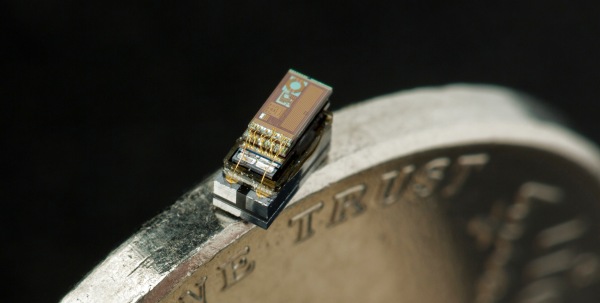
If you want to track a snail, you need a tiny instrumentation package. How do you create an entire data acquisition system, including sensors, memory, data processing and a power supply, small enough to fit onto a snail’s shell?

Throughout history, humans have upset many ecosystems around the world by introducing invasive species. Australia’s rabbits are a famous example, but perhaps less well-known are the Giant African land snails (Lissachatina fulica) that were introduced to South Pacific islands in the mid-20th century. Originally intended as a food source (escargot africain, anyone?), they quickly turned out to be horrible pests, devouring local plants and agricultural crops alike.

Not to be deterred, biologists introduced another snail, hoping to kill off the African ones: the Rosy Wolfsnail (Euglandina rosea), native to the Southeastern United States. This predatory snail did not show great interest in the African intruders however, and instead went on to decimate the indigenous snail population, driving dozens of local species into extinction.
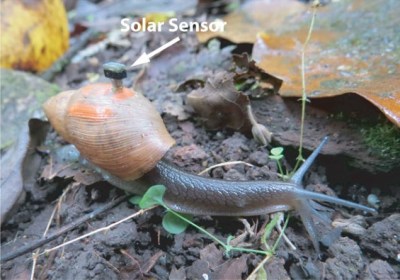
A snail with a solar sensor attached to its shell
A Rosy Wolfsnail carrying a light sensing Micro Mote on its back. Source: Cindy S. Bick et al., 2021

One that managed to survive the onslaught is a small white snail called Partula hyalina. Confined to the edges of the tropical forests of Tahiti, biologists hypothesized that it was able to avoid the predators by hiding in sunny places which were too bright for E. rosea. The milky-white shells of P. hyalina supposedly protected them from overheating by reflecting more sunlight than the wolf snails’ orange-brown ones.

This sounds reasonable, but biologists need proof. So a team from the University of Michigan set up an experiment to measure the amount of solar radiation experienced by both snail types. They attached tiny light sensors to the wolf snails’ shells and then released them again. The sensors measured the amount of sunlight seen by the animals and logged this information during a full day. The snails were then caught again and the data retrieved, and the results proved the original hypothesis.

So much for science, but exactly how did they pull this off? Continue reading “Snails, Sensors, And Smart Dust: The Michigan Micro Mote”
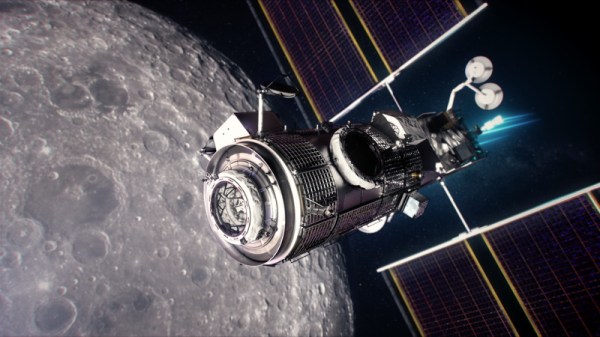

NASA Sets Eyes On Deep Space With Admin Shuffle

Since the Apollo 17 crew returned from the Moon in 1972, human spaceflight has been limited to low Earth orbit (LEO). Whether they were aboard Skylab, Mir, the Space Shuttle, a Soyuz capsule, or the International Space Station, no crew has traveled more than 600 kilometers (372 miles) or so from the Earth’s surface in nearly 50 years. Representatives of the world’s space organizations would say they have been using Earth orbit as a testing ground for the technology that will be needed for more distant missions, but those critical of our seemingly stagnated progress into the solar system would say we’ve simply been stuck.

Many have argued that the International Space Station has consumed an inordinate amount of NASA’s time and budget, making it all but impossible for the agency to formulate concrete plans for crewed missions beyond Earth orbit. The Orion and SLS programs are years behind schedule, and the flagship deep space excursions that would have utilized them, such as the much-touted Asteroid Redirect Mission, never materialized. The cracks are even starting to form in the Artemis program, which appears increasingly unlikely to meet its original goal of returning astronauts to the Moon’s surface by 2024.

But with the recent announcement that NASA will be splitting the current Human Exploration and Operations Mission Directorate into two distinct groups, the agency may finally have the administrative capacity it needs to juggle their existing LEO interests and deep space aspirations. With construction of the ISS essentially complete, and the commercial spaceflight market finally coming together, the reorganization will allow NASA to start shifting the focus of their efforts to more distant frontiers such as the Moon and Mars.

Continue reading “NASA Sets Eyes On Deep Space With Admin Shuffle”

The Coming Copper Shortage: Aluminium Or Carbon Nanotubes To The Rescue?

The use of aluminium in wiring is unlikely to bring a smile to the face of anyone who has had to deal with it in a 1960s, or early 1970s-era house. The causes behind the fires and other accidents were myriad, including failure to deal with the higher thermal expansion of aluminium, the electrically insulating nature of aluminium oxide, and the general brittleness of aluminium when twisted.

Yet while copper is superior to aluminium in terms of electrical conductivity and ease of installation, copper prices have skyrocketed since the 1970s, and are on the verge of taking off to the moon. A big part of the reason is the increased use of copper in everything from electronics and electrical motors to generators, driven by large-scale deployment of wind turbines and electrical vehicles.

As the world moves to massively expand the use of electrical cars and installation of wind turbines, copper demand is predicted to outstrip current copper supply. With aluminium likely to make a big return as a result, it’s worth taking a look at modern-day aluminium-based wiring, including copper-clad aluminium and the use of carbon-based replacements. Continue reading “The Coming Copper Shortage: Aluminium Or Carbon Nanotubes To The Rescue?”

101 Uses For An Everready — Flashlight History

For some reason, I’m always interested in why things are called what they are. For example, I’ve been compelled in the past to research what Absorbine Senior is. Not that it is important, but Absorbine Junior is a smaller size of horse liniment, so you don’t have to buy a drum of ordinary Absorbine just to rub down your sore thumb. So it isn’t a mystery that I would find myself musing over why we call a flashlight a flashlight.

You don’t think of a flashlight as flashing, under normal circumstances, at least. Turns out the answer lies in the history of the device, its poor beginnings, and our willingness to treat imperfect components as though they were much better than they are. That last point, by the way, still has ramifications today, so even if you aren’t a fan of flashlight history, keep reading.

Portable Lighting

Ever since people learned to use fire, there’s been a desire for portable lighting. Torches, candles, and even oil lamps have all had their place. But burning things for light in small cramped spaces leaves a lot to be desired. It isn’t surprising that people quickly turned to electricity when that seemed to be feasible.

Continue reading “101 Uses For An Everready — Flashlight History”

Teardown: Sling Adapter

The consumer electronics space is always in a state of flux, but perhaps nowhere is this more evident than with entertainment equipment. In the span of just a few decades we went from grainy VHS tapes on 24″ CRTs to 4K Blu-rays on 70″ LED panels, only to end up spending most of our viewing time watching streaming content on our smartphones. There’s no sign of things slowing down, either. In fact they’re arguably speeding up. Sure that 4K TV you bought a couple years back might have HDR, but does it have HDMI 2.1 and Dolby Vision?

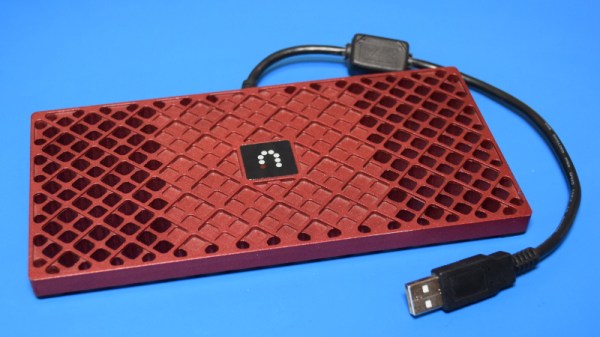
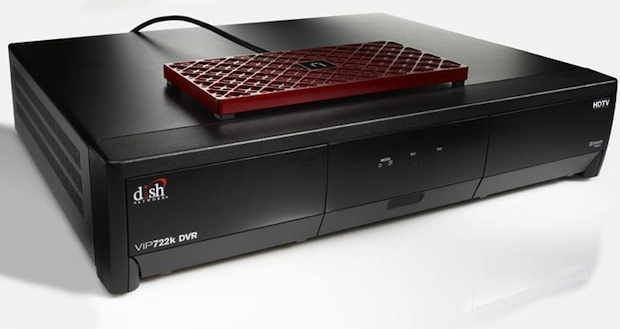
So it’s little surprise that eBay is littered with outdated A/V gadgets that can be had for a pennies on the dollar. Take for example the SB700-100 Sling Adapter we’re looking at today. This device retailed for $99 when it was released in 2010, and enabled Dish Network users to stream content saved on their DVR to a smartphone or tablet. Being able to watch full TV shows and movies on a mobile device over the Internet was a neat trick back then, before Netflix had even started rolling out their Android application. But today it’s about as useful as an HD-DVD drive, which is why you can pick one up for as little as $5.

Of course, that’s only a deal if you can actually do something with the device. Contemporary reviews seemed pretty cagey about how the thing actually worked, explaining simply that plugging it into your Dish DVR imbued the set-top box with hitherto unheard of capabilities. They assured the reader that the performance was excellent, and that it would be $99 well spent should they decide to dive headfirst into this brave new world where your favorite TV shows and movies could finally be enjoyed in the bathroom.

Now, more than a decade after its release, we’ll crack open the SB700-100 Sling Adapter and see if we can’t figure out how this unusual piece of tech actually worked. Its days of slinging the latest episode of The Office may be over, but maybe this old dog can still learn a few new tricks.

Continue reading “Teardown: Sling Adapter”

Illustrated Kristina with an IBM Model M keyboard floating between her hands.

Keebin’ With Kristina: The One Where Shift Happens

It’s been an exciting few weeks for me personally on the clacking front. I got a couple of new-to-me keyboards including my first one with ALPS switches, an old TI/99A keyboard with Futaba MD switches, and a couple of what are supposed to be the original Cherry switches (oh man they clack so nicely!) But enough about my keyboard-related fortuitousness, and on to the hacks and clacks!

Putting My Pedals to the Metal

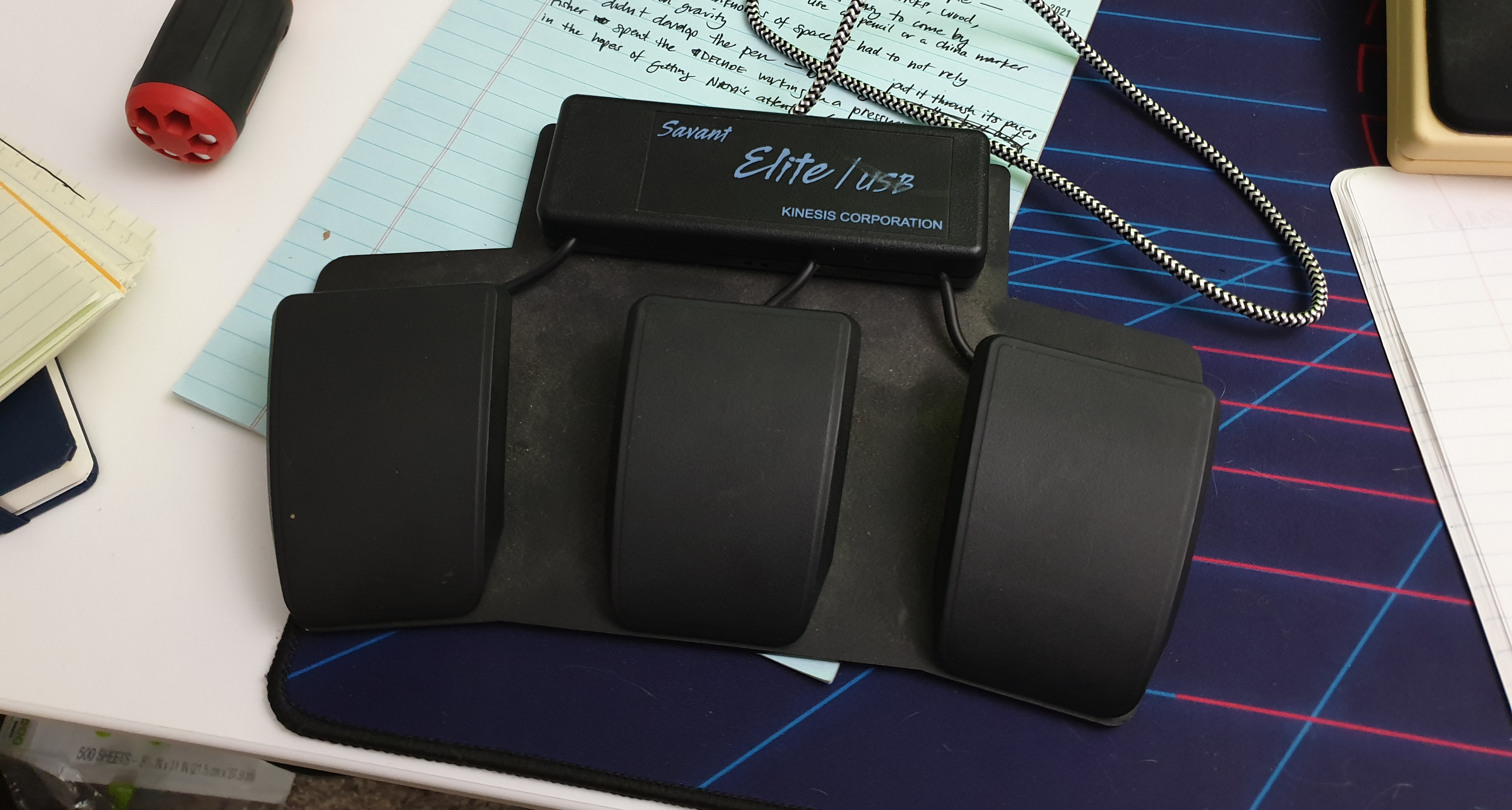
Kinesis Savant Elite triple foot pedal. It's a keyboard for your feet!I picked up this Kinesis Savant Elite triple foot pedal from Goodwill. It works fine, but I don’t like the way it’s programmed — left arrow, right arrow, and right mouse click. I found the manual and the driver on the Kinesis website easily enough, but I soon learned that you need a 32-bit computer to program it. Period. See, Kinesis never wrote an updated driver for the original Savant Elite pedal, they just came out with a new one and people had to fork over another $200 or figure something else out.

I’m fresh out of 32-bit computers, so I tried running the program in XP-compatibility mode like the manual says, but it just doesn’t work. Oh, and the manual says you can brick it if you don’t do things correctly, so that’s pretty weird and scary. It was about this time that I started to realize how easy it would be to open it up and just replace the controller with something much more modern. Once I got inside, I saw that all three switches use JST plugs and right angle header. Then I though hey, why not just re-use this set-up? I might have to make a new board, but it how awesome would it be to plug these pedals’ JSTs into my own board?

Continue reading “Keebin’ With Kristina: The One Where Shift Happens”

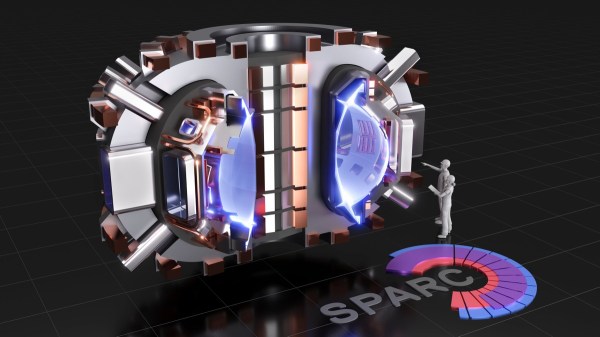
Image of CFS's SPARC reactor

Commonwealth Fusion’s 20 Tesla Magnet: A Bright SPARC Towards Fusion’s Future

After decades of nuclear fusion power being always ten years away, suddenly we are looking at a handful of endeavours striving to be the first to Q > 1, the moment when a nuclear fusion reactor will produce more power than is required to drive the fusion process in the first place. At this point the Joint European Torus (JET) reactor holds the world record with a Q of 0.67.

At the same time, a large international group is busily constructing the massive ITER tokamak test reactor in France, although it won’t begin fusion experiments until the mid-2030s. The idea is that ITER will provide the data required to construct the first DEMO reactors that might see viable commercial fusion as early as the 2040s, optimistically.

And then there’s Commonwealth Fusion Systems (CFS), a fusion energy startup.  Where CFS differs is that they don’t seek to go big, but instead try to make a tokamak system that’s affordable, compact and robust. With their recent demonstration of a 20 Tesla (T) high-temperature superconducting (HTS) rare-earth barium copper oxide (ReBCO) magnet field coil, they made a big leap towards their demonstration reactor: SPARC.

A Story of Tokamaks

CFS didn’t appear out of nowhere. Their roots lie in the nuclear fusion research performed since the 1960s at MIT, when a scientist called Bruno Coppi was working on the Alcator A (Alto Campo Toro being Italian for High Field Torus) tokamak, which saw first plasma in 1972. After a brief period with a B-revision of Alcator, the Alcator C was constructed with a big power supply upgrade. Continue reading “Commonwealth Fusion’s 20 Tesla Magnet: A Bright SPARC Towards Fusion’s Future”