Toyota’s Hydrogen-Burning Racecar Soon To Hit The Track

With the rise of usable electric cars in the marketplace, and markets around the world slowly phasing out the sale of fossil fuel cars, you could be forgiven for thinking that the age of the internal combustion engine is coming to an end. History is rarely so cut and dry, however, and new technologies aim to keep the combustion engine alive for some time yet.

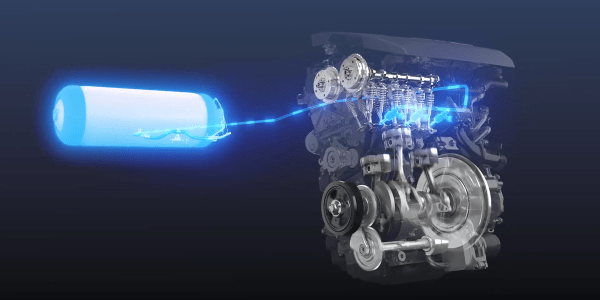
Toyota’s upcoming Corolla Sport-based hydrogen-burning racer. Credit: Toyota media

One of the most interesting technologies in this area are hydrogen-burning combustion engines. In contrast to fuel cell technologies, which combine hydrogen with oxygen through special membranes in order to create electricity, these engines do it the old fashioned way – in flames. Toyota has recently been exploring the technology, and has announced a racecar sporting a three-cylinder hydrogen-burning engine will compete in this year’s Fuji Super TEC 24 Hour race.

Hydrogen Engines?

The benefit of a hydrogen-burning engine is that unlike burning fossil fuels, the emissions from burning hydrogen are remarkably clean. Burning hydrogen in pure oxygen produces only water as a byproduct. When burned in atmospheric air, the result is much the same, albeit with small amounts of nitrogen oxides produced. Thus, there’s great incentive to explore the substitution of existing transportation fuels with hydrogen. It’s a potential way to reduce pollution output while avoiding the hassles of long recharge times with battery electric technologies. Continue reading “Toyota’s Hydrogen-Burning Racecar Soon To Hit The Track”

Historical Hackers: Emergency Antennas Launched By Kite

Your airplane has crashed at sea. You are perched in a lifeboat and you need to call for help. Today you might reach for a satellite phone, but in World War II you would more likely turn a crank on a special survival radio.

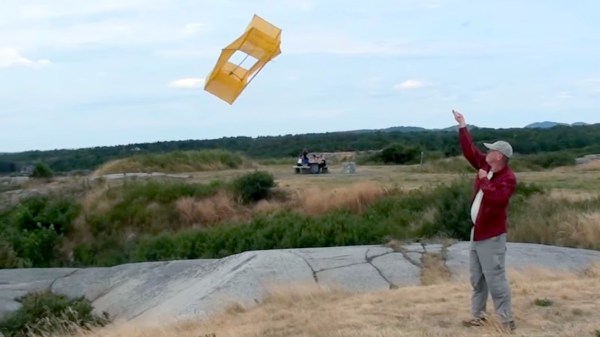
These radios originated in Germany but were soon copied by the British and the United States. In addition to just being a bit of history, we can learn a few lessons from these radios. The designers clearly thought about the challenges stranded personnel would face and came up with novel solutions. For example, how do you loft a 300-foot wire up to use as an antenna? Would you believe a kite or even a balloon?

Continue reading “Historical Hackers: Emergency Antennas Launched By Kite”

Simple Encryption You Can Do On Paper

It’s a concern for Europeans as it is for people elsewhere in the world: there have been suggestions among governments to either outlaw, curtail, or backdoor strong end-to-end encryption. There are many arguments against ruining encryption, but the strongest among them is that encryption can be simple enough to implement that a high-school student can understand its operation, and almost any coder can write something that does it in some form, so to ban it will have no effect on restricting its use among anyone who wants it badly enough to put in the effort to roll their own.

With that in mind, we’re going to have a look at the most basic ciphers, the kind you could put together yourself on paper if you need to.

Continue reading “Simple Encryption You Can Do On Paper”

The Mysterious Wobble Of Muons

You might think that particle physicists would be sad when an experiment comes up with different results than their theory would predict, but nothing brightens up a field like unexplained phenomena.  Indeed, particle physicists have been feverishly looking for deviations from the Standard Model. This year, there have been tantalizing signs that a long unresolved discrepancy between theory and experiment will be confirmed by new experimental results.

In particular, the quest to measure the magnetic moment of muons started more than 60 years ago, and this has been measured ever more precisely since. From an experiment in 1959 at CERN in Switzerland, to the turn of the century at Brookhaven, to this year’s result at Fermilab, the magnetic moment of the muon seems to be at odds with theoretical predictions.

Although a statistical fluke is basically excluded, this value also relies on complex theoretical calculations that are not all in agreement. Instead of heralding a new era of physics, it might just be another headline too good to be true. But some physicists are mumbling “new particle” in hushed tones. Let’s see what all the fuss is about.

Continue reading “The Mysterious Wobble Of Muons”

The Russian Woodpecker: Official Bird Of The Cold War Nests In Giant Antenna

On July 4th, 1976, as Americans celebrated the country’s bicentennial with beer and bottle rockets, a strong signal began disrupting shortwave, maritime, aeronautical, and telecommunications signals all over the world. The signal was a rapid 10 Hz tapping that sounded like a woodpecker or a helicopter thup-thupping on the roof. It had a wide bandwidth of 40 kHz and sometimes exceeded 10 MW.

This was during the Cold War, and plenty of people rushed to the conclusion that it was some sort of Soviet mind control scheme or weather control experiment. But amateur radio operators traced the mysterious signal to an over-the-horizon radar antenna near Chernobyl, Ukraine (then part of the USSR) and they named it the Russian Woodpecker. Here’s a clip of the sound.

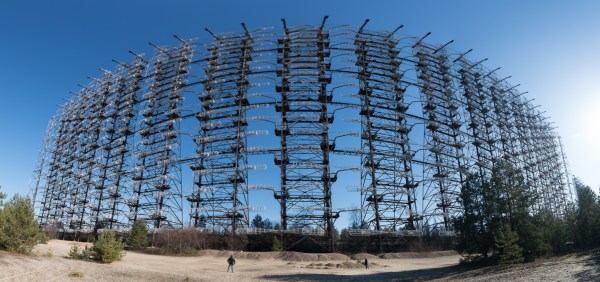
The frequency-hopping Woodpecker signal was so strong that it made communication impossible on certain channels and could even be heard across telephone lines when conditions were right. Several countries filed official complaints with the USSR through the UN, but there was no stopping the Russian Woodpecker. Russia wouldn’t even own up to the signal’s existence, which has since been traced to an immense antenna structure that is nearly half a mile long and at 490 feet, stands slightly taller than the Great Pyramid at Giza.

This imposing steel structure stands within the irradiated forest near Pripyat, an idyllic town founded in 1970 to house the Chernobyl nuclear plant workers. Pictured above is the transmitter, also known as Duga-1, Chernobyl-2, or Duga-3 depending on who you ask. Located 30 miles northeast of Chernobyl, on old Soviet maps the area is simply labeled Boy Scout Camp. Today, it’s all within the Chernobyl Exclusion Zone.

It was such a secret that the government denied it’s existence, yet was being heard all over the world. What was this mammoth installation used for?

Continue reading “The Russian Woodpecker: Official Bird Of The Cold War Nests In Giant Antenna”

The ARMv9 ISA, And What It Can Do For You

The number of distinct ARM Instruction Set Architectures (ISA) versions has slowly increased, with Arm adding a new version every few years. The oldest ISA version in common use today is ARMv6, with the ARMv6 ISA (ARM11) found in the original Raspberry Pi SBC and Raspberry Pi Zero (BCM2835). The ARMv6 ISA was introduced in 2002, followed by ARMv7 in 2005 (start of Cortex-A series) and ARMv8 in 2011. The latter was notable for adding 64-bit support.

With ARMv7 being the first of the Cortex cores, and ARMv8 adding 64-bit support in the form of AArch64, what notable features does ARMv9 bring to the table? As announced earlier this year, ARMv9’s focus appears to be on adding a whole host of features that should improve vector processing (vector extensions, or SVE) as well as digital signal processing (DSP) and security, with its Confidential Compute Architecture (CCA).

In addition to this, ARMv9 also includes all of the features that were added with ARMv8.1, v8.2, v8.3 and so on. In essence, this makes an ARMv9-based processor theoretically capable of going toe-to-toe with the best that Intel and AMD have to offer.

Continue reading “The ARMv9 ISA, And What It Can Do For You”

South Australia Vs. Too Much Home Solar

Once upon a time, the consensus was that renewable energy was too expensive and in too sparse supply to be a viable power source to run our proud, electrified societies on. Since then, prices of solar panels have tanked, becoming more efficient along the way, and homeowners have been installing them on their rooftops in droves.

Where once it was thought we’d never have enough solar energy, in some cities, it’s becoming all too much. In South Australia, where solar output can be huge on a sunny day, electricity authorities are facing problems with grid stability, and are taking measures to limit solar output to the grid.

Isn’t More Usually Better?

The problem faced by South Australian utilities is one of how to properly control an electrical grid with many thousands of distributed power sources. Typically, in conventional modern power grids, voltage and frequency is controlled within set limits by carefully matching the supply from major power plants with the demand from users. Fast-response plants can be brought online to meet shortfalls, and switched off when demand drops, and everything hums along nicely.

Unfortunately, solar power isn’t so easy to throttle, and even less so when it’s coming from thousands of separate households each with their own rooftop install and an inverter to feed back into the grid. This has led to authorities contemplating measures such as charging homeowners to export energy to the grid in peak periods in an effort to slow the huge uptake of home solar systems. Export limits have also been proposed for suburbs with the highest concentration of home solar, as substations in certain residential areas struggle to cope under the huge inflows of energy. Continue reading “South Australia Vs. Too Much Home Solar”