Gassing Up: Understanding The Liquid Fuel Distribution Network

When someone talks about “The Grid,” as in “dropping off the grid” or “the grid is down,” we tend to think in terms of the electromagnetic aspects of the infrastructure of modern life. The mind’s eye sees The Grid as the network of wires that moves electricity from power plants to homes and businesses, or the wires, optical cables, and wireless links that form the web of data lines that have stitched the world together informatically.

The Grid isn’t just about power and data, though. A huge portion of the infrastructure of the developed world is devoted to the simple but vital task of moving liquid fuels from one place to another as efficiently and safely as possible. This fuel distribution network, comprised of pipelines, railways, and tanker trucks, is very much part of The Grid, even if it goes largely unseen and unnoticed. At least until something major happens to shift attention to it, like the recent Colonial Pipeline cyberattack.

Continue reading “Gassing Up: Understanding The Liquid Fuel Distribution Network” →

Should I Automate This?

The short answer to the question posed in the headline: yes.

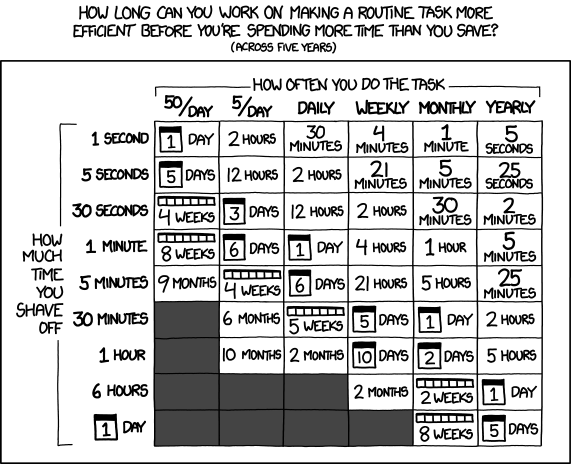
For the long answer, you have to do a little math. How much total time you will save by automating, over some reasonable horizon? It’s a simple product of how much time per occurrence, times how many times per day it happens, times the number of days in your horizon. Or skip out on the math because there’s an XKCD for that.

What’s fun about this table is that it’s kind of a Rorschach test that gives you insight into how much you suffer from automatitis. I always thought that Randall was trying to convince himself not to undertake (fun) automation projects, because that was my condition at the time. Looking at it from my current perspective, it’s a little bit shocking that something that’ll save you five seconds, five times a day, is worth spending twelve hours on. I’ve got some automating to do.

To whit: I use pass as my password manager because it’s ultimately flexible, simple, and failsafe. It stores passwords on my hard drive, and my backup server, encrypted with a GPG key that I have printed out on paper in a fireproof safe. Because I practice good cookie hygiene, I end up re-entering my passwords daily. Because I keep my passwords separate from my browser, that means entering username and password by cut-and-paste. There’s your five seconds, five times per day. Maybe two seconds, ten times, but it’s all the same. It shouldn’t take me even as long as twenty minutes to whip up a script that puts username and password into selection and clipboard for one-click pasting. Why haven’t I done this yet? I’m going to get on it as soon as I’m done with this newsletter.

But the this begs the question. If you spend up to twelve hours on every possible 25-second-per-day savings, when will you ever get your real work done? Again, math gives us the answer. One eight-hour workday * 25 seconds * 12 hours (pessimistically) of labor = 1.58 years before everything that needs automating will be. Next week’s newsletter might be a little bit delayed.

What do you see in the XKCD “Is it worth the time” table? Automate more, or step back from the cliff edge?

This Week In Security: Fragattacks, The Pipeline, Codecov, And IPv6

Some weeks are slow, and the picking are slim when discussing the latest security news. This was not one of those weeks.

First up is Fragattacks, a set of flaws in wireless security protocols, allowing unauthenticated devices to inject packets into the network, and in some cases, read data back out. The flaws revolve around 802.11’s support for packet aggregation and frame fragmentation. The whitepaper is out, so let’s take a look.

Fragmentation and aggregation are techniques for optimizing wireless connections. Packet aggregation is the inclusion of multiple IP packets in a single wireless frame. When a device is sending many small packets, it’s more efficient to send them all at once, in a single wireless frame. On the other hand, if the wireless signal-to-noise ratio is less than ideal, shorter frames are more likely to arrive intact. To better operate in such an environment, long frames can be split into fragments, and recombined upon receipt.

There are a trio of vulnerabilities that are built-in to the wireless protocols themselves. First up is CVE-2020-24588, the aggregation attack. To put this simply, the aggregation section of a wireless frame header is unauthenticated and unencrypted. How to exploit this weakness isn’t immediately obvious, but the authors have done something clever.

First, for the purposes of explanation, we will assume that there is already a TCP connection established between the victim and an attacker controlled server. This could be as simple as an advertisement being displayed on a visited web page, or an image linked to in an email. We will also assume that the attacker is performing a Man in the Middle attack on the target’s wireless connection. Without the password, this only allows the attacker to pass the wireless frames back and forth unmodified, except for the aggregation header data, as mentioned. The actual attack is to send a special IP packet in the established TCP connection, and then modify the header data on the wireless frame that contains that packet.

When the victim tries to unpack what it believes to be an aggregated frame, the TCP payload is interpreted as a discrete packet, which can be addressed to any IP and port the attacker chooses. To put it more simply, it’s a packet within a packet, and the frame aggregation header is abused to pop the internal packet out onto the protected network. Continue reading “This Week In Security: Fragattacks, The Pipeline, Codecov, And IPv6” →


Something’s Up In Switzerland: Explaining The B Meson News From The Large Hadron Collider

Particle physics is a field of extremes. Scales always have 10really big number associated. Some results from the Large Hadron Collider Beauty (LHCb) experiment have recently been reported that are statistically significant, and they may have profound implications for the Standard Model, but it might also just be a numbers anomaly, and we won’t get to find out for a while. Let’s dive into the basics of quantum particles, in case your elementary school education is a little rusty.

It all starts when one particle loves another particle very much and they are attracted to each other, but then things move too fast, and all of a sudden they’re going in circles in opposite directions, and then they break up catastrophically…

Continue reading “Something’s Up In Switzerland: Explaining The B Meson News From The Large Hadron Collider” →

Toyota’s Hydrogen-Burning Racecar Soon To Hit The Track

With the rise of usable electric cars in the marketplace, and markets around the world slowly phasing out the sale of fossil fuel cars, you could be forgiven for thinking that the age of the internal combustion engine is coming to an end. History is rarely so cut and dry, however, and new technologies aim to keep the combustion engine alive for some time yet.

Toyota’s upcoming Corolla Sport-based hydrogen-burning racer. Credit: Toyota media

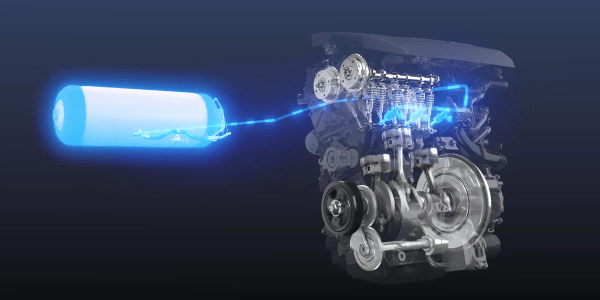
One of the most interesting technologies in this area are hydrogen-burning combustion engines. In contrast to fuel cell technologies, which combine hydrogen with oxygen through special membranes in order to create electricity, these engines do it the old fashioned way – in flames. Toyota has recently been exploring the technology, and has announced a racecar sporting a three-cylinder hydrogen-burning engine will compete in this year’s Fuji Super TEC 24 Hour race.

Hydrogen Engines?

The benefit of a hydrogen-burning engine is that unlike burning fossil fuels, the emissions from burning hydrogen are remarkably clean. Burning hydrogen in pure oxygen produces only water as a byproduct. When burned in atmospheric air, the result is much the same, albeit with small amounts of nitrogen oxides produced. Thus, there’s great incentive to explore the substitution of existing transportation fuels with hydrogen. It’s a potential way to reduce pollution output while avoiding the hassles of long recharge times with battery electric technologies. Continue reading “Toyota’s Hydrogen-Burning Racecar Soon To Hit The Track” →

Historical Hackers: Emergency Antennas Launched By Kite

Your airplane has crashed at sea. You are perched in a lifeboat and you need to call for help. Today you might reach for a satellite phone, but in World War II you would more likely turn a crank on a special survival radio.

These radios originated in Germany but were soon copied by the British and the United States. In addition to just being a bit of history, we can learn a few lessons from these radios. The designers clearly thought about the challenges stranded personnel would face and came up with novel solutions. For example, how do you loft a 300-foot wire up to use as an antenna? Would you believe a kite or even a balloon?

Continue reading “Historical Hackers: Emergency Antennas Launched By Kite” →

Simple Encryption You Can Do On Paper

It’s a concern for Europeans as it is for people elsewhere in the world: there have been suggestions among governments to either outlaw, curtail, or backdoor strong end-to-end encryption. There are many arguments against ruining encryption, but the strongest among them is that encryption can be simple enough to implement that a high-school student can understand its operation, and almost any coder can write something that does it in some form, so to ban it will have no effect on restricting its use among anyone who wants it badly enough to put in the effort to roll their own.

With that in mind, we’re going to have a look at the most basic ciphers, the kind you could put together yourself on paper if you need to.

Continue reading “Simple Encryption You Can Do On Paper” →