Hackaday Podcast 119: Random Robot Writing, Slithering Snake Shenanigans, And Phased Array Phenomena

Hackaday editors Mike Szczys and Elliot Williams pick up on the neatest hacks you may have missed. We start off with another “What’s that Sound?” so put your geeky-ears to the test and win a Hackaday Podcast T-shirt. Here are a couple of classic hacks to bring you joy: music based on Markov chains, and a squiggly take on the classic Nokia game of snake. For the more hardcore science geeks we dive into the B Meson news coming out of CERN’s physics experiments. And after taking a detour in bristle-bot-based pen plotting, we unpack the hidden system of pipes that carry oil, gas, diesel, and more from the refinery to your region.

Take a look at the links below if you want to follow along, and as always, tell us what you think about this episode in the comments!

Direct download (The best 57 MB you’ll download all day!)

Places to follow Hackaday podcasts:

Continue reading “Hackaday Podcast 119: Random Robot Writing, Slithering Snake Shenanigans, And Phased Array Phenomena” →

This Week In Security: Watering Hole Attackception, Ransomware Trick, And More Pipeline News

In what may be a first for watering hole attacks, we’ve now seen an attack that targeted watering holes, or at least water utilities. The way this was discovered is a bit bizarre — it was found by Dragos during an investigation into the February incident at Oldsmar, Florida. A Florida contractor that specializes in water treatment runs a WordPress site that hosted a data-gathering script. The very day that the Oldsmar facility was breached, someone from that location visited the compromised website.

You probably immediately think, as the investigators did, that the visit to the website must be related to the compromise of the Oldsmar treatment plant. The timing is too suspect for it to be a coincidence, right? That’s the thing, the compromised site was only gathering browser fingerprints, seemingly later used to disguise a botnet. The attack itself was likely carried out over Teamviewer. I will note that the primary sources on this story have named Teamviewer, but call it unconfirmed. Assuming that the breach did indeed occur over that platform, then it’s very unlikely that the website visit was a factor, which is what Dragos concluded. On the other hand, it’s easy enough to imagine a scenario where the recorded IP address from the visit led to a port scan and the discovery of a VNC or remote desktop port left open. Continue reading “This Week In Security: Watering Hole Attackception, Ransomware Trick, And More Pipeline News” →

Practical Sensors: The Hall Effect

Measuring a magnetic field can be very easy with some pretty low tech, or it can be very high tech. It just depends on what kind of measurement you need and how much effort you want to expend. The very simplest magnetic sensors are reed switches. These are basically relays with no coil. Instead of a coil, an external magnet gets close enough to make or break the contacts in the reed. You see these a lot in, for example, door alarm sensors.

Then again, there’s no real finesse to a reed. It changes state when it sees enough of a magnetic field and that’s about all. You could use a compass with some sort of detection on the needle to get some more information about the field, but not much more. That was, however, how early magnetometers worked. Today, you have lots of options, including the nearly ubiquitous Hall effect sensor.

You might use a Hall effect to measure the magnetic button on a keyboard key coming down when you press it or the open and closed state of a valve. A lot of Hall effects see service as current monitors. Since a coil generates a magnetic field proportional to the current through it, a magnetic sensor can estimate the current in a coil of wire without any physical contact. Hall effects can also watch a magnet go by in a linear motion system or a rotating system to get an idea of position or speed. For example, check out this brushless motor controller that uses three sensors to understand the motor’s position.

History

Edwin Hall identified the effect in 1879. The basic idea is simple: an electrical conductor carrying current will exhibit changes due to an external magnetic field nearby. These changes show up as voltage you measure across the conductor. Normally, the voltage across a conductor will be nearly zero, but with a magnetic field, you’ll get a non-zero reading in proportion to the magnetic field strength in a particular plane, as we’ll see shortly.

Hall effect sensors are just one type of modern magnetometer. There are many different kinds including those that use inductive pickup coils that may or may not rotate or a fluxgate, which is a special type of coil. Some use a scale or a spring to measure force against another magnet — sometimes microscopically. You can even detect a magnetic field using optical properties like the Kerr effect or Faraday rotation.

Continue reading “Practical Sensors: The Hall Effect” →

Freenode Debacle Prompts Staff Exodus, New Network

It’s no secret that Internet Relay Chat (IRC) has lost some of its appeal in recent years. These days there’s plenty of free chat platforms boasting slick web interfaces and smartphone push notifications, to say nothing of social networks like Facebook and Twitter. The ability to communicate with like minded individuals from all over the planet in real-time is now something we take for granted, so it’s little surprise that newer and flashier protocols and services have steadily eroded the IRC user base.

But there’s often a hidden cost to using these more modern communication protocols. A lack of operational transparency naturally leads to concerns over monitoring and censorship, which makes such services a poor match for the free and open source community. As such, many open projects have eschewed these newer and more popular services for IRC networks that were developed and maintained by the community itself. Among these, the best-known and most respected is Freenode. Originally started as a Linux support channel in 1995, Freenode grew to become the defacto communication and support tool for free and open source projects of all shapes and sizes, and by 2013 had officially become the largest and most active IRC network in the world.

Unfortunately, the incredible legacy of Freenode is now being jeopardized by what former staff members are describing as nothing short of a hostile takeover. Through a complex series of events which actually started several years ago, control of Freenode has been taken from the community and put into the hands of an enigmatic and wealthy entrepreneur who claims his ultimate goal is to revolutionize IRC and return it to the forefront of online communication. Here’s where it gets weird.

Continue reading “Freenode Debacle Prompts Staff Exodus, New Network” →

Do You Really Own It? Motorcycle Airbag Requires Additional Purchase To Inflate

If you ride a motorcycle, you may have noticed that the cost of airbag vests has dropped. In one case, something very different is going on here. As reported by Motherboard, you can pick up a KLIM Ai-1 for $400 but the airbag built into it will not function until unlocked with an additional purchase, and a big one at that. So do you really own the vest for $400?

Given the nature of the electronics and computer business lately, we spend a good bit of time thinking of what it means to own a piece of technology. Do you own your cable modem or cell phone if you aren’t allowed to open it up? Do you own a piece of software that wants to call home periodically and won’t let you stop it?  Sometimes it makes sense that you are paying for a service. But there have been times where, for example, a speaker company essentially bricks devices that could work fine on their own even though you — in theory — own the device.

Continue reading “Do You Really Own It? Motorcycle Airbag Requires Additional Purchase To Inflate” →

2021 Hackaday Prize: Rethink, Refresh, And Rebuild

The 2021 Hackaday Prize begins right now. Tap into your creativity and build your piece of a better future on the topics of supportive technology, everyday robotics, imaginative displays, and work-from-home innovations.

Now in its eighth year, the Hackaday Prize is a global engineering initiative that seeks out new and interesting uses of electronics and other technologies with an eye toward open source/open hardware and a goal of getting your creations out into the world.

The grand prize winner will receive $25,000 and a residency at the Supplyframe Design Lab. In addition to top prizes for the second through fifth place winners, 50 finalists will each receive a $500 prize. But you don’t need to win the Hackaday Prize to take something away. This is your calling: spend time working on those abstract ideas and figuring out how they will fit into life tomorrow, next month, or next decade. Whether it changes peoples’ lives or just brings a smile to a few faces, every interesting step forward is an example where people had ideas so crazy they actually worked. Let’s get in on that!

There are five categories to target with your builds. If you have an idea kicking around, you can probably enter it this year.

Continue reading “2021 Hackaday Prize: Rethink, Refresh, And Rebuild” →

Telemetry Debate Rocks Audacity Community In Open Source Dustup

Starting an open source project is easy: write some code, pick a compatible license, and push it up to GitHub. Extra points awarded if you came up with a clever logo and remembered to actually document what the project is supposed to do. But maintaining a large open source project and keeping its community happy while continuing to evolve and stay on the cutting edge is another story entirely.

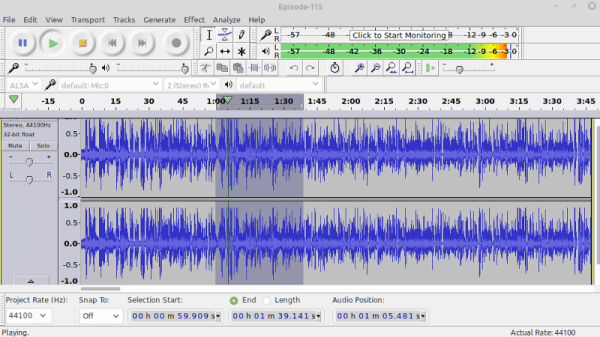
Just ask the maintainers of Audacity. The GPLv2 licensed multi-platform audio editor has been providing a powerful and easy to use set of tools for amateurs and professionals alike since 1999, and is used daily by…well, it’s hard to say. Millions, tens of millions? Nobody really knows how many people are using this particular tool and on what platforms, so it’s not hard to see why a pull request was recently proposed which would bake analytics into the software in an effort to start answering some of these core questions.

Now, the sort of folks who believe that software should be free as in speech tend to be a prickly bunch. They hold privacy in high regard, and any talk of monitoring their activity is always going to be met with strong resistance. Sure enough, the comments for this particular pull request went south quickly. The accusations started flying, and it didn’t take long before the F-word started getting bandied around: fork. If Audacity was going to start snooping on its users, they argued, then it was time to take the source and spin it off into a new project free of such monitoring.

The situation may sound dire, but truth be told, it’s a common enough occurrence in the world of free and open source software (FOSS) development. You’d be hard pressed to find any large FOSS project that hasn’t been threatened with a fork or two when a subset of its users didn’t like the direction they felt things were moving in, and arguably, that’s exactly how the system is supposed to work. Under normal circumstances, you could just chalk this one up to Raymond’s Bazaar at work.

But this time, things were a bit more complicated. Proposing such large and sweeping changes with no warning showed a troubling lack of transparency, and some of the decisions on how to implement this new telemetry system were downright concerning. Combined with the fact that the pull request was made just days after it was announced that Audacity was to be brought under new management, there was plenty of reason to sound the alarm.

Continue reading “Telemetry Debate Rocks Audacity Community In Open Source Dustup” →