Solar power is a great source of renewable energy, but has always had its limitations. At best, there’s only 1,000 Watts/m2 available at the Earth’s surface on a sunny day, and the limited efficiency of solar panels cuts this down further. It’s such a low amount that solar panels on passenger cars have been limited to menial tasks such as battery tending and running low-power ventilation fans.
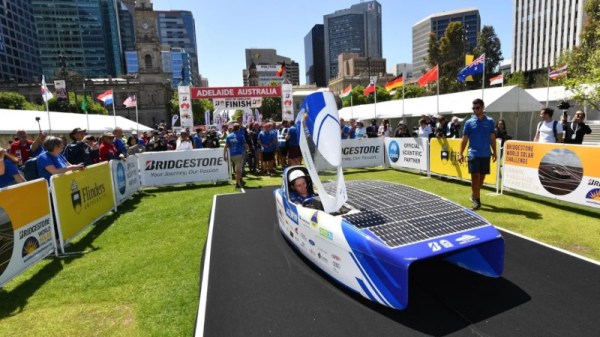
However, where some might see an impossibility, others see opportunity. The World Solar Challenge is a competition that has aimed to show the true potential of solar powered transport. Now 30 years since its inception, what used to be impossible is in fact achieved by multiple teams in under one tenth of the original time. To keep competitors on their toes, the rules have been evolving over time, always pushing the boundaries of what’s possible simply with sunlight. This isn’t mainstream transportation; this is an engineering challenge. How far can you go in a solar car?
Back before COVID-19, I was walking through the airport towards the gate when suddenly I remembered a document I wanted to read on the flight but had forgotten to bring along. No worry, I paused for a bit on the concourse, reached into my pocket and proceeded to download the document from the Internet. Once comfortably seated on the plane, I relaxed and began reading. Afterwards, I did a little programming in C on a shareware program I was developing.
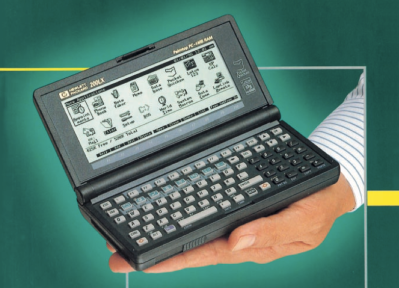
Today this would be an ordinary if not boring recollection, except for one thing: this happened in the 1990s, and what I pulled out of my pocket was a fully functional MS-DOS computer:
Introducing the HP-200LX, the first real palmtop computer. I used one of these daily up until the mid-2000s, and still have an operational one in my desk drawer. Let’s step back in time and see how this powerful pocket computer began its life. Continue reading “The First Real Palmtop”→
The big story this week is Solarwinds. This IT management company supplies network monitoring and other security equipment, and it seems that malicious code was included in a product update as early as last spring. Their equipment is present in a multitude of high-profile networks, like Fireeye, many branches of the US government, and pretty much any other large company you can think of. To say that this supply chain attack is a big deal is an understatement. The blame has initially been placed on APT42, AKA, the Russian hacking pros.
When you want to quickly pull together a combination of media and user interaction, looking to some building blocks for the heavy lifting can be a lifesaver. That’s the idea behind Max, a graphical programming language that’s gained a loyal following among anyone building art installations, technology demos (think children’s museum), and user Kiosks.
Guy Dupont gets us up to speed with a how to get started with Max workshop that was held during the 2020 Hackaday Remoticon. His crash course goes through the basics of the program, and provides a set of sixteen demos that you can play with to get your feet under you. As he puts it, if you need sound, video, images, buttons, knobs, sensors, and Internet data for both input and output, then Max is worth a look. Video of the workshop can be found below.
While some love to carve up mountain roads, and others relish the challenge of perfectly apexing every corner at the track, many crave a different challenge. Drag racing is a sport all about timing, finesse, and brute power. Like any other discipline in motorsport, to compete you’ll need a vehicle finely honed for the task at hand. Here’s how you go about getting started on your first quarter-mile monster.
It’s All About Power, Right?
It’s true that if you want to go faster, having more power on tap is a great way to do it. If that’s what you’re looking for, we’ve covered that topic in detail – for both the naturally aspirated and forced induction fans. However, anyone that’s been to the drag strip before will tell you that’s only part of the story. All of the power in the world isn’t worth jack if you can’t get it down to the ground. Even if you can, you’ve still got to keep your steering wheels planted if you intend to keep your nose out of the wall. So, if you want more power, consider the articles linked above. For everything else that’s important in drag racing, read on below.
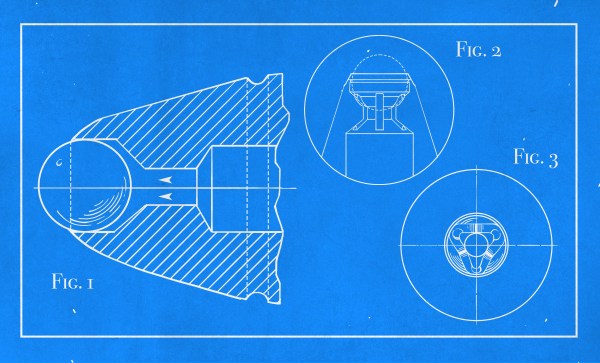
This new pen cost $12.50, which is about $180 today. For many people, the improved experience that the ballpoint promised over the fountain pen was well worth the price. You might laugh, but if you’ve ever used a fountain pen, you can understand the need for something more rugged and portable.
Ballpoint pens are everywhere these days, especially cheap ones. They’re so ubiquitous that we don’t have to carry one around or really think about them at all. Unless you’re into pens, you’ve probably never marveled at the sheer abundance of long-lasting, affordable, permanent writing instruments that are around today. Before the ballpoint, pens were a messy nuisance.
A Revolutionary Pen
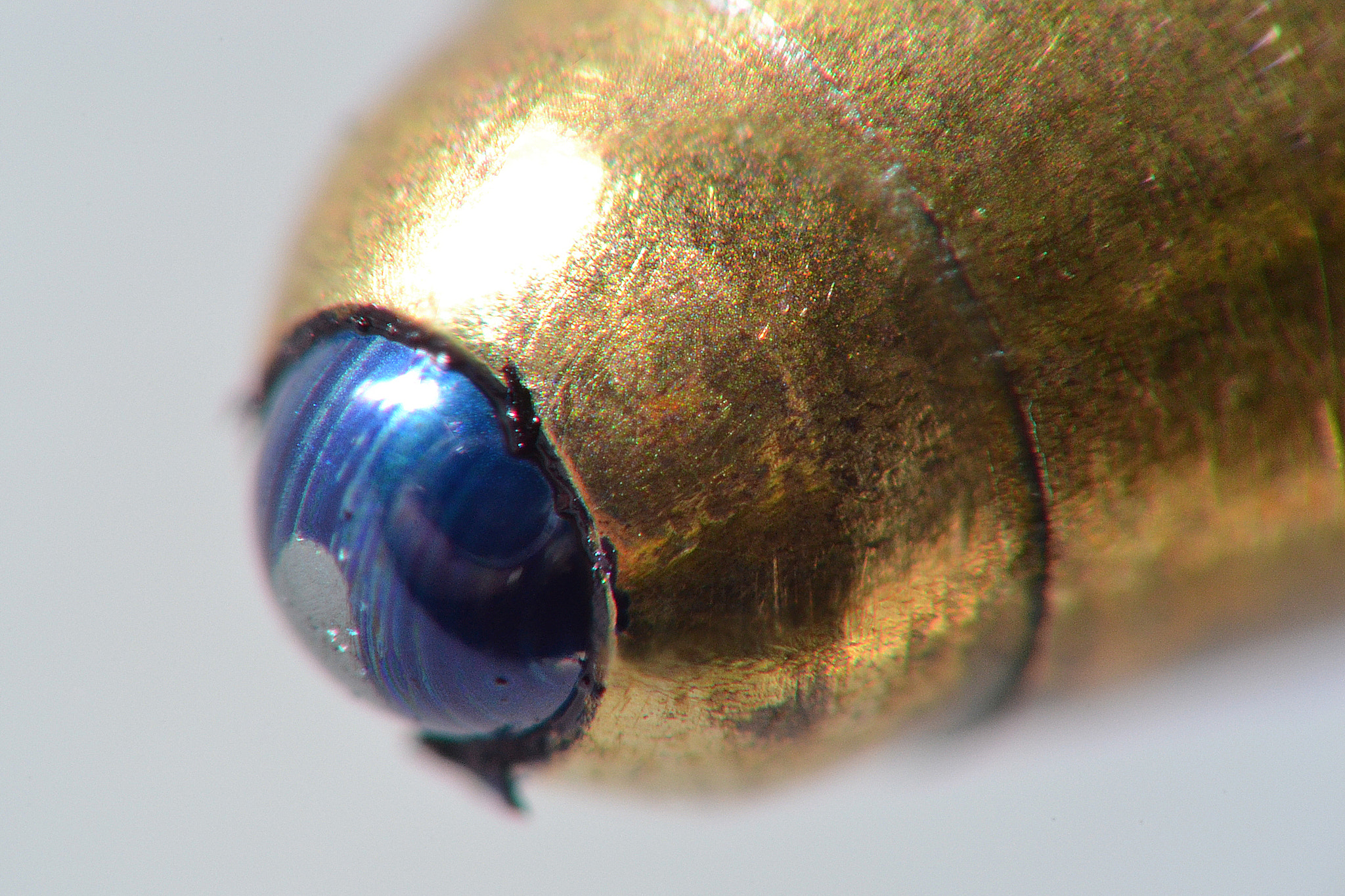
A ballpoint, up close and personal. Image via Wikipedia
Fountain pens use gravity and capillary action to evenly feed ink from a cartridge or reservoir down into the metal nib. The nib is split in two tines and allows ink to flow forth when pressed against paper. It’s not that fountain pens are that delicate. It’s just that they’re only about one step above dipping a nib or a feather directly into ink.
There’s no denying that fountain pens are classy, but you’re playing with fire if you put one in your pocket. They can be a bit messy on a good day, and the cheap ones are prone to leaking ink. No matter how nice of a fountain pen you have, it has to be refilled fairly frequently, either by drawing ink up from a bottle into the pen’s bladder or inserting a new cartridge. And you’re better off using it as often as possible, since a dormant fountain pen will get clogged with dried ink.
Early ballpoint pens were modeled after fountain pens, aesthetically speaking. They had metal bodies and refillable reservoirs that only needed a top-up every couple of years, compared to once a week or so for fountain pens. Instead of a nib, ballpoints have a tiny ball bearing made of steel, brass, or tungsten carbide. These pens rely on gravity to bathe the ball in ink, which allows it to glide around in the socket like a tiny roll-on deodorant.
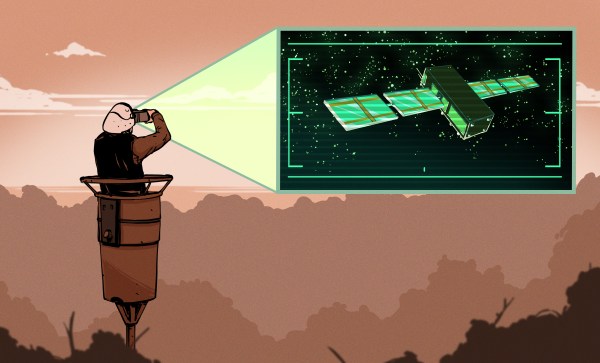
If you want to listen to satellites, you have to be able to track them as they pass over the sky. When I first started tracking amateur satellites, computing the satellite’s location in the sky was a part of the challenge. Nowadays, that’s trivial. What’s left over are all the extremely important real-world details. Let’s take a look at a typical ham satellite tracking setup and see how it all ties together.
Rotators for Steering
The popularity of robotics, 3D printing, and CNC machines has resulted in a deluge of affordable electric motors and drivers. It’s hard to imagine that an electric motor for rotating an antenna would be anything special, but in fact, antenna rotators are non-trivial engineering designs. Most of the challenges are mechanical, not electrical — the antennas that they drive can be huge, have significant wind loading and rotational inertial, and just downright weigh a lot. A rotator design has to consider bearings, weather exposure, all kinds of loads, not just rotational. And usually a brake is required to keep the antenna pointed in windy conditions.
There’s been a 70-some year history of these mechanisms from back in the 1950s when Cornell Dubilier Electronics, the company you know as a capcacitor manufacturer, began making these rotators for television antennas in the 1950s. I was a little surprised to see that the rotator systems you can buy today are not very different from the ones we used in the 1980s, other than improved electronic controls. Continue reading “Tracking Satellites: The Nitty Gritty Details”→


 Back before COVID-19, I was walking through the airport towards the gate when suddenly I remembered a document I wanted to read on the flight but had forgotten to bring along. No worry, I paused for a bit on the concourse, reached into my pocket and proceeded to download the document from the Internet. Once comfortably seated on the plane, I relaxed and began reading. Afterwards, I did a little programming in C on a shareware program I was developing.