Why Is Your Cellphone Not A More Useful Computer?

Sometimes when you are browsing randomly through the tech feeds, up pops an article that just crystallizes a nascent thought that had been simmering below the surface for a long time, and is enough to make you sit up and say “Yes! I agree completely with that!”. Such a moment came with [Cheapscatesguide]’s post: “My Fantasy: A Cellphone I can Use as a Desktop Computer“, in which the pertinent question is asked that if smartphones are so powerful, why are they not much better at being more than, well, smartphones?

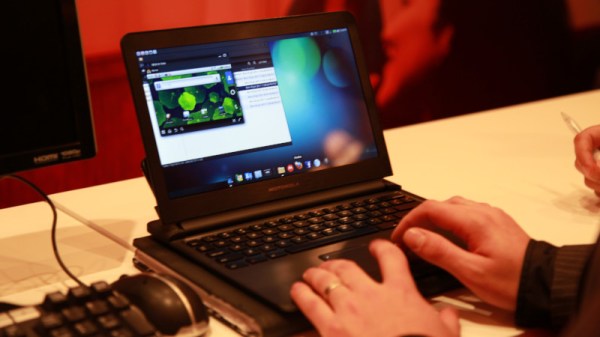
Readers with long memories may recall that the cellphone-as-computer idea is one that has been tried at least once before. The Motorola Atrix appeared in the early years of this decade, and was a high-end smartphone that could be slotted into both desktop replacement and netbook-style base stations and used as a Linux-based personal computer. Unfortunately it was both eye-wateringly expensive and disappointingly slow due to a hobbled operating system, so it failed to set the market alight. There was a brief moment when unsold Atrix netbook docks were available on the surplus market and became popular platforms as a Raspberry Pi desktop interface, but this experiment seems to have put paid to the idea of one device to truly rule them all.

If we had to hazard a guess as to why this has failed to happen, we’d finger both the manufacturer’s desire not to undermine their lucrative sales in other sectors, and both their and the carriers’ desire to lock down the devices as much as possible. A manufacturer such as Apple will for example never  produce an iPhone that can replace a desktop, because it would affect their MacBook sales. Oddly in another form we’re nearly there, this piece is being worked on with a Chromebook, a device that has a useful browser, a functional Android layer, and (because it’s a 64-bit model) an officially supported and useful Debian layer. We don’t expect this to translate into a phone any time soon though.

From another angle, we’ve asked in the past why we aren’t hacking old cellphones.

Moto Atrix lapdock picture: ETC@USC [CC BY-SA 2.0].

Via Hacker News.

Reflection On A Decade Of Hackerspace Expansion

A few days ago I was invited to a party. Party invites are always good, and if I can make it to this one I’ll definitely go. It’s from a continental European hackerspace, and it’s for their tenth birthday party. As I spent a while checking ferries and flights it struck me, a lot of the spaces in my sphere are about a decade old. I went to London Hackspace’s 10th earlier in the year, and a host of other British hackerspaces aren’t far behind. Something tells me I’ll be knocking back the Club Mate and listening to EDM of some form at more than one such party in the coming year.

For most of the decade since I found the then-recently-established mailing list of my local hackerspace I’ve spent a lot of my time involved in more than one space. I’ve been a hackerspace director, a member, and many roles in between and I’ve seen them in both good times and bad ones. Perhaps it’s time to sit back and take stock of that decade and ask a few questions about hackerspaces. How have they fared, what state are they in now, and where are they going?

Continue reading “Reflection On A Decade Of Hackerspace Expansion” →

This Week In Security: VPNs, Patch Tuesday, And Plundervault

An issue in Unix virtual private networks was disclosed recently, where an attacker could potentially hijack a TCP stream, even though that stream is inside the VPN. This attack affects OpenVPN, Wireguard, and even IPSec VPNs. How was this possible? Unix systems support all manner of different network scenarios, and oftentimes a misconfiguration can lead to problems. Here, packets sent to the VPNs IP address are processed and responded to, even though they are coming in over a different interface.

The attack initially sounds implausible, as an attacker has to know the Virtual IP address of the VPN client, the remote IP address of an active TCP connection, and the sequence and ACK numbers of that connection. That’s a lot of information, but an attacker can figure it out one piece at a time, making it a plausible attack. Continue reading “This Week In Security: VPNs, Patch Tuesday, And Plundervault” →

Supercon SMD Challenge Gets 3D Printed Probes: Build Your Own

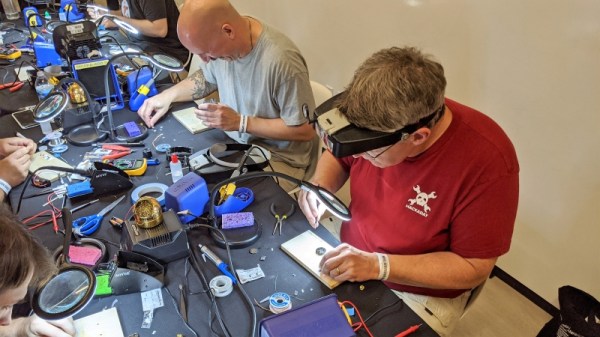
This year was the second SMD challenge at Supercon, so it stands to reason we probably learned a few things from last year. If you aren’t familiar with the challenge, you are served some pretty conventional tools and have to solder a board with LEDs getting progressively smaller until you get to 0201 components. Those are challenging even with proper tools, but a surprising number of people have managed to build them even using the clunky, large irons we provide.

During the first challenge, we did find one problem though. The LEDs are all marked for polarity. However, since we don’t provide super high power magnification, it was often difficult to determine the polarity, especially on the smaller parts. Last year, [xBeau] produced some quick LED testers to help overcome this problem. This year we refined them a bit.

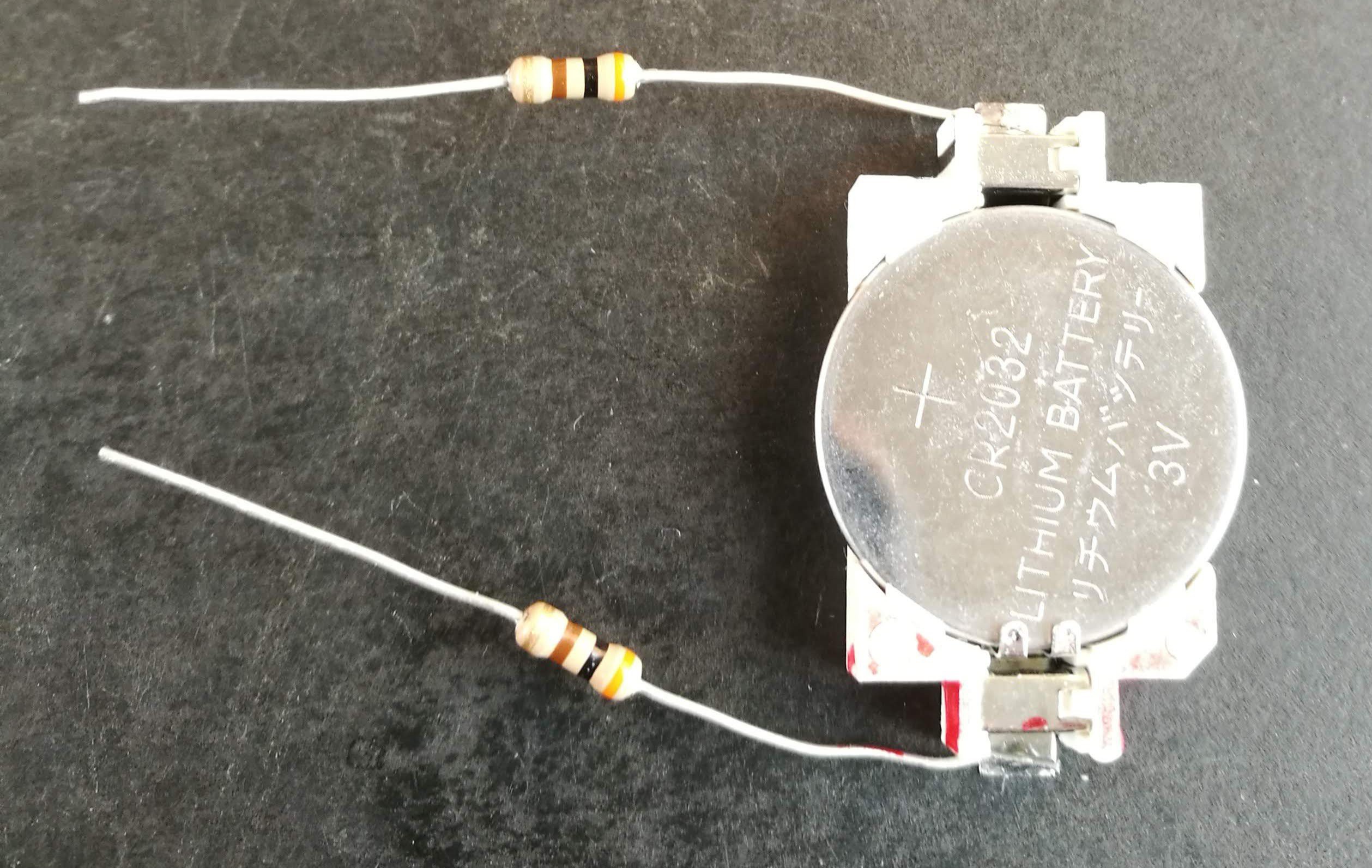
As you can see, the 2018 model was a very clever use of what was on hand. A CR2032 holder powered the probes and the probes themselves were two resistors. If you can get the LED to light with the probes you know which lead is the anode and which is the cathode. A little red ink makes it even more obvious. Continue reading “Supercon SMD Challenge Gets 3D Printed Probes: Build Your Own” →

WWII Aircraft Radio Roars To Life: What It Takes To Restore A Piece Of History

I’ve been told all my life about old-timey Army/Navy surplus stores where you could buy buckets of FT-243 crystals, radio gear, gas masks, and even a Jeep boxed-up in a big wooden crate. Sadly this is no longer the case. Today surplus stores only have contemporary Chinese-made boots, camping gear, and flashlights. They are bitterly disappointing except for one surplus store that I found while on vacation in the Adirondacks: Patriot of Lake George.

There I found a unicorn of historical significance; an un-modified-since-WW2 surplus CBY-46104 receiver with dynamotor. The date of manufacture was early-war, February 1942. This thing was preserved as good as the day it was removed from its F4F Hellcat. No ham has ever laid a soldering iron or a drill bit to it. Could this unit have seen some action in the south Pacific? Imagine the stories it could tell!

My unconventional restoration of this radio followed strict rules so as to minimize the evidence of repair both inside and out yet make this radio perform again as though it came fresh off the assembly line. Let’s see how I did.

Continue reading “WWII Aircraft Radio Roars To Life: What It Takes To Restore A Piece Of History” →

Linux Fu: Debugging Bash Scripts

A recent post about debugging constructs surprised me. There were quite a few comments about how you didn’t need a debugger, as long as you had printf. For that matter, we’ve all debugged systems where you had nothing but an LED to flash or otherwise turn on to communicate with the user. However, it is hard to deny that a debugger can help with complex code.

To say you only need printf would be like saying you only need machine language. Technically accurate — you can do anything in machine language. But it sure makes things easier to have an assembler or some language to help you work out your problem. If you write a simple bash script, you can use the equivalent to printf — maybe that’s the echo command, although there is usually a printf command on a typical system, if you want to use it. However, there are other things you can do with bash including a pretty cool debugger if you know how to find it.

I assume you already know how to use echo and printf, but let’s dig into how to use trace execution line by line without the need for echo statements on every other line. Along the way, you’ll learn how to get started with the bash debugger.

Continue reading “Linux Fu: Debugging Bash Scripts” →

Weird Substances: Hagfish Slime

In the cold, dark recesses of ocean floors around the world, hagfish slither around like sea snakes, searching for food. When a hagfish finds a suitable carcass, it devours the dead fish in two different ways. As it burrows face-first through the tissue, eating with its jaw-less, tentacled mouth, the hagfish also absorbs nutrients through its skin.

Hagfish are not the unholy result of dumping toxic waste in the ocean. They’re one of the oldest creatures on Earth, having been around for more than 300 million years. How have they lasted this long?

A coiled hagfish reveals its slime ports. Image via Oregon Coast Aquarium

These ancient creatures have no eyes, no backbones, and no scales. They are often misidentified as eel, and often called ‘slime eels’, but they are definitely fish. They just don’t look like conventional fish. In fact, when conventional, gill-faced fish come after hagfish, those guys are in for a surprise, because hagfish have a disgusting but ingenious defense mechanism.

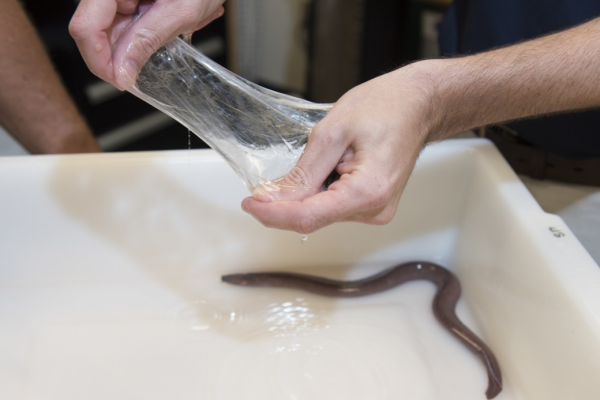
Whenever hagfish are attacked or even just stressed by nearby fish or curious grabby humans, they immediately emit amazing amounts of mucus at an alarming rate. At the same time, the hagfish shoots out silky strands of protein that hold the slime together in a cohesive blob. Any predator that tries to bite down on one of these velvety frankfurters of the deep sea will find its mouth and gills covered in a wad of suffocating slime.

How is it that hagfish haven’t slimed themselves out of existence? Whenever they get get a taste of their own medicine, these boneless noodles quickly twist themselves into a pretzel. In the same motion, they use their paddle-shaped tails to squeegee off the slime.

Continue reading “Weird Substances: Hagfish Slime” →