Learn Neural Network And Evolution Theory Fast

[carykh] has a really interesting video series which can give a beginner or a pro a great insight into how neural networks operate and at the same time how evolution works. You may remember his work creating a Bach audio producing neural network, and this series again shows his talent at explaining the complex topic so anyone may understand.

He starts with 1000 “creatures”. Each has an internal clock which acts a bit like a heart beat however does not change speed throughout the creature’s life. Creatures also have nodes which cause friction with the ground but don’t collide with each other. Connecting the nodes are muscles which can stretch or contract and have different strengths.

At the beginning of the simulation the creatures are randomly generated along with their random traits. Some have longer/shorter muscles, while node and muscle positions are also randomly selected. Once this is set up they have one job: move from left to right as far as possible in 15 seconds.

Each creature has a chance to perform and 500 are then selected to evolve based on how far they managed to travel to the right of the starting position. The better the creature performs the higher the probability it will survive, although some of the high performing creatures randomly die and some lower performers randomly survive. The 500 surviving creatures reproduce asexually creating another 500 to replace the population that were killed off.

The simulation is run again and again until one or two types of species start to dominate. When this happens evolution slows down as the gene pool begins to get very similar. Occasionally a breakthrough will occur either creating a new species or improving the current best species leading to a bit of a competition for the top spot.

We think the series of four short YouTube videos (all around 5 mins each) that kick off the series demonstrate neural networks in a very visual way and make it really easy to understand. Whether you don’t know much about neural networks or you do and want to see something really cool, these are worthy of your time.

Continue reading “Learn Neural Network And Evolution Theory Fast”
How To Trick Your Electrical Meter By Saving Power

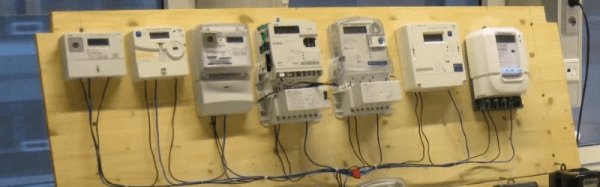
A group of Dutch scientists have been testing out some of today’s “smart” electrical meters to check their accuracy, among other things. Not ones to disappoint, the scientists have found consistently false readings that in some cases are 582% higher than actual energy consumption.

With experiments lasting for six months, the researchers tried to focus on meters representative of those commonly used in the Netherlands and manufactured between 2004 and 2014. Moreover, the researchers tried to reproduce standard household energy consumption patters rather than focusing on stress tests.

Their results? Well, “results varied wildly, with some meters reporting errors way above their disclosed range, going from -32% to +582%. Tests with uncommon results were repeated several times and the results were within a few percents of the original.” Moreover, “The greatest inaccuracies were seen when researchers combined dimmers with energy saving light bulbs and LED bulbs.” Not constrained to energy saving light bulbs, the inaccuracies are, ironically, tied to devices with integrated energy saving features. (Certainly makes us want to keep a close eye on our electric meters.)

“The reason for faulty readings appears to be the current sensor, and the associated circuitry,” said researchers. “The experimental results […] show that static energy meters can be pushed into faulty reading (positive and negative) if sufficiently fast pulsed currents are drawn by the consumer”

It is worth noting that there is contradictory research published by “the European voice of the providers of smart energy solutions” that maintains that “there is no reason to question smart metering technology”. Still, we wouldn’t blame you if you wanted a second opinion.

Thanks [acs] for sending this in!

The Shocking Truth About Transformerless Power Supplies

Transformerless power supplies are showing up a lot here on Hackaday, especially in inexpensive products where the cost of a transformer would add significantly to the BOM. But transformerless power supplies are a double-edged sword. That title? Not clickbait. Poking around in a transformerless-powered device can turn your oscilloscope into a smoking pile or get you electrocuted if you don’t understand them and take proper safety precautions.

But this isn’t a scare piece. Transformerless designs are great in their proper place, and you’re probably going to encounter one someday because they’re in everything from LED lightbulbs to IoT WiFi switches. We’re going to look at how they work, and how to design and work on them safely, because you never know when you might want to hack on one.

Here’s the punchline: transformerless power supplies are safely useable only in situations where the entire device can be enclosed and nobody can accidentally come in contact with any part of it. That means no physical electrical connections in or out — RF and IR are fair game. And when you work with one, you have to know that any part of the circuit can be at mains voltage. Now read on to see why!

Continue reading “The Shocking Truth About Transformerless Power Supplies”

How Many Parts In A Triumph Herald Heater?

This Herald is in much better condition than my 12/50 was. Philafrenzy [CC BY-SA 4.0]
What was your first car? Mine was a 1965 Triumph Herald 12/50 in conifer green, and to be frank, it was a bit of a dog.

The Triumph Herald is a small saloon car manufactured between about 1959 and 1971. If you are British your grandparents probably had one, though if you are not a Brit you may have never heard of it. Americans may be familiar with the Triumph Spitfire sports car, a derivative on a shortened version of the same platform. It was an odd car even by the standards of British cars of the 1950s and 1960s. Standard Triumph, the manufacturer, had a problem with their pressing plant being owned by a rival, so had to design a car that used pressings of a smaller size that they could do in-house. Thus the Herald was one of the last British mass-produced cars to have a separate chassis, at a time when all other manufacturers had produced moncoques for years.

My 12/50 was the sporty model, it had the high-lift cam from the Spitfire and a full-length Britax sunroof. It was this sunroof that was its downfall, when I had it around a quarter century of rainwater had leaked in and rotted its rear bodywork. This combined with the engine being spectacularly tired and the Solex carburetor having a penchant for flooding the engine with petrol made it more of a pretty thing to look at than a useful piece of transport. But I loved it, tended it, and when it finally died irreparably I broke it for parts. Since then I’ve had four other Heralds of various different varieties, and the current one, a 1960 Herald 948, I’ve owned since the early 1990s. A piece of advice: never buy version 0 of a car.

Continue reading “How Many Parts In A Triumph Herald Heater?”

Have You Ever Tried Desoldering Needles?

If you are an electronics enthusiast who has a tendency to hoard junk because it Might Be Useful Someday, you may well have a significant experience when it comes to desoldering. Why order that component, when you’ve got one on this old board?

So we’ve become experts in removing old components from dead PCBs, so when it comes to desoldering techniques you might think we’ve seen it all, there’s nothing new to learn. Then along comes [fede.tft], with a tip of a desoldering tool that’s new to us. The video below the break from [MSylvain59] demonstrates the needles in action, what do you think? Have any of you used a desoldering needle?

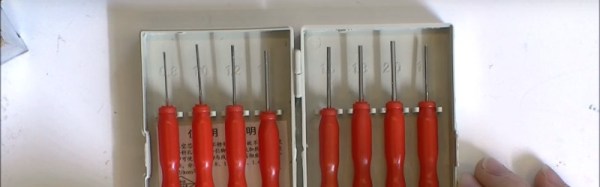
This is a set of tools you might use to desolder a through-hole component with a wire-end poking out beneath the board. The idea is that as stainless steel needles the solder won’t adhere to them, so you can select the appropriate size and use it to push out the lead from below.

We remain to be convinced, as it seems to be a slightly more fiddly way to do what we’ve used a small screwdriver for to lever from above the board for years, but it’s always worth talking about a tool that could be a useful new weapon in our armoury.

Continue reading “Have You Ever Tried Desoldering Needles?”

When The Grid Goes Dark

If you lived through the Y2K fiasco, you might remember a lot of hype with almost zero real-world ramifications in the end. As the calendar year flipped from 1999 to 2000 many forecast disastrous software bugs in machines controlling our banking and infrastructure. While this potential disaster didn’t quite live up to its expectations there was another major infrastructure problem, resulting in many blackouts in North America, that reared its head shortly after the new millennium began. While it may have seemed like Y2K was finally coming to fruition based on the amount of chaos that was caused, the actual cause of these blackouts was simply institutional problems with the power grid itself.

Continue reading “When The Grid Goes Dark”

Revealing Capcom’s Custom Silicon Security

Ask any security professional and they’ll tell you, when an attacker has hardware access it’s game over. You would think this easily applies to arcade games too — the very nature of placing the hardware in the wild means you’ve let all your secrets out. Capcom is the exception to this scenario. They developed their arcade boards to die with their secrets through a “suicide” system. All these decades later we’re beginning to get a clear look at the custom silicon that went into Capcom’s coin-op security.

Alas, this is a “part 1” article and like petulant children, we want all of our presents right now! But have patience, [Eduardo Cruz] over at ArcadeHacker is the storyteller you want to listen to on this topic. He is part of the team that figured out how to “de-suicide” the CP2 protections on old arcade games. We learned of that process last September when the guide was put out. [Eduardo] is now going through all the amazing things they learned while figuring out that process.

These machines — which had numerous titles like Super Street Fighter II and Marvel vs. Capcom — used battery-backed ram to store an encryption key. If someone tampered with the system the key would be lost and the code stored within undecipherable thanks to “two four-round Feistel ciphers with a 64-bit key”. The other scenario is that battery’s shelf life simply expires and the code is also lost. This was the real motivation behind the desuicide project.

An overview of the hardware shows that Capcom employed at least 11 types of custom silicon. As the board revisions became more eloquent, the number of chips dropped, but they continued to employ the trick of supplying each with battery power, hiding the actual location of the encryption key, and even the 68000 processor core itself. There is a 6-pin header that also suicides the boards; this has been a head-scratcher for those doing the reverse engineering. We assume it’s for an optional case-switch, a digital way to ensure you void the warranty for looking under the hood.

Thanks for walking us through this hardware [Eduardo], we can’t wait for the next installment in the series!