Review: Monoprice Maker Ultimate 3D Printer

A few months ago, a very inexpensive 3D printer appeared on Monoprice. My curiosity for this printer was worth more than $200, so I picked one of these machines up. The Monoprice MP Select Mini is an awesome 3D printer. It’s the perfect printer to buy for a 13-year-old who might be going through a ‘3D printing phase’. It’s a great printer to print a better printer on. This printer is a sign the 3D printing industry is not collapsing, despite Makerbot, and foreshadows the coming age of consumer 3D printers.

The MP Select Mini isn’t Monoprice’s only 3D printer; the printer I bought was merely the ‘good’ printer in the good-better-best lineup. Since my review of the MP Select Mini, Monoprice has introduced their top of the line, the Maker Ultimate 3D printer. Monoprice asked if I would like to take a look at this offering, and I’m more than happy to oblige.

After a week of burn-in, I can safely say you’re not wasting your money on this $700 3D printer. It’s not a starter printer — it’s one that will last you a long time. 2016 is the beginning of the age of consumer 3D printers, and the Monoprice Maker Ultimate is more than proof of this.

Continue reading “Review: Monoprice Maker Ultimate 3D Printer”

Fixing The Ampere: Redefining The SI Unit

We all know that it’s not the volts that kill you, it’s the amps. But exactly how many electrons per second are there in an amp? It turns out that nobody really knows. But according to a press release from the US National Institute of Standards and Technology (NIST), that’s all going to change in 2018.

The amp is a “metrological embarrassment” because it’s not defined in terms of any physical constants. Worse, it’s not even potentially measurable, being the “constant current which, if maintained in two straight parallel conductors of infinite length, of negligible circular cross-section, and placed 1 meter apart in vacuum, would produce between these conductors a force equal to 2 x 10⁻⁷ newton per meter of length.” You can’t just order a spool of infinite length and negligible cross-section wire and have it express shipped.

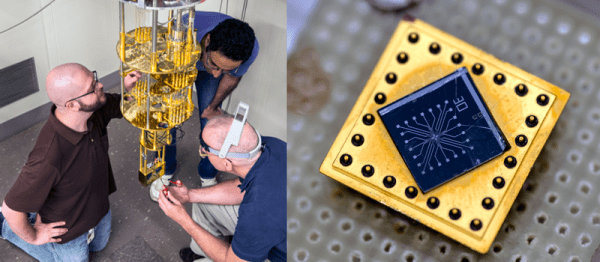
So to quantify the exact number of electrons per second in an amp, the folks at NIST need an electron counter. This device turns out to be a super-cooled, quantum mechanical gate that closes itself once an electron has passed through. Repeatedly re-opening one of these at gigahertz still provides around a picoamp. Current (tee-hee) research is focused on making practical devices that push a bit more juice. Even then, it’s likely that they’ll need to gang 100 of these gates to get even a single microamp. But when they do, they’ll know how many electrons per second have passed through to a few tens of parts per billion. Not too shabby.

We had no idea that the amp was indirectly defined, but now that we do, we’re looking forward to a better standard. Thanks, NIST!

Thanks [CBGB123B] for the tip!

How Accurate Is Microstepping Really?

Stepper motors divide a full rotation into hundreds of discrete steps, which makes them ideal to precisely control movements, be it in cars, robots, 3D printers or CNC machines. Most stepper motors you’ll encounter in DIY projects, 3D printers, and small CNC machines are bi-polar, 2-phase hybrid stepper motors, either with 200 or — in the high-res variant — with 400 steps per revolution. This results in a step angle of 1.8 °, respectively 0.9 °.

Can you increase the resolution of this stepper motor?

In a way, steps are the pixels of motion, and oftentimes, the given, physical resolution isn’t enough. Hard-switching a stepper motor’s coils in full-step mode (wave-drive) causes the motor to jump from one step position to the next, resulting in overshoot, torque ripple, and vibrations. Also, we want to increase the resolution of a stepper motor for more accurate positioning. Modern stepper motor drivers feature microstepping, a driving technique that squeezes arbitrary numbers of microsteps into every single full-step of a stepper motor, which noticeably reduces vibrations and (supposedly) increases the stepper motor’s resolution and accuracy.

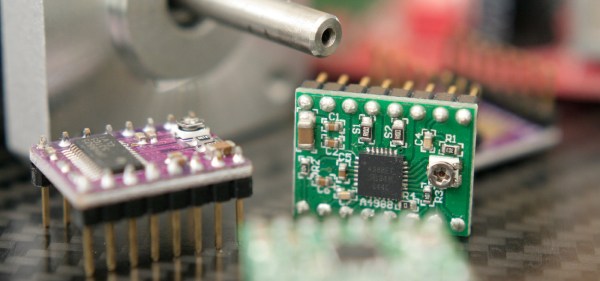
On the one hand, microsteps are really steps that a stepper motor can physically execute, even under load. On the other hand, they usually don’t add to the stepper motor’s positioning accuracy. Microstepping is bound to cause confusion. This article is dedicated to clearing that up a bit and — since it’s a very driver dependent matter — I’ll also compare the microstepping capabilities of the commonly used A4988, DRV8825 and TB6560AHQ motor drivers.

Continue reading “How Accurate Is Microstepping Really?”

Hyperuniformity — A Hidden Order Found In The Greatest Set Of Eyes

Of all the things evolution has stumbled across, the eye is one of the most remarkable. Acting as sort of a ‘biological electromagnetic transducer’, the eye converts incoming photons into electrical and chemical spikes, known as action potentials. These spikes then drive the brain of the host life form. Billions of years of natural selection has produced several types of eyes, with some better than others. It would be an honest mistake to think that the human eye is at the top of the food chain, as this is not the case. Mammals underwent a long stint scurrying around in dark caves and crevasses, causing our eyes to take a back seat to other more important functions, such as the development of a cortex.

There are color sensitive cones in all eyes. Mammals have three types of cones, which are…wait for it…Red, Blue and Green. Our red and green cones are relatively recent on the evolutionary timescale – appearing about 30 million years ago.

The way these cones are distributed around our eyes is not perfect. They’re scattered around in lumpy, uneven patterns, and thus give us an uneven light sampling of our world. Evolution simply has not had enough time to optimize our eyes.

There is another animal on this planet, however, that never went through “the dark ages” as mammals did. This animal has been soaring high above its predators for over 60 million years, allowing its eyes to reach the pinnacle of the natural selection process. A bald eagle can spot a mouse from over a mile away. Birds eyes have 5 types of light sensitive cones – red, blue and green like our own. But add in violet and a type of cone that can detect no light, or black. But it is the way these cones are distributed around the bird’s eye that is most fascinating, and the subject of today’s article.

Continue reading “Hyperuniformity — A Hidden Order Found In The Greatest Set Of Eyes”

Open Source SNES To USB Converter Lets You Emulate Legally

[Andrew Milkovich] was inspired build his own Super Nintendo cartridge reader based on a device we covered an eternity (in internet years) ago. The device mounts a real cartridge as a USB mass storage device, allowing you to play your games using an emulator directly from the cart.

This uses a Teensy++ 2.0  at its core. [Andrew] had to desolder the EEPROM pins from the SNES cartridge and reverse engineer the pinouts himself, but the end result was a device that could successfully read the cartridge without erasing it, no small accomplishment. The finished cartridge reader is build on some protoboard and we’d like to complement [Andrew] on his jumper routing on the underside of that board.

Of course, the experience of any console is just not the same without the original controller. So [Andrew] went a step further and made his own SNES controller to USB converter. This had the venerable Atmel ATmega328 at its core, and can be used separate from the cartridge reader if desired.

Working In Peace With An Off-Grid Office Shed

Finding a good work space at home isn’t a trivial task, especially when you’ve got a wife and kid. A lot of us use a spare bedroom, basement, or garage as a space to work on our hobbies (or jobs). But, the lack of true separation from the home can make getting real work done difficult. For many of us, we need to have the mental distance between our living space and our working space in order to actually get stuff done.

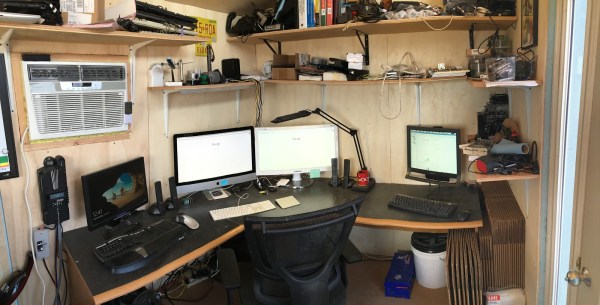
This is the problem [Syonyk] had — he needed a quiet place to work that was separated from the rest of his house. To accomplish this, he used a Tuff Shed and set it up to run off-grid. The reason for going off-grid wasn’t purely environmental, it was actually more practical than trying to run power lines from the house. Because of the geology where he lives, burying power lines wasn’t financially feasible.

Continue reading “Working In Peace With An Off-Grid Office Shed”

Atari Archaeology Without Digging Up Landfill Sites

We are fortunate to live in an age of commoditized high-power computer hardware and driver abstraction, in which most up-to-date computers have the ability to do more or less anything that requires keeping up with the attention of a human without breaking a sweat. Processors are very fast, memory is plentiful, and 3D graphics acceleration is both speedy and ubiquitous.

Thirty years ago it was a different matter on the desktop. Even the fastest processors of the day would struggle to perform on their own all the tasks demanded of them by a 1980s teenager who had gained a taste for arcade games. The manufacturers rose to this challenge by surrounding whichever CPU they had chosen with custom co-processors, ASICs that would take away the heavy lifting associated with 2D graphics acceleration, or audio and music synthesis.

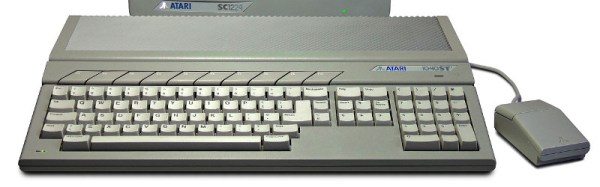
One of the 1980s objects of computing desire was the Atari ST, featuring a Motorola 68000 processor, a then-astounding 512k of RAM, a GUI OS, high-res colour graphics, and 3.5″ floppy drive storage. Were you to open up the case of your ST you’d have found those ASICs we mentioned as being responsible for its impressive spec.

Jumping forward three decades, [Christian Zietz] found that there was frustratingly little information on the ST ASIC internal workings. Since a trove of backed-up data became available when Atari closed down he thought it would be worth digging through it to see what he could find. His write-up is a story of detective work in ancient OS and backup software archaeology, but it paid off as he found schematics for not only an ASIC from an unreleased Atari product but for the early ST ASICs he was looking for. He found hundreds of pages of schematics and timing diagrams which will surely take the efforts of many Atari enthusiasts to fully understand, and best of all he thinks there are more to be unlocked.

We’ve covered a lot of Atari stories over the years, but many of them have related to their other products such as the iconic 2600 console. We have brought you news of an open-source ST on an FPGA though, and more recently the restoration of an ST that had had a hard life. The title of this piece refers to the fate of Atari’s huge unsold stocks of 2600 console cartridges, such a disastrous marketing failure that unsold cartridges were taken to a New Mexico landfill site in 1983 and buried. We reported on the 2013 exhumation of these video gaming relics.

A tip of the hat to Hacker News for bringing this to our attention.

Atari ST image, Bill Bertram (CC-BY-2.5) via Wikimedia Commons.