Full-size AT-ST Star Wars Build

Think you made a cool tree-house for your kids? Sorry to burst your bubble, but we don’t think anything can top this full-size 1:1 replica of a Star Wars AT-ST — complete with sound effects and moving turrets! Did we mention it seats two?

Built in his backyard, this AT-ST is constructed of wood, plastic, and sheet metal. On the inside it is decked out with joysticks, display panels, and other knobs and buttons for your imagination to go wild with. It even features solar panels on the roof to power two ventilation fans to keep you cool while daydreaming of blowing up Rebel scum on Hoth.

Stay tuned after the break to see a video of it in action.

Continue reading “Full-size AT-ST Star Wars Build”

The Ultraviolet Catastrophe

As the light of the 20th century was peeking over the horizon, a young physicist by the name of Max Planck was taking to heart some career advice he had received while he attended Munich University in Germany. With the recent discovery of thermodynamics, there wasn’t much left in physics to know, or so his adviser thought. Hindsight is indeed 20/20.

It turns out that Planck was an expert at thermodynamics. Having mastered the subject gave him some leverage to use against a growing group of physicists known as atomists who were using statistical models along with so called ‘atoms’ to predict experimental outcomes. Atomists believed that matter was composed of discrete units. Planck believed the world was continuous and could not be divided into any type of discrete component. And he would draw the second law of thermodynamics from his holster and put this atom idea in the clay.

Continue reading “The Ultraviolet Catastrophe”

A 2,200 Pound Personal Computer

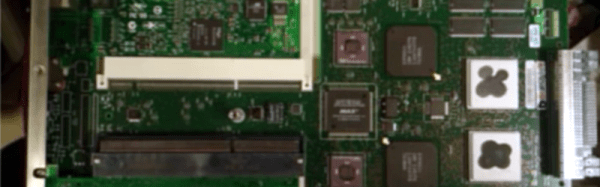
[Connor Krukosky] wanted to buy another computer. Even though he is only 18, he had his first computer at 18 months old. He’s had plenty since then and his interest in computers led him to pursue a career in electrical engineering. A few years ago, [Conner] started collecting vintage computers.

He’d bought up some Apple computers, terminals, and even a Data General minicomputer. Then he found a notice that Rutgers was auctioning off an IBM z890 mainframe computer. People warned [Conner] that this wasn’t a desktop workstation, it was a 2,200 pound case that probably wouldn’t fit through standard doors.

He was undeterred. He won the auction for under $240. The real expense, of course, would be moving it. He planned to make two trips: One to strip the machine to parts and bring some parts back and then a second trip to get the remaining parts.

You can see in the video below that he had a lot of adventure moving the beast. Things didn’t fit and even some excavation had to happen to get the computer in his basement.

Continue reading “A 2,200 Pound Personal Computer”

Raspberry Pi As Speed Camera

Wherever you stand on the topics of road safety and vehicle speed limits it’s probably fair to say that speed cameras are not a universally popular sight on our roads. If you want a heated argument in the pub, throw that one into the mix.

But what if you live in a suburban street used as a so-called “rat run” through route, with drivers regularly flouting the speed limit by a significant margin. Suddenly the issue becomes one of personal safety, and all those arguments from the pub mean very little.

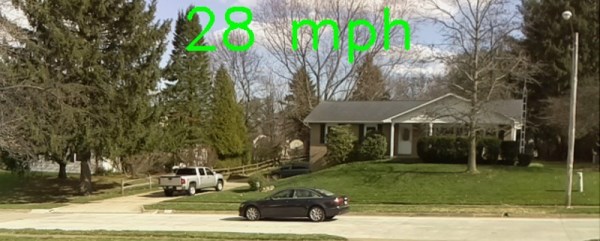
Sample car speed measurements

[Gregtinkers]’ brother-in-law posted a message on Facebook outlining just that problem, and sadly the local police department lacked the resources to enforce the limit. This set [Gregtinkers] on a path to document the scale of the problem and lend justification to police action, which led him to use OpenCV and the Raspberry Pi camera to make his own speed camera.

The theory of operation is straightforward, the software tracks moving objects along the road in the camera’s field of view, times their traversal, and calculates the resulting speed. The area of the image containing the road is defined by a bounding box, to stop spurious readings from birds or neighbours straying into view.

He provides installation and dependency instructions and a run-down of the software’s operation in his blog post, and the software itself is available on his GitHub account.

We’ve had a lot of OpenCV-based projects but haven’t featured a speed camera before here on Hackaday. But we have had a couple of dubious countermeasures, like that humorous attempt at an SQL injection attack, or a flash-based countermeasure.

Ethernet Controller Discovered In The ESP8266

The venerable ESP8266 has rocked the Internet of Things world. Originally little more than a curious $3 WiFi-to-serial bridge, bit by bit, the true power of the ESP has become known, fully programmable, with a treasure trove of peripherals it seemed that the list of things the ESP couldn’t do was short. On that list, at least until today was Ethernet.

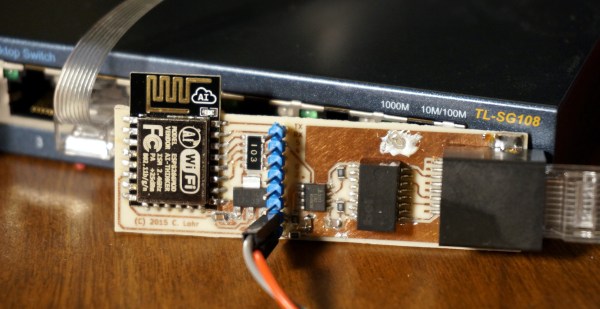
No, despite the misleading title, the ESP does not have a MAC and/or PHY, but what it does have is an incredible 80 MHz DMA-able shift register which can be used to communicate 10BASE-T Ethernet using a new project, espthernet. Join me after the break for video proof, and a deep dive into how this is possible.

Continue reading “Ethernet Controller Discovered In The ESP8266”

Apple Introduces Their Answer To The Raspberry Pi

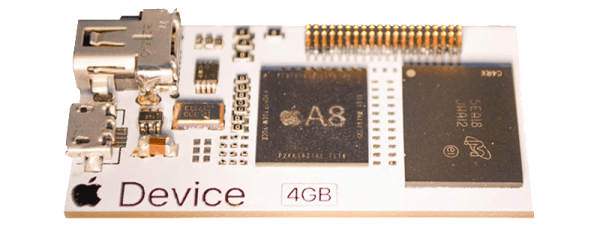
Today, Apple has announced their latest bit of hardware. Following in the tradition of the Raspberry Pi, BeagleBone, and the Intel Edison, Apple have released a single board computer meant for embedded and Internet of Things applications. It’s called the Apple Device, and is sure to be a game changer in the field of low-power, Internet-enabled computing.

First off, some specs. The Apple Device uses Apple’s own A8 chip, the same dual-core 64-bit CPU found in the iPhone 6. This CPU is clocked at 1.1 GHz, and comes equipped with 1GB of LPDDR3 RAM and 4GB of eMMC Flash. I/O includes a Mini DisplayPort capable of driving a 4k display, 802.11ac, Bluetooth, and USB. In a massive break from the Apple zeitgeist of the last decade or so, the Apple Device also includes a forty pin header for expansion, much like the Raspberry Pi, BeagleBone, and Edison.

Although Apple’s first foray into the embedded computing market is a shocker, in retrospect it should come as no surprise; the introduction of HomeKit in iOS 9 laid the groundwork for an Internet of Apple Devices, embedded into toasters, refrigerators, smart homes, and cars. The Apple Device lives up to all these expectations, but what is the hands-on experience like?

See our review of the Apple Device after the break.

Continue reading “Apple Introduces Their Answer To The Raspberry Pi”

Co-Exist With Your Coax: Choose The Right Connector For The Job

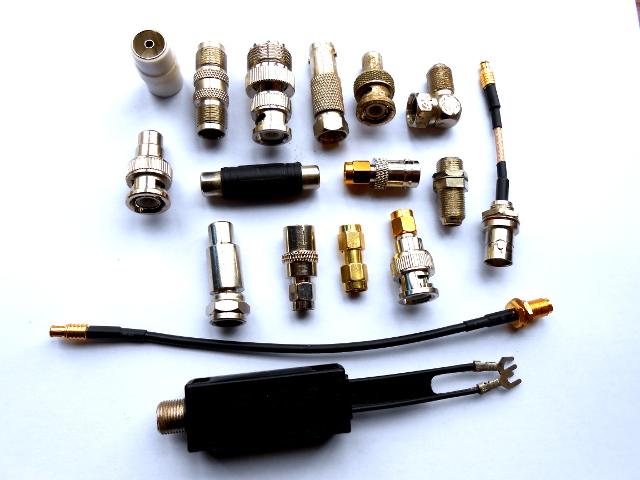
Just a selection from the author's unholy assortment of adaptors.
Just a selection from the author’s unholy assortment of adaptors.

If you do any work with analogue signals at frequencies above the most basic audio, it’s probable that somewhere you’ll have a box of coax adaptors. You’ll need them, because the chances are your bench will feature instruments, devices, and modules with a bewildering variety of connectors. In making all these disparate devices talk to each other you probably have a guilty past: at some time you will have created an unholy monster of a coax interface by tying several adaptors together to achieve your desired combination of input and output connector. Don’t worry, your secret is safe with me.

Continue reading “Co-Exist With Your Coax: Choose The Right Connector For The Job”