You Can Learn A Lot From A Dummy (Load)

If you work on RF circuits–even if you aren’t a ham radio operator–you ought to have a dummy load. A dummy load is a non-radiative “antenna” with known impedance that you can use to test your RF circuit without radiating. For radio work, you usually just need a 50-ohm resistor that is non-inductive (at least at the frequencies you are interested in) and that can dissipate the amount of power you’ll expect it to handle (at least for a short time). [VO1PWF] wanted a dummy load and built his own.
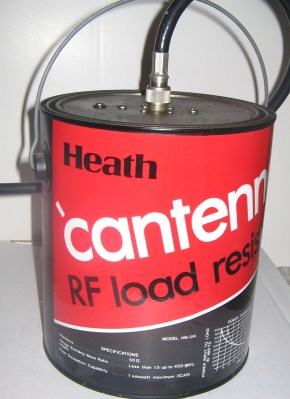
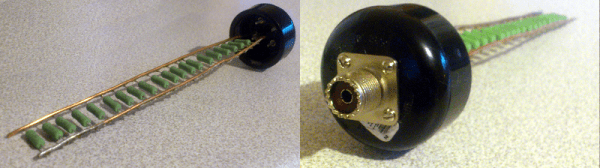
CantennaThe Cantenna (not the Pringle’s kind; see right) was a famous dummy load design when Heathkit was in business. It was a single carbon rod immersed in a paint can full transformer oil (which we now know was full of dangerous PCBs; and we don’t mean printed circuit boards). [VO1PWF’s] design is a little more practical, using some resistors in parallel (20 1K resistors), a plastic pipe housing, and mineral oil to keep it all cool.

The reason for the parallel resistors is to maximize the power handling capability. The resistors are 3W units, so the dummy load–in theory–can handle 60 watts. Often, high power resistors are wire wound and thus have a good bit of parasitic inductance that makes the dummy load reactive (not a good thing since that makes the load impedance vary by frequency). They do make non-inductive wire wound resistors, but these aren’t truly non-inductive. The wire winds in two different directions, so the inductance tends to cancel out. We wouldn’t trust them to be a pure resistance in a high-power dummy load design.

Continue reading “You Can Learn A Lot From A Dummy (Load)”

Firing Up A Raspberry Pi Zero

I ordered a Raspberry Pi Zero from Adafruit in their Startup Pack right after they were released. There are a few Greater Than Zero Pis (GTZPi) already on my workbench so my purchase was driven by curiosity, not necessity. With no rush on delivery it eventually got here, and I finally got around to looking at it. My experience with the Pi family began with the Pi B+ and, shortly after that, the Pi 2. The speed difference between them was noticeable so I decided to dive in and further test the performance of the Zero.

Continue reading “Firing Up A Raspberry Pi Zero”

The ESP32 Beta Units Arrive

A little more than a year ago, the ESP8266 WiFi module showed up uneventfully in Seeed Studio’s store. Since then, the documentation has been translated to English, a proper development environment for this chip was created, and everybody is using this cheap but powerful chip for the latest Internet of Things things.

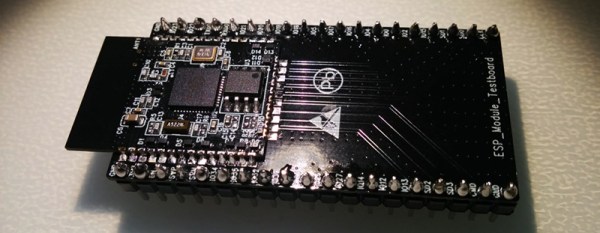
The company behind the ESP8266, Espressif, is not one to rest on their laurels, and for several months they’ve been working on the next generation of powerful WiFi-enabled tiny, cheap systems. They have their silicon, and already 200 lucky people have their hands on the very first test units of the ESP32, the next generation of Espressif’s WiFi chips. The teardowns have begun, and [LadyAda] streamed her initial experiments with the chip to the Intertubes (available below). [Martin] is also one of the guys who received these early beta chips, and he was kind enough to post his thoughts on Espressif’s newest chip.

A little bit of information on the ESP32 has dribbled out, and [LadyAda] and [Martin]’s demo unit confirm all we’ve suspected. There are two Tensilica L108 processors running at up to 160MHz, a lot of peripherals including ADCs, DACs, I2C, SPI, I2S, and PWM, more RAM, AES and SSL for security, and Bluetooth Low Energy. WiFi has also been upgraded, and the ESP32 will support speeds up to 150 Mbps.

Continue reading “The ESP32 Beta Units Arrive”

Before Google There Was The Chemical Rubber Company

Quick. What’s the difference in conductivity between silver and copper? Today, that’s easy to find out. You just ask Google (maybe even out loud if you have a phone handy). But it wasn’t that long ago that you needed another option. Before the Internet age, a big part of being “that guy” (or gal) was knowing where to go to find things. You had to be a master of the library’s reference section, know what might be in an encyclopedia or an almanac.

However if you were a hardcore math, science, or engineering geek you probably had, at least, one edition of CRC handbooks. Today, we usually think of CRC as cyclic redundancy check, but back then it was the Chemical Rubber Company.

The Chemical Rubber Company dates back to 1903 when brothers Arthur, Leo, and Emanuel Friedman were selling rubber lab aprons in Cleveland, Ohio (Arthur, apparently, had been in a similar business from 1900). In 1913, the brothers offered a short (116-page) booklet called the Rubber Handbook free with the purchase of a dozen aprons.

Continue reading “Before Google There Was The Chemical Rubber Company”

The Scientific Implausibility Of Starkiller Base

This post contains spoilers for Star Wars: The Force Awakens. These spoilers won’t affect you if you haven’t seen the movie; they’re equivalent to saying, “in A New Hope there’s a moon sized battle station with a superlaser” and “someone gets a hand amputated with a lightsaber in a Star Wars movie”


A lot has happened in the Star Wars universe since the battle of Endor. The Empire is in ruins, and Yavin 5 and the forest moon of Endor both have new planetary ring systems. The Rebellion has given way to a new Galactic Republic, but there is a spectre of evil looming in the unknown areas of the galaxy: the First Order, a malevolent force that has built a planet-sized superweapon capable of destroying entire planetary systems from across the galaxy. The Starkiller gets its energy from harvesting entire suns, moving from one solar system to another to feed this massive weapon of terror.

We’ve had nearly forty years to argue the plausibility of the Death Star, lightsabers, parsecs as a unit of time, and hyperdrives. It’s time to pass the hallowed tradition of arguing over fictional spacecraft to a new generation. Starkiller Base is a cool idea, but does the science behind it hold up? No. It’s completely implausible. It makes for a great story, but it’s completely implausible.

Continue reading “The Scientific Implausibility Of Starkiller Base”

Homemade Internal Combustion Engine – Sans Machine Shop

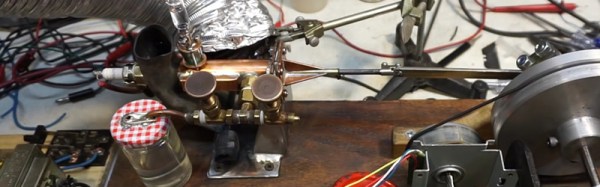
We’ve got a question for you:  If you were stuck in a basement, with nothing too much more than some copper pipe, solder, JB-Weld, and a few hand tools, do you think you could make a working 2-stroke motor? Well, [Makerj101] did just that, and the results are fan-freaking-tastic.

[Makerj101] began his journey like most of us do – with a full face-plant type failure. His first attempted at building an internal combustion engine wouldn’t run, due to a low compression ratio, and too small port sizes. So he did what most of us would do, and tore apart a small gas-power weed-whacker motor to see what he was doing wrong.

The type of engine he’s making is a 2-stroke. That makes the design much simpler as there are no mechanically controlled valves a like 4-stroke motor. The piston (along with the cylinder wall) does double duty by also directing the intake and exhaust gasses – along with a simple flap-type check valve.

For now, the ignition system is run off of mains power, but he has plans to change that – creating a self contained engine. We’re amazed that the entire build is made with such simple tools. Even the the piston is cast out of “JB Weld” epoxy putty. After seeing this, we think that the kid who took apart a clock is going to have to up his game a bit.

We’ve included all 6 parts after the break.

Continue reading “Homemade Internal Combustion Engine – Sans Machine Shop”

Lise Meitner: A Physicist Who Never Lost Her Humanity

It is said that the first casualty of war is the truth, and few wars have demonstrated that more than World War II. One scientist, whose insights would make the atomic age possible, would learn a harsh lesson at the outset of the war about how scientific truth can easily be trumped by politics and bigotry.

Lise Meitner was born into a prosperous Jewish family in Vienna in 1878. Her father, a lawyer and chess master, took the unusual step of encouraging his daughter’s education. In a time when women were not allowed to attend institutions of higher learning, Lise was able to pursue her interest in physics with a private education funded by her father. His continued support, both emotional and financial, would prove important throughout Lise’s early career. Continue reading “Lise Meitner: A Physicist Who Never Lost Her Humanity”