While laser cutting remains the dominant force for rapid prototyping anything made of plastic, MDF or wood, the real holy grail is the ability to cut metal — something most laser cutters are just not capable of.
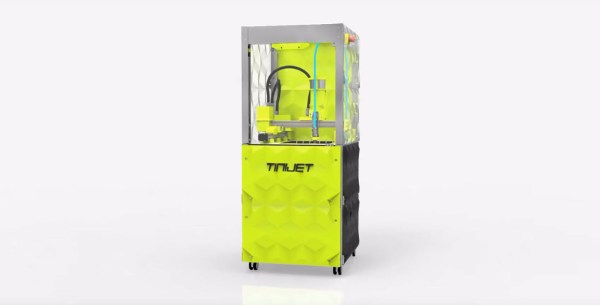
In the industry, this is done using extremely high-powered laser cutters, plasma cutters, or water jet cutters. All of which are very pricey equipment for a hacker. Until now anyway. Introducing the Tinijet, the missing tool for affordable water jet cutting.
We first covered this project a few years ago when it was just a university research project called Hydro — it’s since evolved immensely, and will be available for sale very soon.
USB has been on our desktops and laptops since about 1997 or so, and since then it has been the mainstay of computer peripherals. No other connector is as useful for connecting mice, keyboards, webcams, microcontroller development boards, and everything else; it’s even the standard power connector for phones. The latest advance to come out of the USB Implementers Forum is the USB Type-C connector, a device with gigabits of bandwidth and can handle enough current to power a laptop. It’s the future, even if Apple’s one-port wonder isn’t.
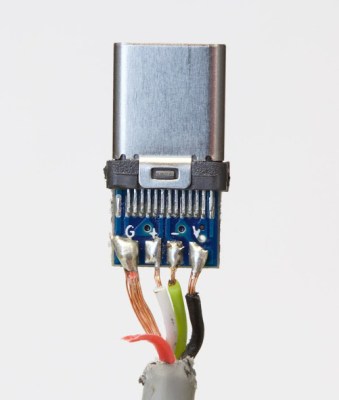
The cable of the future is, by default, new. This means manufacturers are still figuring out the port, and how to wire it up. You would think remembering ‘red = power, black = ground’ is easy, but some manufacturers get it so terribly wrong.
The cable in question was a SurjTech 3M cable that has thankfully been taken down from Amazon. Swapping GND and Vbus weren’t the only problem – the SuperSpeed wires were missing, meaning this was effectively only a USB 2 cable with a Type-C connector. The resistor required by USB spec was the wrong value, and was configured as a pull-down instead of a pull-up.
This isn’t an issue of a cable not meeting a design spec. Ethernet cables, specifically Cat6 cables, have been shown to work but fail to meet the specs for Cat6 cables. That’s shady manufacturing, but it won’t break a computer. This is a new low in the world of computer cables, but at least the cable has disappeared from Amazon.
If you read my first post about a simple CPLD do-it-yourself project you may remember that I seriously wiffed when I made the footprint 1” wide, which was a bit too wide for common solderless breadboards. Since then I started over, having fixed the width problem, and ended up with a module that looks decidedly… cuter.
To back up a little bit, a Complex Programmable Logic Device (CPLD) is a cool piece of hardware to have in your repertoire and it can be used to learn logic or a high level design language or replace obsolete functions or chips. But a CPLD needs a little bit of support infrastructure to become usable, and that’s what I’ll be walking you through here. So if you’re interested in learning CPLDs, or just designing boards for them, read on!
[menkveldj] built a service that encrypts files which self destruct in 24 hours. The download link can only be used once. If the wrong people were to get the link and download the file, they’d need many years on a pretty powerful computer to crack the 256AES encryption.
The sender shares a file that is encrypted client side using a password generated Pbkdf2 key to encrypt the data before uploading it to the s3 storage service. The sender is then provided the one-time-use link to share with the recipient. After the first download, or 24 hours, the link and the encrypted file are both deleted. The receiver must enter the same password to decrypt and recover the file. No one but the sharer and receiver know what the actual file is.
It’s still work in progress, so chime in with your comments and suggestions. To dig into the code, check out his repository on Github, which also has instructions to build and run it if you’d like to do your own version.
Oh, and you’ll like this. If want to thumb your nose at the powers that be, the site has a redirect for the whimsical domain: NSAfu.com.
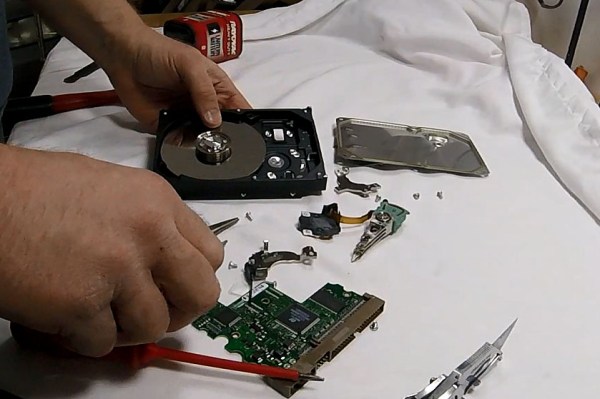
Have any dead hard drives kicking around? Hackaday alum [Jeremy Cook] shows how easy it is to disassemble a hard drive to scavenge its goodies. The hardest part is having the patience and the tools to get past all those screws that stand between you and the treasure inside.
The case screws are frequently of the Torx variety. Any self-respecting hacker probably has one or two of these already, but if you’re in the market, [Jeremy] recommends a nice set that looks way better than ours. Once the case is open, you can find rare earth magnets, bearings, and one or more platters.
Those terrifically strong magnets are good for all kinds of projects. Glue a couple of them to the back of an attractive piece of wood, mount it on the kitchen wall, and you have yourself a knife block. Keep a couple on the bench to temporarily magnetize tools. Use them to build a pickup to amplify a cigar box guitar or thumb piano. Or run the pickup into a small amplified speaker and wave it like a stethoscope near your electronics to hear them hum. As far as liberating the magnets goes, [Jeremy] resorted to clamping his in a vise and using a hammer and chisel to pry it away from the actuator hardware.
You’ve no doubt seen clocks made from old hard drives that were kept mostly intact. Many makers including [Jeremy] will extract the shiny platters to use as bases for clock faces and engrave the numbers, etch them, or glue them on. Those platters also make excellent chimes. Even if you just hang one platter off of a finger and tap it with a fingernail, it sounds really nice.
If simple chimes don’t really butter your muffin, there are all kinds of sonic projects for dead hard drives. How about making a microphone or speakers? Maybe an HDD MIDI controller or a synthesizer is more your speed. Speaking of synths, watch [Jeremy] take a hard drive apart to some sweet sounds after the break.
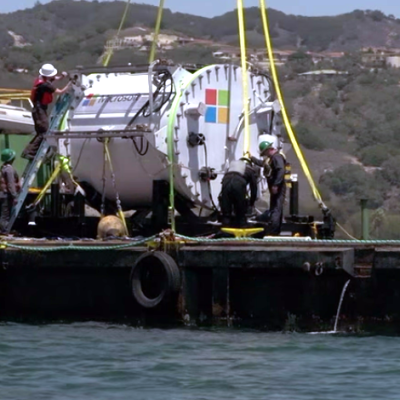
Have you heard that Microsoft is testing underwater data centers? On the surface (well, actually on the ocean floor) it’s not a bad idea. Project Natick seals a node of servers in a steel pipe for an undersea adventure planned for at least 10 years. The primary reason is to utilize cold ocean temperatures to keep the machines cool as they crunch through your incessant Candy Crush Saga sessions.
Passive cooling is wonderful, and really drops the energy footprint of a data center, albeit a very small one which is being tested. Scaled up, I can think of another big impact: property taxes. Does anyone know what the law says about dropping a pod in the ocean? As far as I can tell, laying undersea cabling is expensive, but once installed there are no landlords holding out their hands for a monthly extraction. Rent aside, taking up space with windowless buildings sucking huge amounts of electricity isn’t going to win hearts and minds of the neighborhood. Undersea real estate make sense there too.
But it’s fun to play Devil’s Advocate, and this one immediately raised my eyebrow. I read as much Sci Fi as time allows, and am always interested to see which authors are registering the best technology predictions. This is the second time in short order that I turn to [William Hertling’s] work. Back in November, Google announced a project to add predictive responses to Gmail. This parallels the premise of [Hertling’s] Singularity Series which begins with Avogadro Corp. Another major point in that novel is the use of offshore data centers.
We live in a world transformed by our ability to manipulate the nucleus of atoms. Nuclear power plants provide abundant energy without polluting the air, yet on the other hand thousands of nuclear warheads sit in multiple countries ready to annihilate everything, even if it’s not on purpose. There are an uncountable number of other ways that humanity’s dive into nuclear chemistry has impacted the lives of people across the world, from medical imaging equipment to smoke detectors and even, surprisingly, to some of the food that we eat.
After World War 2, there was a push to find peaceful uses for atomic energy. After all, dropping two nuclear weapons on a civilian population isn’t great PR and there’s still a debate on whether or not their use was justified. Either way, however, the search was on to find other uses for atomic energy besides bombs. While most scientists turned their attention to creating a viable nuclear power station (the first of which would only come online in 1954, almost ten years after the end of World War 2), a few scientists turned their attention to something much less obvious: plants.





 Passive cooling is wonderful, and really drops the energy footprint of a data center, albeit a very small one which is being tested. Scaled up, I can think of another big impact: property taxes. Does anyone know what the law says about dropping a pod in the ocean? As far as I can tell, laying undersea cabling is expensive, but once installed there are no landlords holding out their hands for a monthly extraction. Rent aside, taking up space with windowless buildings sucking huge amounts of electricity isn’t going to win hearts and minds of the neighborhood. Undersea real estate make sense there too.