Uses For Quantum Entanglement With Shanni Prutchi

For those of you that weren’t at the Hackaday SuperConference, it started off with a pretty intense talk that could have been tough for anyone to follow. However, [Shanni Prutchi] presented her talk on quantum entanglement of photons in a way that is both approachable, and leaves you with plenty of hints for further study. Check it out in the video below, and join us after the break for a rundown of what she covered in her presentation.

Continue reading “Uses For Quantum Entanglement With Shanni Prutchi”

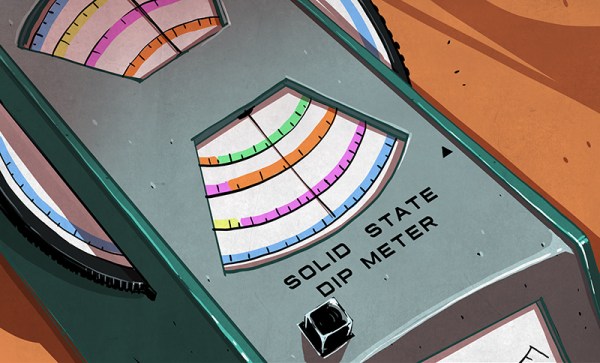
The Grid Dip Meter: Forgotten Instrument

It used to be a major rite of passage for a hardware hacker to acquire an oscilloscope. Until recently, new instruments were rarely in normal people’s budgets, so you probably made do with a used scope. Now, there are lots of inexpensive options, especially if you include low-end PC scopes and “scope meters.” Digital meters are also now inexpensive (often free at some major stores), along with signal generators, frequency counters, and even logic analyzers.

But there is one piece of test equipment you don’t see as often as you used to and its a shame, because it is a very versatile piece of kit. Admittedly, if you aren’t doing wireless work, it might not be high on your wish list, but if you do anything with RF, it is not only a versatile tool, but a good value, too. What’s it called? That depends. Historically, they went by the name “Grid Dip Oscillator” or GDO. Sometimes you’d hear it called a “Grid Dip Meter” instead. However, modern versions don’t have tubes (and, thus, no grid) so sometimes you hear them now called dip meters or maybe just dippers.

Continue reading “The Grid Dip Meter: Forgotten Instrument”

Swallow The Doctor — The Present And Future Of Robots Inside Us

I recently finished the Silo series by Hugh Howey, a self-published collection of novellas that details life in a near-future, post-apocalyptic world where all that remains of humanity has been stuffed into subterranean silos. It has a great plot with some fun twists and plenty of details to keep the hacker and sci-fi fan entertained.

One such detail is nanorobots, used in later volumes of the series as both life-extending tools and viciously specific bio-weapons. Like all good reads, Silo is mainly character driven, so Howey doesn’t spend a lot of eInk on describing these microscopic machines – just enough detail to move the plot along. But it left me wondering about the potential for nanorobotics, and where we are today with the field that dates back to Richard Feynman’s suggestion that humans would some day “swallow the doctor” in a 1959 lecture and essay called There’s Plenty of Room at the Bottom.”

Continue reading “Swallow The Doctor — The Present And Future Of Robots Inside Us”

Listen Up: IPhone Hack Diagnoses HVAC

We all know that guy (or, in some cases, we are that guy) that can listen to a car running and say something like, “Yep. Needs a lifter adjustment.” A startup company named Augury aims to replace that skill with an iPhone app.

Aimed at commercial installations, a technician places a magnetic sensor to the body of the machine in question. The sensor connects to a custom box called an Auguscope that collects vibration and ultrasonic data and forwards it via the iPhone to a back end server for analysis. Moving the sensor can even allow the back end to determine the location of the fault in some cases. The comparison data the back end uses includes reference data on similar machines as well as historical data about the machine in question.

Continue reading “Listen Up: IPhone Hack Diagnoses HVAC”

First Raspberry Pi Zero Hack – Piggy-Back WiFi.

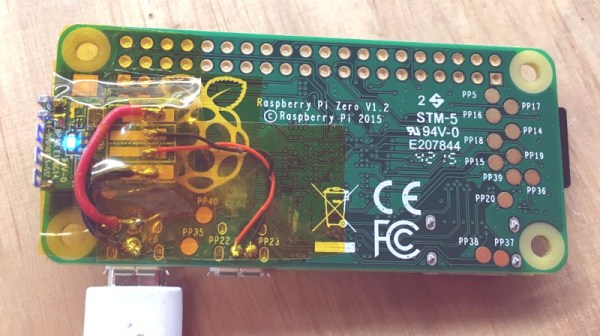
And we have the first Raspberry Pi Zero hack! In less than 72 hours from the official release announcement [Shintaro] attached an Edimax WiFi USB Adapter directly to the USB solder pads on the Pi Zero. He couldn’t bear to disturb the small dimensions of the Pi Zero by using the USB On-the-Go (OTG). The OTG is needed to convert the micro-USB connector on the board to a full USB-A connector.

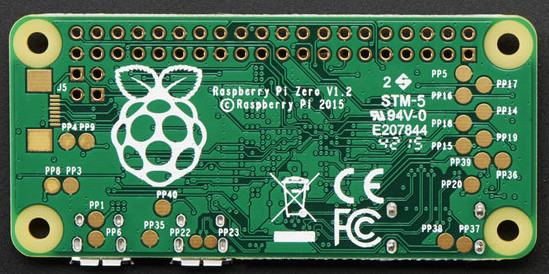
The case was removed from the Edimax and the device and Zero wrapped in Kapton to insulate the exposed solder points. Power was taken from the PP1 and PP6 points on the back of the board. These are the unregulated inputs from the USB power so should be used with caution. Some cheap USB power supplies can put out more that 5 volts when first connected and that might let the smoke out of a device.

raspberry_pi_quarter

The data wires were connected to PP22 and PP23, also on the back, and behind the USB data connector. Since USB is a differential signal these wires were carefully kept of equal length to avoid distorting the signal.

An SD card was created and edited on a Raspberry Pi B 2 to set the WiFi credentials. Inserted into the Zero it booted fine and started up the WiFi network connection.

Congratulations, [Shintaro] for the first Hackaday Raspberry Pi Zero hack. Is that a Hack-a-Zero-Day hack?

The Internet Of Reflow Ovens

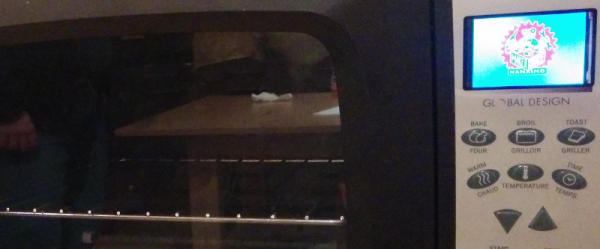
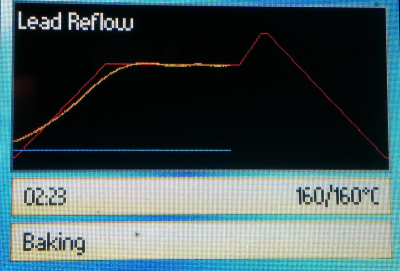
Using a toaster oven to reflow solder isn’t a new idea. But [Sukasa] wanted something that had more features and improved appearace. So he married a Netduino, a toaster oven, and some solid state relays to made a clean-looking reflow oven. His goal was to have nothing look like an overt modification to a casual observer. Inside, however, the oven now has a network connection for system status via a Web browser or JSON.

The new brains of the oven are a Netduino Plus 2 and an I2C port expander that connects to a few extra I/O devices. The challenging I/O, though, is the heaters. When cold, the oven can draw over 16 amps, so a pair of 12A solid state relays in parallel handle that load. There are also two fans: one to keep the electronics cool and another on software control. An IGBT allows the controller to pulse width modulate the fan’s output. A pair of MAX31855s read the thermocouples that report the temperature.

lcdThe controller was a mashup of the existing oven’s keypad and an add-on LCD display (see right). One thing we didn’t see was a schematic. Of course, you can read the code and figure out how it is all connected and (unless you use the exact same oven) you are probably going to need to modify things to suit your particular setup, anyway.

We’ve seen other good looking reflow oven and controller builds in the past, including one with a touchscreen. It is also worth noting that you can find reflow ovens at relatively low prices now if you don’t feel like rolling your own.

Thorough Macbook Charger Teardown Reveals Some Complex Circuitry

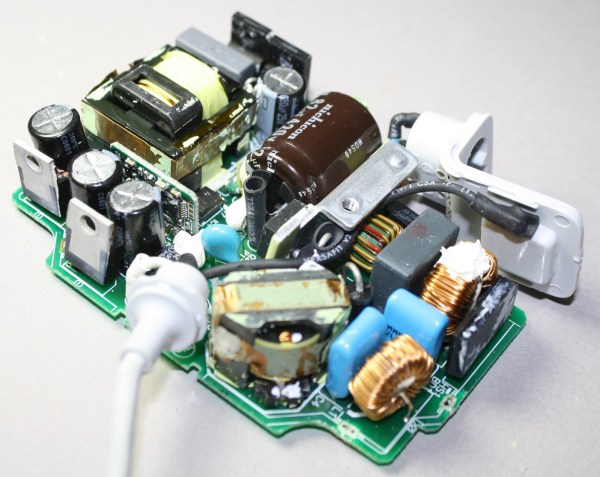
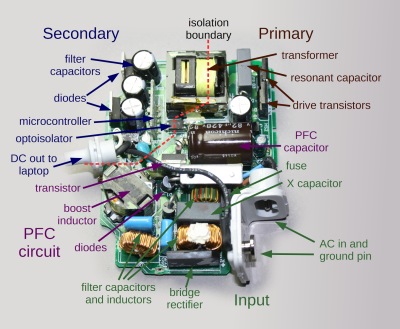
Apple has a reputation in the tech world as being overpriced, and nowhere is that perception more common than in the Hackaday comments. The standard argument, of course, is that for a device with equivalent specs, Apple charges a lot more than its competitors. That argument is not without its flaws, especially when you consider factors other than simple specs like RAM and processor speed, and take into account materials used and build quality. But, as this teardown by [Ken Shirriff] shows, Apple’s attention to detail extends beyond simply machining Macbook bodies out of aluminum.

In his teardown, [Ken Shirriff] thoroughly investigates and describes all of the components and circuitry that go into the ubiquitous Macbook charger. Why does it cost $79? Other than the MagSafe connector, what makes it any better than the charger that came with your Toshiba Satellite in the ’90s? Isn’t it just a transformer to convert AC power to DC?

components1

[Ken Shirriff] answers all of this and more, and you may be surprised by what he found. As it turns out, the Macbook charger isn’t just a transformer in a plastic case with a fancy magnetic connector. There is a lot of high-quality circuitry involved to make the power output as clean and stable as possible, and to avoid potential damage to your Macbook that could be caused by dirty power or voltage spikes. Does it justify the costs, even with so many reported failures? That’s for you to decide, but there is no questioning that Apple put more thought into their chargers than simply converting AC to DC.