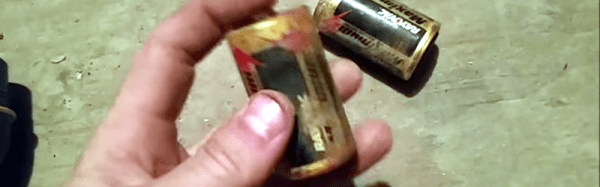
One Way To Recharge Alkaline Batteries

It says it right on the side of every alkaline battery – do not attempt to recharge. By which of course the manufacturer means don’t try to force electrons back into the cell. But [Cody] figured he could work around that safety warning chemically, by replacing the guts of an alkaline dry cell.

The batteries in question were certainly old, gnarly looking, and pretty dead – [Cody] barely got a reading on his multimeter. As you can see after the break, he cleaned off the exterior corrosion and did a quick teardown of the dry cells, removing the remains of the zinc anode, now in the form of zinc oxide paste looking very much like what you’d slather on your nose before a day at the beach. He filled the resulting cavity with a putty of zinc dust, freshened up the electrolyte charge with a squirt of 20% potassium hydroxide, sealed up the cell with a little silicone caulking, and put the recycled cell to the test. Result: 1.27 volts. Not too shabby.

Continue reading “One Way To Recharge Alkaline Batteries”

There are 96 macbooks in this rack

96 MacBook Pros: Most Expensive Server Rack We’ve Ever Seen

Ever see a standard server rack stuffed full with 8-dozen MacBook Pros? Well now you have.

Now before the torrential downpour of anti-Mac comments come, this actually has a purpose. No seriously. Besides, what company in their right mind would spend that much money on a rack full of paperweights? Kidding.

[Steve] works for a company that designs electronics, and for a particular launch they needed to perform a lot of testing — using MacBook Pros. There are ways he could have emulated OS X on a much cheaper hardware setup, but the whole point was to test the product with Apple hardware. So he took a stroll down to the local Apple store and picked up two pallets worth. Continue reading “96 MacBook Pros: Most Expensive Server Rack We’ve Ever Seen”

Find And Repair A 230kV 800Amp Oil-Filled Power Cable Feels Like Mission Impossible

How do you fix a shorted cable ? Not just any cable. An underground, 3-phase, 230kV, 800 amp per phase, 10 mile long one, carrying power from a power station to a distribution centre. It costs $13,000 per hour in downtime, counting 1989 money, and takes 8 months to fix. That’s almost $75 million. The Los Angeles Department of Water and Power did this fix about 26 years ago on the cable going from the Scattergood Steam Plant in El Segundo to a distribution center near Bundy and S.M. Blvd. [Jamie Zawinski] posted details on his blog in 2002. [Jamie] a.k.a [jwz] may be familiar to many as one of the founders of Netscape and Mozilla.

To begin with, you need Liquid Nitrogen. Lots of it. As in truckloads. The cable is 16 inch diameter co-axial, filled with 100,000 gallons of oil dielectric pressurised to 200 psi. You can’t drain out all the oil for lots of very good reasons – time and cost being on top of the list. That’s where the LN2 comes in. They dig holes on both sides (20-30 feet each way) of the fault, wrap the pipe with giant blankets filled with all kind of tubes and wires, feed LN2 through the tubes, and *freeze* the oil. With the frozen oil acting as a plug, the faulty section is cut open, drained, the bad stuff removed, replaced, welded back together, topped off, and the plugs are thawed. To make sure the frozen plugs don’t blow out, the oil pressure is reduced to 80 psi during the repair process. They can’t lower it any further, again due to several compelling reasons. The cable was laid in 1972 and was designed to have a MTBF of 60 years.

Continue reading “Find And Repair A 230kV 800Amp Oil-Filled Power Cable Feels Like Mission Impossible”

The Factory Of The World – Hackaday Documentary On The Shenzhen Ecosystem

When it comes to manufacturing, no place in the world has the same kind of allure as the Pearl River Delta region of China. Within just an hour-long train ride, two vastly different cultures co-exist, each with its unique appeal that keeps attracting engineers, entrepreneurs, and hustlers alike. On the mainland side, cities like Shenzhen and Guangzhou bring the promise of cheap components, low-cost contract work, and the street cred of “having done the Shenzhen thing.” And on the island, the capitalist utopia called Hong Kong glows with all of its high finance and stories of lavish expat lifestyles.

As the “new” China evolves, it seems like it’s exactly the convergence of these two cultures that will bring the biggest change—and not just to the area but to the whole world. Still, understanding what exactly is going on and what the place is really all about remains a mystery to many. So, this June, we jumped on the bandwagon and headed east, trying to get our own feel for the whole thing.

Here’s what we came back with…

Continue reading “The Factory Of The World – Hackaday Documentary On The Shenzhen Ecosystem”

Retro TO-3 Switching Voltage Regulator

Restoring old gear often means replacing unavailable parts with modern equivalents. [Alex Eisenhut] needed to replace some old TO-3 voltage regulators and decided to make an authentic-looking switching power supply replacement. These three pin metal cans were very common, especially the LM340 5V regulator which was, of course, a linear regulator. Today, you are more likely to see a 7805 in a TO-220 case or something surface mount for a comparable linear regulator.

As you might expect, the board uses surface mount components. [Alex] used Mill Max machine pins to match the original regulator footprint and calls the regulator Ton3y. He plans to cover it up with a 3D printed lid, but it seems a shame to hide the fine PCB work.

In the pictures, you can see that the machine pins are a tight fit. [Alex] used a hammer to lightly tap them into place. Of course, the original TO-3 regulators were linear and would generate a lot of heat. The Ton3y, as you’d expect from a switching power supply, runs cool (according to the scientific measurement made with [Alex]’s pinky finger) and surely has a wider input voltage range and more output current capacity.

We’ve seen replacement switching regulators before, but this one is really a work of art.

[Federico Musto] Of Arduino SRL Discusses Arduino Legal Situation

Recently we had the opportunity to sit down and interview Arduino SRL’s CEO, [Federico Musto], over a nice dinner. His company is one half of the Arduino vs Arduino debacle which has pitted Arduino.cc against Arduino.org in a battle over the trademark on “Arduino”.

Given the tremendous amount of press coverage of [Massimo Banzi] and the Arduino LLC side of the story (Arduino.cc), we were very interested in hearing how the whole situation looks where [Frederico Musto] sit (Arduino.org). In the end, we came away with what we feel is a more balanced and complete picture of the situation, as well as interesting news about future products from the Arduino SRL camp. [Musto’s] take on the legal proceedings, both past and present, is nothing short of fascinating.

Continue reading “[Federico Musto] Of Arduino SRL Discusses Arduino Legal Situation”

No, Mounting A Gun To A Quadcopter (Probably) Isn’t Illegal

Earlier this month, [Austin Haghwout] posted a video on YouTube of a remote controlled quadcopter armed with a semiautomatic handgun. While there are no details of this build, it’s safe to say any reasonably sized quadcopter could be armed in such a manner; just strap a pistol to the frame, add a servo, and connect the servo to the RC receiver. We don’t think this is the first time it’s been done, but has garnered the most attention.

There is nothing novel about mounting a handgun to a quadcopter. Anyone with any experience with RC flying could replicate this build, and the only interesting part of watching a video of a quad firing a gun is seeing how the flight controller reacts to the recoil. However, in the pursuit of the exploitation of a fear of technology, this video has gone viral.

The Verge calls it, ‘totally illegal’, while The Christian Science Monitor asks how it is legal. Wired posits it is, ‘most likely illegal,’ while CNET suggests, ‘surely this isn’t legal.’ In a rare break from reality, YouTube commentors have demonstrated a larger vocabulary than normal, calling the build, ‘felonious.’

With so many calling this build illegal, there should be someone who could point out the laws or regulation [Austin Haghwout] is violating. This information is surprisingly absent. In a Newsweek post, a representative from the Bureau of Alcohol, Tobacco, Firearms, and Explosives is quoted as saying:

“ATF has reviewed the video with local law enforcement and other federal agencies. It does not appear that the device violates any existing firearms regulations…”

The Associated Press reports no state laws were broken by [Austin]. With the BAFTE and Connecticut State Police both signing off on this build, the issue of jurisdiction becomes more pronounced. How, exactly, is a gun mounted on a quad illegal?

The answer, as with all things involving quadcopters, comes from the FAA. We could find no regulations explicitly banning handguns on remote controlled quadcopters, but of all stories and posts on [Austin]’s handiwork, this is the closest anyone has come to providing the framework for calling this build illegal:

No pilot in command of a civil aircraft may allow any object to be dropped from that aircraft in flight that creates a hazard to persons or property. However, this section does not prohibit the dropping of any object if reasonable precautions are taken to avoid injury or damage to persons or property.

-FAR Part 91 Sec. 91.15

That’s it. The closest anyone has come to providing a reason why a semiauto quadcopter is illegal: because the cartridge (and bullet), are ‘dropped’ from a quad. The Feds charging [Austin] with “dropping” a bullet from a quadcopter is like taking down [Al Capone] for Income Tax Evasion. The difference being that [Al] was a notorious criminal who had obviously harmed a large swath of people and [Austin] doesn’t seem to be harming anyone.

Although [Austin]’s video of a gun toting quad is only fourteen seconds long, a few reasonable assumptions can be made about his small experiment in flying firepower. The video shows the quad hovering a few feet above the ground. This is surely allowed by the recently published safety guidelines for sUAS users. The gun itself appears to be firing into an offscreen hillside – a sensible precaution. If the only justification for the FAA’s investigation of [Austin]’s video is FAR 91.15, he’s on easy street.