Trinket EDC Contest Winners

It’s time to announce the winners of the Trinket Everyday Carry Contest! We’ve had a great 5 weeks watching the projects come together. A team of Hackaday staffers spent their weekend watching videos and selecting their top entries based on the contest rules. We had a really hard time picking the top three – the competition was tight, and there were quite a few awesome projects.

Without further ado, here are the winners!

1337toolFirst Prize: 1337 3310 tool. [Mastro Gippo] really knocked this one out of the park. He built a swiss army knife of a tool out of the iconic Nokia 3310 candybar phone. 1337 3310 tool is a graphing voltage and current meter, an ohmmeter, a continuity tester that plays the original Nokia ringtone, and a gaming machine which can play Tetris.  [Mastro Gippo] is 99% there with TV-B-Gone functionality as well. Amazingly, [Mastro Gippo] kept the Nokia look and feel in his user interface. He spent quite a bit of time grabbing data and bitmaps from the 3310’s original ROM.  [Mastro Gippo] is getting a Rigol DS1054Z scope to help iron out the bugs in his future projects!

pavaproSecond Prize: Pavapro – portable AVR programmer. [Jaromir] built an incredible pocket-sized microcontroller programming tool. Pavapro can read and edit text files, handle serial I/O at 9600 baud, and burn AVR microcontrollers. If that’s not enough, it can actually assemble AVR binaries from source. That’s right, [Jaromir] managed to fit an entire assembler on the Pro Trinket’s ATmega328 processor. Pavapro’s 16 button keypad won’t allow for much in the way of touch typing, but it does get the job done with T9 style text entry. The device is also extensible, we’re hoping [Jaromir] adds a few other architectures! PIC and MSP430 modes would be awesome!  [Jaromir] will be receiving a Fluke 179 multimeter with a 6 piece industrial electronics tip kit! We’re sure he’ll put it to good use.
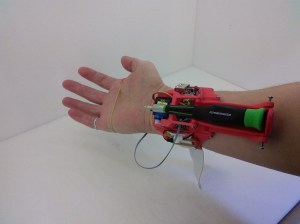
robohandThird Prize: Robotic 3rd Hand. Let’s face it. We can’t all be Tony Stark. But [Tim] gets us a little bit closer with his awesome wearable entry. Need a tool? Just press the button, and Robotic 3rd Hand will give you a … hand. [Tim’s] creation utilizes the Pro Trinket to drive a servo which moves an incredibly well designed and 3D printed mechanism that lifts a screwdriver off the wearer’s wrist and places it into their hand. [Tim] originally was going to go with Electromyography (EMG) sensors to drive the hand, however he switched to a simple button when they proved problematic. We absolutely think this was the right decision for the contest – it’s always better to have a simpler but working project rather than a complex yet unreliable one. That said, we’d love to see him circle back and give EMG another try! [Tim’s] next project will be soldered up with the help of a Hakko FX888D with a tip kit. If things get a bit wobbly, he can use his new Panavise 324 Electronic Work center to keep everything steady.

If you didn’t make the top three in this contest, don’t give up! We’re going to be having quite a few contests this year. The top 50 entrants will receive custom Hackaday EDC Contest T-shirts. Check out the full list of 50 on Hackday.io!

Genetic Algorithm Programmer Gets Functions

[Kory] has been writing genetic algorithms for a few months now. This in itself isn’t anything unique or exceptional, except for what he’s getting these genetic algorithms to do. [Kory] has been using genetic algorithms to write programs in Brainfuck. Yes, it’s a computer programming a computer. Be thankful Skynet is 18 years late.

When we first saw [Kory]’s work, he had programmed a computer to write and run its own programs in Brainfuck. Although the name of the language [Kory] chose could use some work, it’s actually the ideal language for computer-generated programs. With only eight commands, each consisting of a single character, it greatly reduces the overhead of what any genetic algorithm must produce and what a fitness function must evaluate.

There was one shortcoming to [Kory]’s initial efforts: functions. It’s relatively easy to get a program to say Hello World, but to do something complex, you’re going to need something like a macro or a function. Brainfuck, it its most simple form, doesn’t support functions. This throws a wrench in [Kory]’s plan to have his computer programming computer grow smarter and get over local minima in its genetic algorithms.

The solution to this problem was the creation of a new dialect of Brainfuck [Kory] calls BrainPlus. This takes the best parts of Extended Brainfuck and adds a command that basically serves as a break statement.

With this, [Kory]’s self programming computer can develop more complex programs. Already it has created a program to generate the first few numbers of the Fibonacci sequence. It only goes up to 233 because 255 is the maximum value for a byte, and the program itself took seven hours to generate. It does, however, work. Other programs generated with the new Brainplus functions include reciting 99 bottles on the wall and a program that multiples two values.

Even though [Kory]’s computer is spending a long time to generate these programs, given enough time, there’s really not much this program can’t do. Brainfuck, and [Kory]’s Brainplus, are Turing complete, so that given infinite memory and time it can compute anything. With the new addition of functions, it can compute anything faster.

All the code for [Kyle]’s GA is available on Github.


3D Printing Circuits Gets Rid Of The Box Altogether

Many think that the next big step in 3D printing is when we’ll be able to print in metal, well, at an affordable rate. But what about printing in metal and plastic at the same time?

The thing is, most electronics are typically two-dimensional. Layers upon layers of relatively flat PCBs make up the brains of every bit of technology we know and love. The funny thing is, we live in a three-dimensional world, and we like to shove these flat circuits into three-dimensional boxes. Well, what if we didn’t have to? What if the circuit could be embedded directly into whatever shape we want? It’d be pretty awesome — minus the whole servicing aspect of the product…

Anyway we’ve seen some great hacks over the years attempting this, like adding a copper wire strand into your 3D print, embedding components into your print by pausing the job, or even going old school and using the point-to-point Manhattan style circuit construction to add some electronic features to your part. But what if your printer could do it for you?

That’s exactly what Optomec is attempting with the Voxel8 3D printing electronics platform. It is your standard run of the mill FDM style 3D printer, but it has a 2nd extruder that is capable of squeezing out liquid silver ink that dries at room temperature. Just take a look at this quadrotor they were able to make.

Continue reading “3D Printing Circuits Gets Rid Of The Box Altogether”

Upgrading DJI Flight Controllers

DJI, the company that gave us the far too popular Phantom line of quadcopters, doesn’t just make the most popular line of FPV quads. Their top of the line flight controller, The Naza V2, is very good, able to connect to flight planning software that will set waypoints, talk to peripherals over a CAN bus, and has improved flight algorithms. On the other hand, their ‘reduced price’ model, the Naza Light, can’t connect to these nifty CAN bus peripherals and has a bit of a problem with drifting the quad from one side or another.

The Naza V2 sells for around $300, and the Naza Light sells for about $170, both with a GPS module. The hardware inside the V2 and Light is exactly the same. We all know how this is going to go down, right?

[udnham] over on the RC Groups forum figured out a way to load the more capable Naza V2 firmware on the Naza Light, giving the cheaper flight controller features that were, until now, only found in the more expensive V2 hardware. The upgrades include better algorithms for GPS position and altitude hold, the ability to connect to DJI peripherals including the Bluetooth module, the iOSD, and camera gimbals, Octocopter support, the DJI datalink modem, and a bunch of other features.

Even though DJI is using the same hardware in the $170 Naza Light and the $300 Naza V2, upgrading the firmware requires an Internet connection to the DJI servers. [udnham] wrote a utility that modifies the /etc/hosts file on your computer, runs a service, and allows you to upgrade your firmware on the Naza Light. It’s basically a $130 firmware upgrade for a DJI flight controller that’s a single download away.

[udnham] set up a site where you can download the firmware flashing tool with a few videos showing the upgrade process and the improvement over the stock firmware. You can check those out below.

Continue reading “Upgrading DJI Flight Controllers”

Reverse-Engineering A Superior Chinese Product

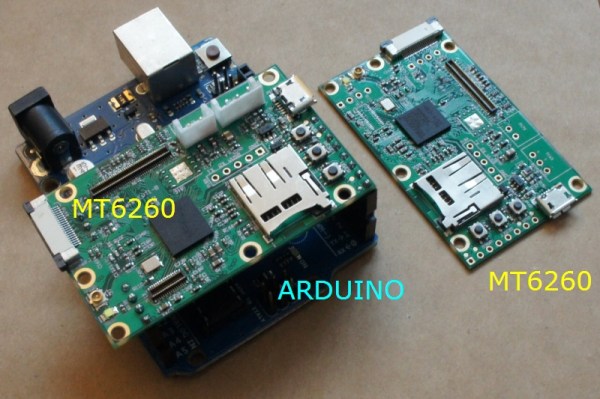
It makes an Arduino look like a 555.  A 364 Mhz, 32 bit processor. 8 MB RAM. GSM. Bluetooth. LCD controller. PWM. USB and dozens more. Smaller than a Zippo and thinner than corrugated cardboard. And here is the kicker: $3. So why isn’t everyone using it? They can’t.

Adoption would mandate tier after tier of hacks just to figure out what exact hardware is there. Try to buy one and find that suppliers close their doors to foreigners. Try to use one, and only hints of incomplete documentation will be found. Is the problem patents? No, not really.

[Bunnie] has dubbed the phenomenon “Gongkai”, a type of institutionalized, collaborative, infringementesque knowledge-exchange that occupies an IP equivalent of bartering. Not quite open source, not quite proprietary. Legally, this sharing is only grey-market on paper, but widespread and quasi-accepted in practice – even among the rights holders. [Bunnie] figures it is just the way business is done in the East and it is a way that is encouraging innovation by knocking down barriers to entry. Chinese startups can churn out gimmicky trash almost on whim, using hardware most of us could only dream about for a serious project.

Continue reading “Reverse-Engineering A Superior Chinese Product”

Hacking Education; Project-Based Learning Trumps The Ivory Tower

Project-based learning, hackathons, and final projects for college courses are fulfilling a demand for hands-on technical learning that had previously fallen by the wayside during the internet/multi-media computer euphoria of the late 90’s. By getting back to building actual hardware yourself, Hackers are influencing the direction of education. In this post we will review some of this progress and seek your input for where we go next.

Continue reading “Hacking Education; Project-Based Learning Trumps The Ivory Tower”

Towards The Perfect Coin Flip: The NIST Randomness Beacon

Since early evening on September 5th, 2013 the US National Institute of Standards and Technology (NIST) has been publishing a 512-bit, full-entropy random number every minute of every day. What’s more, each number is cryptographically signed so that you can easily verify that it was generated by the NIST. A date stamp is included in the process, so that you can tell when the random values were created. And finally, all of the values are linked to the previous value in a chain so that you can detect if any of the past numbers in the series have been altered after the next number is published. This is quite an extensive list of features for a list of random values, and we’ll get into the rationale, methods, and uses behind this scheme in the next section, so stick around.

Continue reading “Towards The Perfect Coin Flip: The NIST Randomness Beacon”