Dumping Spacecraft In The Middle Of Nowhere

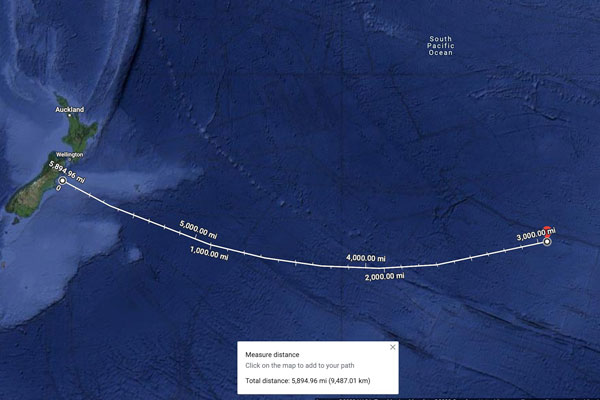
The BBC has an interesting article on Point Nemo, AKA the Oceanic Pole of Inaccessibility, AKA the spacecraft graveyard. This is the place in the ocean that is furthest from land, in the middle of the usually stormy South Pacific. It’s as far out there as you can get without leaving the planet: about 2,688 kilometers (1670 miles) from the nearest dry land. Even the ocean floor is 4 km (2.5 miles) down; the closest human life is the International Space Station (ISS) astronauts flying 415 km (260 miles) above it. It is not near any shipping lanes or transport routes. It is, to put it bluntly, the middle of goddam nowhere. So, it is a perfect place to dump derelict spacecraft.

Since 1971, over 160 spacecraft have met their end in these chilly waters, from the fiery public end of the Mir space station to the secret death of numerous secret spy satellites. The article in question focuses on the Soviet satellites, but plenty of other countries dump their end-of-life satellites there, including trash from the ISS. The Chinese Taingong-1 space station crashed nearby, although that was more by accident than design. The ISS is scheduled to join its trash in a few years: the current plan is that the massive space station will be de-orbited and crashed near Point Nemo in 2030.

Will there be anyone to see it? When the Mir space station was de-orbited, some entrepreneurial companies offered flights to the area to catch a glimpse, but the best view was from the island of Fiji. So, start planning your trip now…

Continue reading “Dumping Spacecraft In The Middle Of Nowhere” →
An observatory atop a hill

The Ultimate US Astronomy Roadtrip

Have 73 hours to kill and fancy a 4,609-mile road trip? Then you can check out some of the best observatories in the US (although we would probably recommend taking a couple of weeks rather than cramming the trip into three days, so you can spend at least one night stargazing at each).

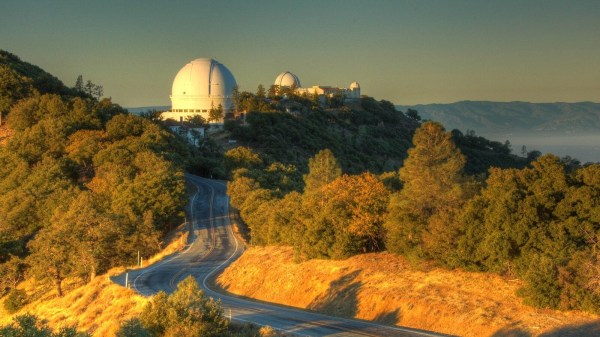
Matador Network compiled a list of what they call the top ten US observatories, and published the daunting map you see above. Even if your trip is plagued by cloudy skies, rest assured the destinations will still be worth a visit. From Arizona’s Lowell Observatory, where the evidence Edwin Hubble used to formulate the Big Bang Theory was collected, to the Green Bank National Radio Observatory in West Virginia, home of Earth’s largest fully-steerable radio telescope, each site has incredibly rich history.

All of the observatories are open to the public in some way or another, but some are only accessible a few days per month, so make sure you plan your trip carefully! You may even want to travel with your own homemade telescope, Game Boy astrphotography rig, or, if you’re really dedicated, portable radio telescope.

Continue reading “The Ultimate US Astronomy Roadtrip” →

ISS Mimic Brings Space Station Down To Earth

Built at a cost of more than $150 billion over the last twenty-five years, the International Space Station is arguably one of humanity’s greatest engineering triumphs. Unfortunately, unlike Earthly construction feats such as the Hoover Dam, Burj Khalifa, or the Millau Viaduct, you can’t visit it in person to really appreciate its scale and complexity. Well, not unless you’ve got the $50 million or so to spare to buy a seat on a Dragon capsule.

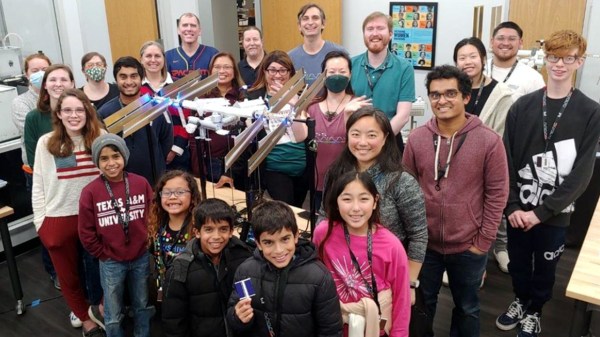
Which is why the team behind the ISS Mimic project are trying to make the ISS a bit more relatable. The open source project consists of a 3D printable 1:100 model of the Station, which is linked to the telemetry coming down from the real thing. A dozen motors in the model rotate the solar arrays and radiators to match the positions of their full-scale counterparts, while LEDs light up to indicate the status of various onboard systems.

To learn more about the ISS Mimic, team members Bryan Murphy, Sam Treadgold, and Tristan Moody stopped by this week’s Hack Chat to bring us up to speed on the past, present, and future of this fascinating project.

Continue reading “ISS Mimic Brings Space Station Down To Earth” →

The Path To Profiling Extraterrestrial Atmospheres With Astrophotonics

A major part of finding extraterrestrial life is to be able to profile the atmosphere of any planets outside of our solar system. This is not an easy task, as these planets are usually found through the slight darkening of their star as they pass in front of it (transition). Although spectroscopy is the ideal way to profile the chemical composure of such a planet, having a massive, extremely bright star right next to the planet is more than enough to completely overpower the faint light reflecting off the planet’s surface and through its atmosphere. This is a major issue that the upcoming Habitable Exoplanet Imaging Mission (HabEx, also called the Habitable Worlds Observatory, or HWO) hopes to address using a range of technologies, including a coronagraph that should block out most of the stellar glare.

While this solves much of the issue, there are still a range of issues which the new field of astrophotonics seeks to address, as detailed in a recent paper by Nemanja Jovanovic and colleagues. This involves not only profiling chemical compositions, but also increasing the precision when monitoring for planet transit events using e.g. semiconductors-based laser frequency combs. These are generally combined with a spectral flattener, which in experimental on-chip form are significantly less bulky than previous setups, to the point where they don’t necessarily have to be Earth-based.

Continue reading “The Path To Profiling Extraterrestrial Atmospheres With Astrophotonics” →

NASA’s Parker Probe Gets Front Row Seat To CME

A little over a year ago, and about 150 million kilometers (93 million miles) from where you’re currently reading this, NASA’s Parker Solar Probe quietly made history by safely flying through one of the most powerful coronal mass ejections (CMEs) ever recorded. Now that researchers have had time to review the data, amateur space nerds like ourselves are finally getting details about the probe’s fiery flight.

Launched in August 2018, the Parker Solar Probe was built to get up close and personal with our local star. Just two months after liftoff, it had already beaten the record for closest approach to the Sun by a spacecraft. The probe, with its distinctive solar shield, has come within 8.5 million kilometers (5.3 million miles) of its surface, a record that it’s set to break as its highly elliptical orbit tightens.

The fury of a CME at close range.

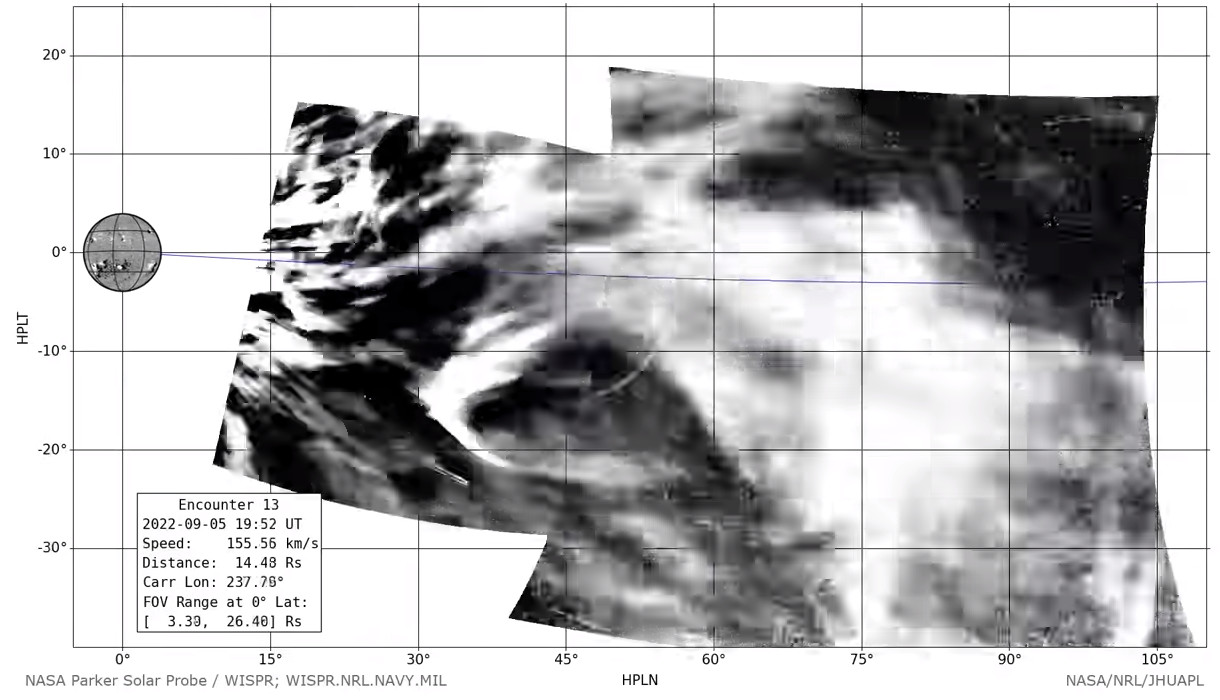
As clearly visible in the video below, the Parker probe flew directly into the erupting CME on September the 5th of 2022, and didn’t get fully clear of the plasma for a few days. During that time, researchers say it observed something that had previously only been theorized — the interaction between a CME and the swirling dust and debris that fills our solar system.

According to the Johns Hopkins Applied Physics Laboratory (APL), the blast that Parker flew through managed to displace this slurry of cosmic bric a brac out to approximately 9.6 million km (6 million miles), though the void it created was nearly instantly refilled. The researchers say that better understanding how a CME propagates through the interplanetary medium could help us better predict and track potentially dangerous space weather.

It’s been a busy year for the Parker Solar Probe. Back in June it announced that data from the craft was improving our understanding of high-speed solar winds. With the spacecraft set to move closer and closer to the Sun over the next two years, we’re willing to bet this isn’t the last discovery to come from this fascinating mission.

Continue reading “NASA’s Parker Probe Gets Front Row Seat To CME” →

Scientists Call Out Apollo 17 After Investigating Moonquakes Past

In the vast realm of space exploration, new discoveries often emerge from old data. Thanks to advanced algorithms and keen observers, the seismic activities of our closest celestial neighbor, the Moon, have recently been thrust back into the limelight.

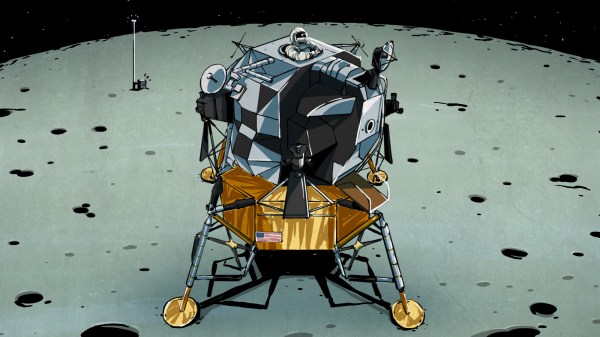
Thanks to the effort of the NASA crew involved in the Apollo 17 mission, it’s possible investigate these phenomena today with datasets from the past. Recently, researchers working with this data turned up some intriguing findings, and published them in a new paper. It reveals that one unexpected source of moonquakes could be the very equipment that Earth’s astronauts left behind. Continue reading “Scientists Call Out Apollo 17 After Investigating Moonquakes Past” →

A ceiling-mounted model of the Solar System

Ceiling-Mounted Orrery Is An Excercise In Simplicity

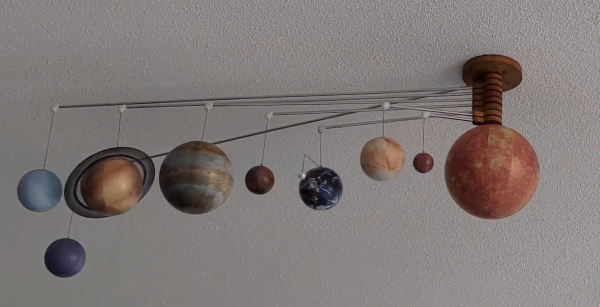
Ever since humans figured out that planets move along predetermined paths in the heavens, they have tried to make models that can accurately predict their motion. Watchmakers and astronomers worked together to create orreries: mechanical contraptions that illustrate the positions of all planets and the way they move over time through complex gear systems. [Illusionmanager] continues the orrery tradition but uses a different approach: he built a beautiful ceiling-mounted model of our Solar System without a gearing system.

The mechanism that makes his Solar System tick is deceptively simple. All planets can move freely along their orbit’s axis except Mercury, which is moved along its orbit by a motor hidden inside the Sun. Once Mercury has completed a full revolution, a pin attached to its arm will begin pushing Venus along with it. After Venus has completed a full circle, its own pin will pick up Earth, and so on all the way to Neptune. Neptune is then advanced to its correct location as reported by NASA, after which Mercury’s motion is reversed and the whole procedure is repeated in the opposite direction to position Uranus.

Cycling through the entire Solar System in this way takes a long time, which is why the planets’ positions are only updated once a day at midnight. An ESP32, also hidden inside the Sun, connects to the internet to retrieve the correct positions for the day and drives the motor. The planet models, sourced from a museum shop, are hanging from thin aluminium tubes attached to wooden mounts made with a desktop CNC machine.

[Illusionmanager] made a detailed Instructables page showing the process of making a miniature version of the mechanism using just laser-cut wooden parts, as an update to a version we featured earlier. We really like the simplicity of this design, which stands in stark contrast to the huge gear trains used in more traditional orreries.

Continue reading “Ceiling-Mounted Orrery Is An Excercise In Simplicity” →