[Leo] Repairs A MIDI Sequencer

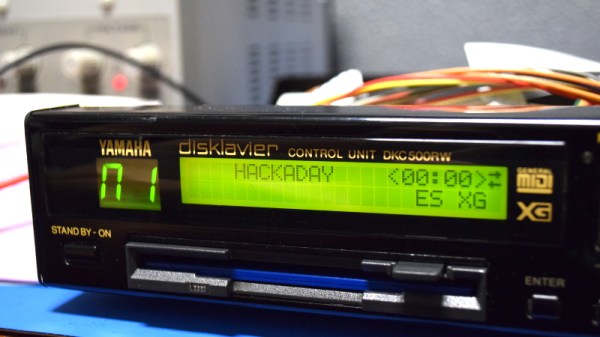
We all have that friend who brings us their sad busted electronics. In [Leo’s] case, he had a MIDI sequencer from a musician friend. It had a dead display and the manufacturer advised that a driver IC was probably bad, even sending a replacement surface mount part.

[Leo] wasn’t convinced though. He knew that people were always pushing on the switches that were mounted on the board and he speculated that it might just be a bad solder joint. As you can see in the video below, that didn’t prove out.

The next step was to fire up a hot air gun. Instead of removing the chip, he wanted to reflow the solder anyway. He was a little worried about melting the 7-segment LEDs so he built a little foil shield to protect it. That didn’t get things working, either.

Continue reading “[Leo] Repairs A MIDI Sequencer”

Deep Discounts Yield Deep Reverse Engineering Of Biotech Hardware

Hitting the electronic surplus shop is probably old hat to most of our readership. Somewhere, everyone’s got that little festering pile of hardware they’re definitely going to use some day. An old fax is one thing, but how would your partner feel if you took home an entire pallet-sized gene sequencing rig? Our friend [kaspar] sent along an interesting note that the folks at Swiss hackerspace Hackteria got their hands on an Illumina HiSeq 2000 last year (see funny “look what we got!” photo at top) and have generated a huge amount of open documentation about whats inside and how to use it.

Okay first off, what the heck is this machine anyway? The HiSeq is designed to automatically perform the sequencing step of Illumina’s proprietary multi step gene sequencing process (see manufacturer’s glossy for more), and to do so with minimal human intervention. That means that the unit contains a microfluidics system to manipulate samples, an extremely high performance optical scan system complete with controllable stage, imager, fluorescence modes, etc, and lots of other things this author isn’t sufficiently trained to guess at.

The folks at Hackteria have done a pretty thorough teardown of the system and produced block diagrams of most of its modules. They’ve also run some of the tools and recorded logs of what they were up to, including the serial commands sent to and from the machine to control certain subsystems. Of course a tool like this was meant to be driven by Illumina’s specific software, but unusually those are available and surprisingly usable which is how the aforementioned logs were captured. Right now it looks like Hackteria has put together tools to use the system as a fluorescent microscope.

Oddly the most interesting thing here might be how available these systems are. It appears that they’re being replaced en masse and have become easily available in the range of thousands of dollars on the secondary market. At that price point they’re almost worth snapping up for the enclosure and parts! But we prefer Hackteria’s goal of enabling the Citizen Scientist to make use of these incredible machines for their intended purpose. Who knows what exciting projects we’ll find when hackers start sequencing their cats!

Thanks for the tip [kaspar]!

Cutting Wit And Plastic

If you have ever used a scalpel to cut something tougher than an eraser, you can appreciate a hot knife or better yet, an ultrasonic cutter. Saws work too, but they have their own issues. [This Old Tony] uses a hobby store tool to cut some plastic and wood, then demos a commercial ultrasonic cutter to show how a blade can sail through with less brute force. The previous requires some muscle, finesse, and eventually a splash of Bactine antiseptic. The video can also be seen after the break.

This is more than a tool review, [Tony] takes it apart with a screwdriver and offers his snarky comments. On the plus side is that it cuts polystyrene well where a regular knife won’t do more than scratch or shatter it. Meanwhile in the negative category we don’t hear a definitive price, but they seem to cost half as much as his mini-lathe. If you need an estimated return on investment, consider the price of two-thousand X-acto blades, but you may also wish to factor in the reduced hand calluses. While you are shopping, maybe also think about a set of earplugs; when the video gets to 17:30 he tries to cut a ceramic fitting and manages to make a child-deafening screech instead. We warned you.

This is a fitting follow-up to his unsuccessful attempt to turn an ultrasonic cleaner into an ultrasonic cutter, but we have seen success converting a tooth scaler into a cutter.

Continue reading “Cutting Wit And Plastic”

A Cloned Bluetooth Tracker Meets Its Maker

The holidays bring us many things. Family and friends are a given, as is the grand meal in which we invariably overindulge. It’s a chance for decades old songs and movies to somehow manage to bubble back up to the surface, and occasionally a little goodwill even slips in here or there. But perhaps above all, the holidays are a time for every retailer to stock themselves to the rafters with stuff. Do you need it? No. Do they want it? No. But it’s there on display anyway, and you’re almost certainly going to buy it.

Which is precisely how I came to purchase a two pack of Bluetooth Low Energy (BLE) “trackers” for the princely sum of $10 USD. I didn’t expect much out of them for $5 each, but as this seemed an exceptionally low price for such technology in a brick and mortar store, I couldn’t resist. Plus there was something familiar about the look of the tracker that I couldn’t quite put my finger on while I was still in the store.

That vague feeling of recollection sent me digging through my parts bin as soon as I got home, convinced that I had seen something among the detritus that reminded me of my latest prize. Sure enough, I found a “Cube” Bluetooth tracker which, ironically, I had received as a Christmas gift some years ago. Putting them side by side, it was clear that the design of these “itek” trackers took more than a little inspiration from the better known (and five times as expensive) product.

The Cube was a bit thicker, but otherwise the shape, size, and even button placement on the itek was nearly identical. Reading through their respective manuals, the capabilities also seemed in perfect parity, down to being able to use the button on the device as a remote camera control for your smartphone. Which got me thinking: just how similar would these two devices be internally? Clearly they looked and functioned the same, but would they be built the same as well? They would have to cut costs somewhere.

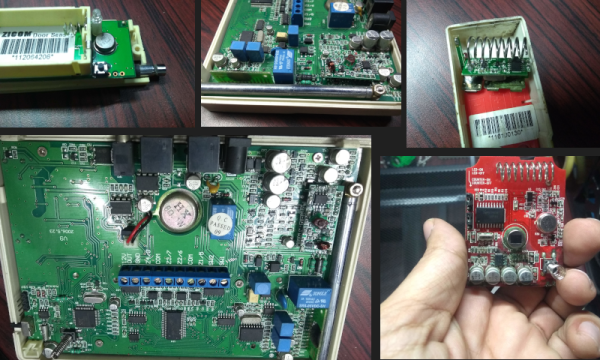
Determined to find out how a company can put out what for all the world looks like a mirror image of a competitor’s device while undercutting them by such a large margin, I cracked both trackers open to get a bit more familiar with what makes them tick. What I found on closer inspection of these two similar gadgets is perhaps best summarized by that age old cautionary adage: “Don’t judge a book by its cover.”

Continue reading “A Cloned Bluetooth Tracker Meets Its Maker”

Teardown Shows Why Innovative Designs Sometimes Fail

Some ideas are real head-scratchers from a design standpoint: Why in the world would you do it that way? For many of us, answering that question often requires a teardown, which is what [Ben Katz] did when this PCB motor-powered weed whacker came across his bench. The results are instructive on what it takes to succeed in the marketplace, or in this case, how to fail.

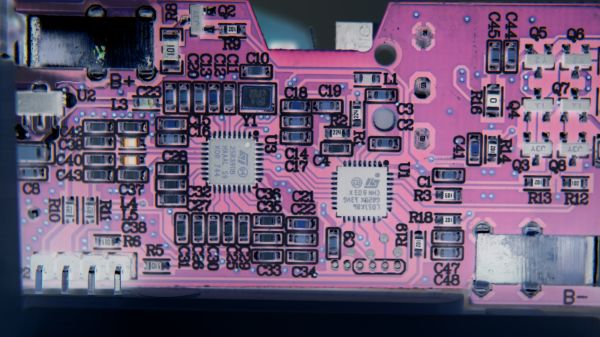
The unit in question comes from an outfit called CORE Outdoor Power. The line trimmer was powered by a big lithium-ion battery pack, but [Ben] concentrated on the unique motor for his teardown. After a problematic entry into the very sturdy case at the far end of the trimmer’s shaft, he found what looks like a souped-up version of [Carl Bugeja]’s PCB brushless motors. The rotors, each with eight large magnets embedded, are sandwiched on either side of a very thick four-layer PCB with intricately etched heavy copper traces. The PCB forms the stator, with four flat coils. The designer pulled a neat trick with the Hall-effect sensors needed for feedback; rather than go with surface-mount sensors, which would add to the thickness of the board, they used through-hole packages soldered to surface pads, with the body of the sensor nestled in a hole in the board. The whole design is very innovative, but sadly, [Ben]’s analysis shows that it has poor performance for its size and weight.

Google around a bit and you’ll see that CORE was purchased some years back by MTD, a big player in the internal combustion engine outdoor power market. They don’t appear to be a going concern anymore, and it looks as though [Ben] has discovered why.

[Jozef] tipped us off to this one. Thanks!

1973: When Calculators Were Built Like Computers

Should you ever pick up [Steve Wozniak]’s autobiography, you will learn that in the early 1970s when his friend [Steve Jobs] was working for Atari, [Woz] was designing calculators for Hewlett Packard. It seems scarcely believable today, but he describes his excitement at the prospects for the calculator business, admitting that he almost missed out on the emerging microcomputer scene that would make him famous. Calculators in the very early 1970s were genuinely exciting, and were expensive and desirable consumer items.

[Amen] has a calculator from that period, a Prinztronic Micro, and he’s subjected it to an interesting teardown. Inside he finds an unusual modular design, with keyboard, processor, and display all having their own PCBs. Construction is typical of the period, with all through hole components, and PCBs that look hand laid rather than made using a CAD package. The chipset is a Toshiba one, with three devices covering logic, display driver and clock.

The Prinztronic is an interesting device in itself, being a rebadged 1972 Sharp model under a house brand name for the British retailer Dixons, and that Toshiba chipset is special because it is the first CMOS design to market. It was one of many very similar basic calculators on the market at the time, but at the equivalent of over 100 dollars in today’s money it would still have been a significant purchase.

Long-tern Hackaday readers will remember we’ve shown you at least one classic calculator rebuild in the past, the venerable 1975 Sinclair!

1985 Electric Vehicle Restoration

We tend to think of electric vehicles as a recent innovation, however many successful products are not the first ones to appear on the market. We have a habit of forgetting the progenitors such as mechanical scanned TVs or the $10,000 Honeywell kitchen computer. A case in point is [Clive Sinclair]’s C5 electric vehicle from 1985. If you’ve heard of it at all, you probably recall it was considered a stellar disaster when it was released. But it is a part of electric vehicle history and you can see [RetroManCave] talk to [Dave] about how he restored and operates a C5 of his own in the video below. If you want to dig into the actual restoration, [Dave] has three videos about the teardown and rebuild on his channel.

Sinclair saw this as the first shot across the bow with a series of electric vehicles, but it was doomed from the start. It isn’t a car. In fact, it is more like a bicycle with a battery. It seats one occupant who is exposed to the elements. It had a very tiny trunk. It can go — optimistically — 15 miles per hour and runs out of juice after about 20 miles — if you helped out by pedaling. If you weren’t up for the exercise, you’d get less out of the lead-acid battery.

Continue reading “1985 Electric Vehicle Restoration”