Top Secret Teardown Reveals Soviet Missile Secrets

Technology has moved at such a furious pace that what would have been most secret military technology a few decades ago is now surplus on eBay. Case in point: [msylvain59] picked up a Soviet-era K-13 IR seeker used to guide air-to-air missiles to their targets. Inside is a mechanical gyroscope turning at over 4,000 RPM, a filter made of germanium to block visible light, and a photoresistor. It’s sobering to think you can get all of this in a few small packages these days, if not integrated into one IC.

Fitting on top of a missile, the device isn’t that large anyway, but it is nothing like what a modern device would look like. A complex set of electronics processes the signal and moves steering actuators that control fins and other controls to guide the missile’s flight. You can see a video of the device giving up its secrets, below.

Continue reading “Top Secret Teardown Reveals Soviet Missile Secrets”

Old Wattmeter Uses Magnetics To Do The Math

Measuring power transfer through a circuit seems a simple task. Measure the current and voltage, do a little math courtesy of [Joule] and [Ohm], and you’ve got your answer. But what if you want to design an instrument that does the math automatically? And what if you had to do this strictly electromechanically?

That’s the question [Shahriar] tackles in his teardown of an old lab-grade wattmeter. The video is somewhat of a departure for him, honestly; we’re used to seeing instruments come across his bench that would punch a seven-figure hole in one’s wallet if acquired new. These wattmeters are from Weston Instruments and are beautiful examples of sturdy, mid-century industrial design, and seem to have been in service until at least 2013. The heavy bakelite cases and sturdy binding posts for current and voltage inputs make it seem like the meters could laugh off a tumble to the floor.

But as [Shahriar] discovers upon teardown of a sacrificial meter, the electromechanical movement behind the instrument is quite delicate. The wattmeter uses a moving coil meter much like any other panel meter, but replaces the permanent magnet stator with a pair of coils. The voltage binding posts are connected to the fine wire of the moving coil through a series resistance, while the current is passed through the heavier windings of the stator coils. The two magnetic fields act together, multiplying the voltage by the current, and deflect a needle against a spring preload to indicate the power. It’s quite clever, and the inner workings are a joy to behold.

We just love looking inside old electronics, and moving coil meters especially. They’re great gadgets, and fun to repurpose, too.

Continue reading “Old Wattmeter Uses Magnetics To Do The Math”

1,000 Watt Power Supply Tear Down And Repair

[TheSignalPath] wanted to repair a broken Instek PSW80-40.5 because it has a lot of output for a programmable power supply — 1,080 watts, to be exact. This isn’t a cheap supply — it looks like it costs about $2,200 new. The unit wasn’t working and when he took it apart, he found a nasty surprise. There is a base PCB and three identical power supply modules, and virtually no access without disconnecting the boards. He continued the teardown, and you can see the results in the video below.

Each of the power supply modules are two separate PCBs and the design has to account for the high currents required. The power supply is a switching design with some filtering on the motherboard. One of the boards of the power supply module rectifies the incoming line voltage to a high DC voltage (about 400 volts). The second board then does DC to DC conversion to the desired output.

Continue reading “1,000 Watt Power Supply Tear Down And Repair”

The Electronics Of Cold War Nightmares

It is a good bet that if you look around you, you’ll be able to find at least one smoke detector in sight. If not, there’s probably one not too far away. Why not? Fires happen and you’d like to know about a fire even if you are sleeping or alert others if you are away. During the cold war, there were other things that people didn’t want to sleep through. [Msylvain59] tears down two examples: a Soviet GSP-11 nerve agent detector and a Polish RS-70 radiation alarm. You can see both videos, below.

In all fairness, the GSP-11 is clearly not meant for consumer use. It actually uses a test strip that changes colors and monitors the color change. Presumably, the people operating it were wearing breathing gear because the machine could take quite a while to provide a positive output. Inside reminded us of a film processing machine, which isn’t too far off.

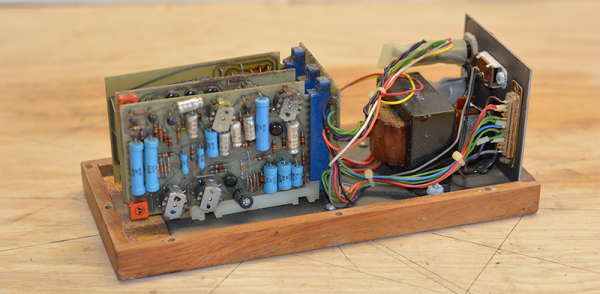
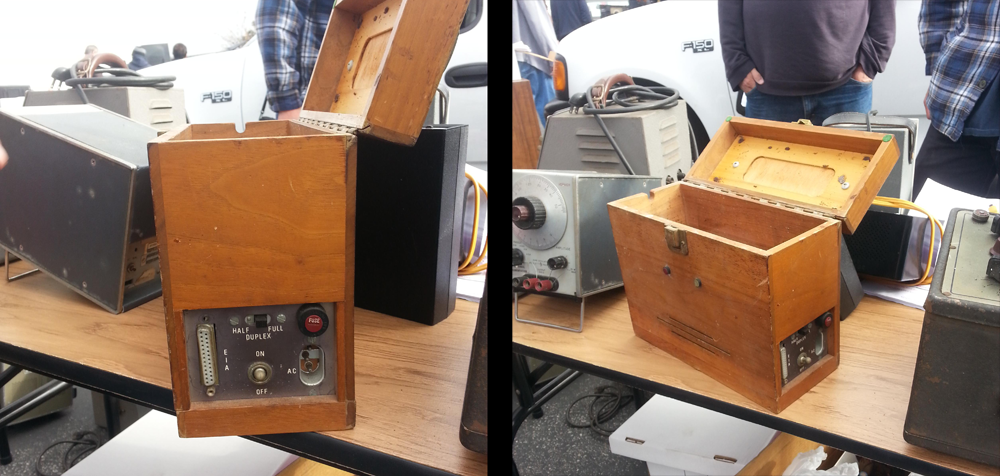
The radiation monitor looks more like a miniature version of an old floor-standing radio. The case design, the thick-traced, single-sided, hand-drawn printed wiring board, and the –by today’s standards — huge parts within all contribute to making this look like a piece of radio gear from the 1970s or even earlier.

Continue reading “The Electronics Of Cold War Nightmares”

Poké Ball Plus Teardown Reveals No Pikachu Inside

The latest entry in the fan favorite franchise Pokémon saw release earlier this month alongside a particularly interesting controller. Known as the Poké Ball Plus, this controller is able to control Pokémon games that are available on completely separate platforms, as well as transfer data between them. It rumbles, It talks, it lights up, it’s wireless, and [Spawn] uploaded a video that reveals what’s really inside.

Continue reading “Poké Ball Plus Teardown Reveals No Pikachu Inside”

Agilent LCR Meter Teardown

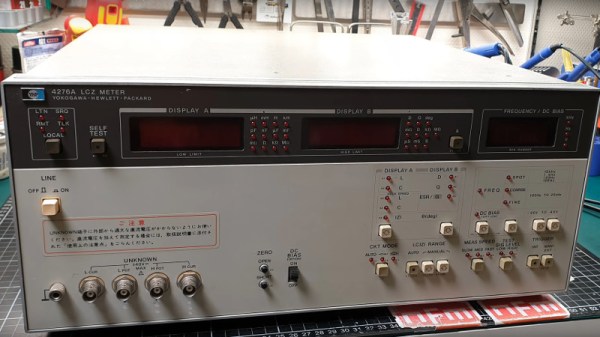
Since 1999, one of the more popular manufacturers of test equipment has been Agilent, the spun-off former instrument division of Hewlett-Packard. From simple multimeters to fully-equipped oscilloscopes, they have been covering every corner of this particular market. And, with the help of [Kerry Wong] and his teardown of an Agilent LCR meter, we can also see that they’ve been making consistent upgrades to their equipment as well.

The particular meter that [Kerry] took apart was an Agilent U1731B, a capable LCR (inductance, capacitance, resistance) meter. He had needed one for himself and noted that while they’re expensive when new, they can be found at a bargain used, but that means dealing with older versions of hardware. For example, his meter uses an 8-bit ADC while the more recent U1733 series uses a 24-bit ADC. The other quality of this meter that [Kerry] made special note of was how densely populated the circuit board is, presumably to save on the design of a VLSI circuit.

While we don’t claim to stump for Agilent in any way, it’s good to know that newer releases of their equipment actually have improved hardware and aren’t just rebadged or firmware-upgraded versions of old hardware with a bigger price tag attached. Also, there wasn’t really any goal that [Kerry] had in mind besides sheer curiosity and a willingness to dive deep into electronics details, as those familiar with his other projects know already.

[Ben Krasnow] Gasses MEMS Chips, For Science

Why in the world does helium kill iPhones and other members of the Apple ecosystem? Enquiring minds want to know, and [Ben Krasnow] has obliged with an investigation of the culprit: the MEMS oscillator. (YouTube, embedded below.)

When we first heard about this, courtesy in part via a Hackaday post on MRI-killed iPhones, we couldn’t imagine how poisoning a micro-electromechanical system (MEMS) part could kill a phone. We’d always associated MEMS with accelerometers and gyros, important sensors in the smartphone suite, but hardly essential. It turns out there’s another MEMS component in many Apple products: an SiT 1532 oscillator, a tiny replacement for quartz crystal oscillators.

[Ben] got a few from DigiKey and put them through some tests in a DIY gas chamber. He found that a partial pressure of helium as low as 2 kPa, or just 2% of atmospheric pressure, can kill the oscillator. To understand why, and because [Ben] has a scanning electron microscope, he lapped down some spare MEMS oscillators to expose their intricate innards. His SEM images are stunning but perplexing, raising questions about how such things could be made which he also addresses.

The bottom line: helium poisons MEMS oscillators in low enough concentrations that the original MRI story is plausible. As a bonus, we now understand MEMS devices a bit better, and have one more reason never to own an iPhone.

Continue reading “[Ben Krasnow] Gasses MEMS Chips, For Science”