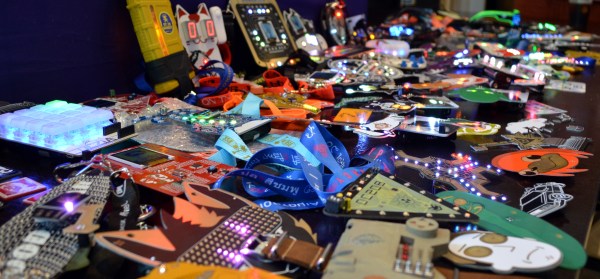
At the recent Electromagnetic Field hacker camp in the UK, one of the highlights was the Null Sector, a cyberpunk-themed zone best described as something close to the set of Blade Runner made from shipping containers, clever props, and lighting. Our community rose to the occasion with some truly impressive costumes and wearable electronics, lending the venue a real authenticity.
Among the many creations on show there was one that stood quite literally head and shoulders above the rest. [Chebe]’s colour stealing sound reactive LED headdress is a confection of Neopixels, organza, and transparent floor protectors on a wire frame, driven by a Lillypad wearable microcontroller board with a microphone and colour sensor attached. The resulting sound-and-colour-reactive display stood out across a crowded venue full of hackers who’d all made their own efforts to produce similar outfits, which is really saying something!
The Lillypad and LEDs are standard fare, but the wire part of this project isn’t, and that’s what makes it rather interesting from our perspective. Anyone can make something that goes over their head, but to make something that’s comfortable takes a bit of effort and thought. Have you ever tried a set of ill-fitting sunglasses? If you have then you might understand. In this case stiff garden wire is used, bent to shape and joined with rolled-up tape, before being covered with wound-on ribbon for extra comfort. A Hackaday scribe travels the field at a hacker camp, and though [Chebe]’s cranium is a little more petite than the Hackaday bonce it was certainly an enveloping fit when we tried it.
Anyone can attach an LED to an item of clothing and call it a wearable. But to be noticed like this one it has to be done with style. If you’ve not had your fill of this topic, we suggest you continue with the Hackaday Belgrade talk from our friend [Rachel “Konichiwakitty” Wong].