3D Printing On The Subway; Or Anywhere Else!

3D-Printed wearable electronics are on the rise, however our own [Naomi Wu] flipped it around and made a wearable 3D printer which not only is portable but also manufactures on the move!

The project starts with a baby carrier that was locally purchased, and the extra fat was trimmed off leaving behind only the primary harness and square frame. This square frame is left intact to provide stability to the mounted printer as well as some level of comfort to the wearer. [Naomi] then drills a number of new holes in the delta printer in question, of which fortunately the top is made of plastic. Using swivel screws and long screws, the upper part connects with the harness. The receptacle clamp for the upper part is 3D-printed as well, and provides a modular rigid fixture for the machine.

The lower part also uses a 3D-printed triangular base that has a slot for the carrier frame which attaches with the bottom part of the delta using screws. The project is powered via two 3 Ah batteries that are kept in place behind the printer using custom clamps made with PLA. The whole project works on the move, as demonstrated by [Naomi] in the video below.

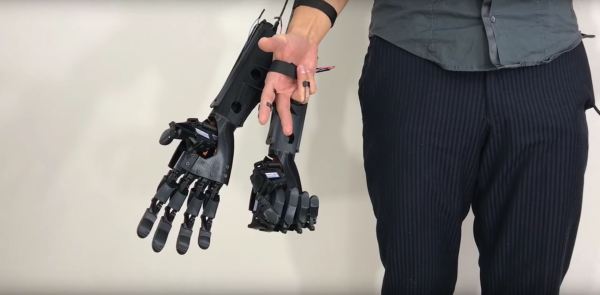
From dissecting the baby carrier to puncturing holes in a harness using a screwdriver heated by a blow torch, this project has a lot of DIY in it. For those looking for a more productive motorised wearable, check out Adding Haptic Feedback For The Disabled. Continue reading “3D Printing On The Subway; Or Anywhere Else!”

LED Princess Dress Also Lights Up Girl’s Face

We’re pretty sure that [Luke] took Uncle of the Year last Halloween when he made an RGB LED princess dress for his niece. He recently found the time to document the build with a comprehensive how-to that’s just in time for Halloween ’17.

[Luke] made the system modular so that his niece could use it with any dress. The RGB LED strips are actually fastened down the inside of a petticoat — a fluffy, puffy kind of slip that’s worn underneath the dress. The LEDs face in toward the body, which helps diffuse the light. [Luke] first attached the strips with their own adhesive and then spent a lot of time sewing them down so they stayed put. At some point, he found that hot glue worked just as well.

The coolest part of this project (aside from the blinkenlights of course) is the power source. [Luke] used what he already had lying around: an 18V Ryobi battery pack. He wired a step-converter to it using a printed cap from Shapeways that’s designed to connect metal clips to the battery contacts. This cap really makes these packs useful for a lot of projects that need long-lasting portability.

These batteries are rated for 240W, which is overkill considering the load. But there’s a reason: it keeps heat to a minimum, since the electronics are hidden inside a cute little backpack. Speaking of cute, you can see his niece model the dress after the break.

Continue reading “LED Princess Dress Also Lights Up Girl’s Face”

Hybrid Technique Breaks Backscatter Distance Barrier

Low cost, long range, or low power — when it comes to wireless connectivity, historically you’ve only been able to pick two. But a group at the University of Washington appears to have made a breakthrough in backscatter communications that allows reliable data transfer over 2.8 kilometers using only microwatts, and for pennies apiece.

For those unfamiliar with backscatter, it’s a very cool technology that modulates data onto RF energy incident from some local source, like an FM broadcast station or nearby WiFi router. Since the backscatter device doesn’t need to power local oscillators or other hungry components, it has negligible power requirements. Traditionally, though, that has given backscatter devices a range of a few hundred meters at most. The UW team, led by [Shyamnath Gollokota], describe a new backscatter technique (PDF link) that blows away previous records. By combining the spread-spectrum modulation of LoRa with the switched attenuation of incident RF energy that forms the basis for backscatter, the UW team was able to cover 2800 meters for under 10 microwatts. What’s more, with printable batteries or cheap button cells, the backscatter tags can be made for as little as 10 cents a piece. The possibilities for cheap agricultural sensors, ultracompact and low power wearable sensors, or even just deploy-and-forget IoT devices are endless.

We’ve covered backscatter before, both for agricultural uses and for pirate broadcasting stations. Backscatter also has also seen more cloak and dagger duty.

Continue reading “Hybrid Technique Breaks Backscatter Distance Barrier”

Hacked Headset Brings VR To The Commodore 64

The venerable Commodore 64 got a lot of people started in computers, and a hard core of aficionados keeps the platform very much alive to this day. But a C64 just doesn’t have the horsepower to do anything more than some retro 8-bit graphics games, right?

Not if [jim_64] has anything to say about it. He’s created a pair of virtual-reality goggles for the C64, and the results are pretty neat. Calling them VR is a bit of a stretch, since that would imply the headset is capable of sensing the wearer’s movements, which it’s not. With just a small LCD screen tucked into the slot normally occupied by a smartphone in the cheap VR goggles [jim64] used as a foundation for his build, this is really more of a 3D wearable display — so far. The display brings 3D-graphics to the C64, at least for the “Street Defender” game that [jim64] authored, a demo of which can be seen below. We’ll bet position sensing could be built into the goggles to control the game too. Even then it won’t be quite the immersive (and oft-times nauseating) experience that VR has become, but for a 35-year old platform, it’s not too shabby.

Looking for more C64 love? We’ve got a million of ’em — case mods, C64 laptops, tablets, even CPU upgrades.

Continue reading “Hacked Headset Brings VR To The Commodore 64”

Hackaday Prize Entry: SNAP Is Almost Geordi La Forge’s Visor

Echolocation projects typically rely on inexpensive distance sensors and the human brain to do most of the processing. The team creating SNAP: Augmented Echolocation are using much stronger computational power to translate robotic vision into a 3D soundscape.

The SNAP team starts with an Intel RealSense R200. The first part of the processing happens here because it outputs a depth map which takes the heavy lifting out of robotic vision. From here, an AAEON Up board, packaged with the RealSense, takes the depth map and associates sound with the objects in the field of view.

Binaural sound generation is a feat in itself and works on the principle that our brains process incoming sound from both ears to understand where a sound originates. Our eyes do the same thing. We are bilateral creatures so using two ears or two eyes to understand our environment is already part of the human operating system.

In the video after the break, we see a demonstration where the wearer doesn’t need to move his head to realize what is happening in front of him. Instead of a single distance reading, where the wearer must systematically scan the area, the wearer simply has to be pointed the right way.

Another Assistive Technology entry used the traditional ultrasonic distance sensor instead of robotic vision. There is even a version out there for augmented humans with magnet implants covered in Cyberpunk Yourself called Bottlenose.

Continue reading “Hackaday Prize Entry: SNAP Is Almost Geordi La Forge’s Visor”

Project Kino: Robotic Jewelry And Tech Accessory

Researchers from MIT and Stanford are taking the ‘person’ in ‘personal assistant’ to mean something more literal with these robots that scurry around on the user’s clothing.

Project Kino — inspired by living jewelry — are robotic accessories that use magnetic gripping wheels on both sides of the clothing to move about. For now they fill a mostly aesthetic function, creating kinetic accents to one’s attire, but one day they might be able to provide more interactive functionality. They could act as a phone’s mic, adjust clothing to suit the weather, function as high-visibility wear for cyclists or joggers, as haptic feedback sensors for all manner of applications (haptic sonar bodysuit, anyone?), assemble into large displays, and even function as a third — or more! — hand are just the tip of the iceberg for these ‘bots.

Continue reading “Project Kino: Robotic Jewelry And Tech Accessory”

Catch The Eclipse With A Wearable Pinhole Camera

You say you didn’t have enough warning to order eclipse glasses, and now they’re too expensive to buy? Or maybe you did order some but they ended up being those retina-combusting knock-offs, and now you’ve got nothing to protect you during the partial phase of Monday’s eclipse? Don’t dump a ton of money on unobtainium glasses — just stick your head in a cardboard box.

You may end up looking like a Box Troll with the aptly named [audreyobscura]’s box on your head, but it really is a safe and effective way of watching the eclipse, or for gazing at our star anytime for that matter. It’s nothing more than a large pinhole camera, with a tiny hole in a scrap of aluminum soda can acting as an aperture. The pinhole in one end of a box casts a perfect image of the sun on a paper screen at the other end of the box. A hole for your head with a proper gasket around your neck — maybe the neck of an old T-shirt would be a bit more comfortable and light tight? — and you’re ready for the show. The bigger the box, the bigger (and dimmer) the image will be, so you’ll want to cruise the local home center for long boxes. Because walking around with a water heater box on your head is totally cool.

Really, though, Hackaday readers can’t say they didn’t know this was coming. We started covering this in January, we’ve got hundreds of eclipse meetups across the country, and we’ve even covered some citizen science opportunities you can partake in on Eclipse Day. If you don’t have your head in a box, that is.

Thanks to [Roger Guess] for the idea on this one.