Humans Vs. Zombies Via The ESP8266

Zombies, for the most part, remain fictional and are yet to trouble human communities. Despite the many real world calamities we face, the zombie concept remains a compelling one and the subject of many books, films, and video games. [CNLohr] was at MagStock Eight when he met [Aaron], who has developed a real world game in this vein. (YouTube, embedded below.)

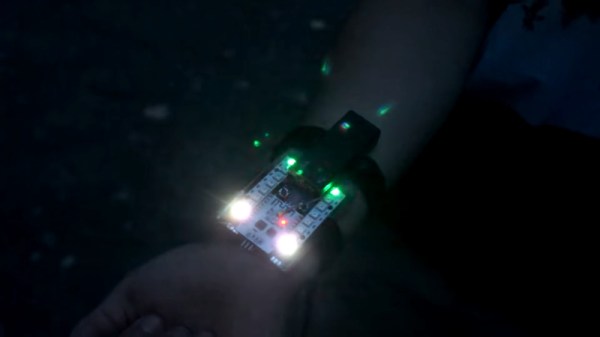
[Aaron]’s game goes by the name of SpyTag, and is played by a group of people who each have a small device affixed to their wrist. Two players start off as zombies, and the rest are humans. The zombies can use their devices as proximity detectors to hunt down nearby humans, and the humans can use their devices to detect nearby zombies, helping them escape and evade.

The devices operate using the ESP8266, in AP+station mode. The proximity sensing works on a very simple method. Devices show their human or zombie status by appearing as a WiFi AP by that name, and proximity detection is achieved by showing the signal strength of the opposite AP on an LED bar on the device. Once zombies get close enough to human devices, the humans are infected and become zombies themselves.

It’s a tidy and lightweight way to implement the gameplay, and requires no infrastructure or support hardware outside of the wristband hardware for the players. While this method would likely be vulnerable to spoofing, [CNLohr] reports that future work will likely switch to using the ESP-NOW protocol to make the game more secure.

[Aaron] has shared the project on Github for those interested in digging deeper into the code. We’ve seen a similar game played before, using IR instead. Video after the break.

[Thanks to Baldpower for the tip!]

Continue reading “Humans Vs. Zombies Via The ESP8266”

Automate Your Home From The Clearance Rack

The month or so after the holidays have always been a great time to pick up some interesting gadgets on steep clearance, but with decorations and lights becoming increasingly complex over the last few years, the “Christmas Clearance” rack is an absolute must see for enterprising hackers. You might just luck out like [ModernHam] and find a couple packs of these dirt cheap wireless light controllers, which can fairly easily be hacked into the start of a home automation system with little more than the Raspberry Pi and a short length of wire.

In the video after the break, [ModernHam] walks the viewer through the start to finish process of commanding these cheap remote plugs. Starting with finding which frequencies the remotes use thanks to the FCC database and ending with using cron to schedule the transmission of control signals from the Pi, his video really is a wealth of information. Even if you don’t have this particular model of remote plug, or don’t necessarily want to setup a home automation system, there’s probably some element of this video that you could still adapt to your own projects.

The first step of the process is figuring out how the remote is communicating to the plugs. [ModernHam] noticed there was no frequency listed on the devices, but using their FCC IDs he was able to find the relevant information. In the United States, devices like these must have their FCC IDs visible (though they could be behind a battery door) by law, so the searchable database is an invaluable tool to do some basic reconnaissance on a poorly documented gadget.

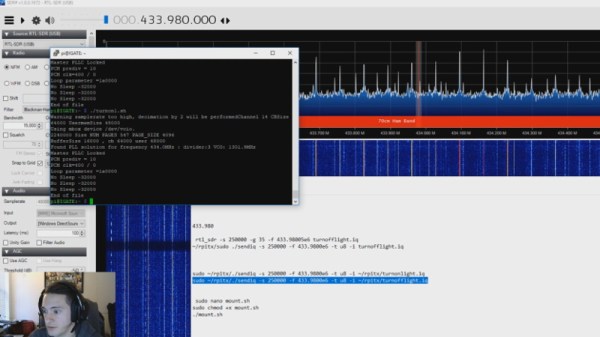
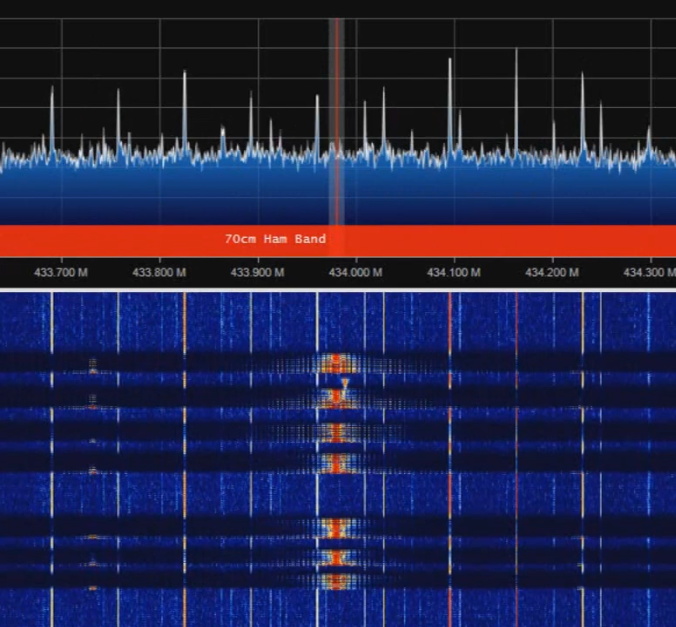
An RTL-SDR receiver is then used to fine tune the information gleaned from the FCC filing. [ModernHam] found that the signals for all four of the remote plugs were being broadcast on the same frequency, which makes controlling them all the easier. Using the rtl-sdr command, he was able to capture the various signals from the transmitter and save them to separate files. Then it’s just a matter of replaying the appropriate file to get the plugs to do your bidding.

Of course, the RTL-SDR can’t transmit so you’ll have to leave your dongle behind for this last step. Luckily all you need to transmit is the rpitx package created by [F5OEO], along with a supported Raspberry Pi and a small length of wire attached to the appropriate GPIO pin. This package contains the tool sendiq which can be used to replay the raw captures made in the previous step. With some scripting, it’s fairly straightforward to automate these transmissions to control the remote plugs however you wish from the Pi.

The RTL-SDR Blog put together their own guide for “brute forcing” simple remote control devices like this as well, and we’ve even seen similar techniques used against automotive key fobs in the past. Amazing what a piece of wire and some clever code can pull off.

Continue reading “Automate Your Home From The Clearance Rack”

Hacking Hackaday.io From CircuitPython

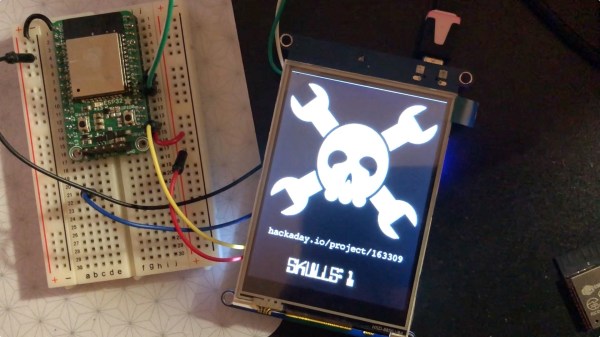
If you’ve ever engaged in social media, you’re familiar with the little thrill you receive when your post, tweet, or project gets a like. But, if logging in feels like too much overhead to obtain your dopamine reward, [pt’s] CircuitPython Hackaday portal may be just what you’re looking for. This project creates a stand-alone counter to display the number of “skulls” (aka likes) received by a project on hackaday.io, and of course, it’s currently counting its own.

The code is running on a SAMD51 (Cortex M4) microcontroller and serving up the skulls on 240×320 TFT display. For WiFi connectivity, the project uses an ESP-32 controlled through the usual AT command set. All the gory details of this interaction are abstracted away by a CircuitPython library, which is great because that code really isn’t something you want to write for every project. The program accesses the hackaday.io API to retrieve the number of skulls for the project, but could be easily modified to interface with any service that returned a JSON result.

We’ve been seeing a lot of CircuitPython code lately. Just in case you’re not familiar with it, CircuitPython is Adafruit’s version of Micropython, a python language targeted at embedded processors. While it sounds like something concocted purely to make old-school embedded-C programmers grumble, it’s actually powerful and convenient for embedded prototyping and development. Fueled by the speed of the latest inexpensive microcontrollers and a rapidly growing set of libraries that take the sting out of using integrated peripherals and common hacker-friendly parts, it offers a solid alternative to older embedded frameworks. There are lots of examples around if you want to get started, and we’re maintaining our own list of CircuitPython projects over on hackaday.io that you can check out.

You can see a video of the display after the break. It’s not a live stream, so you won’t see your like appear on the display, but rest assured, [pt] will!

Continue reading “Hacking Hackaday.io From CircuitPython”

Long-Range RFID With Feedback

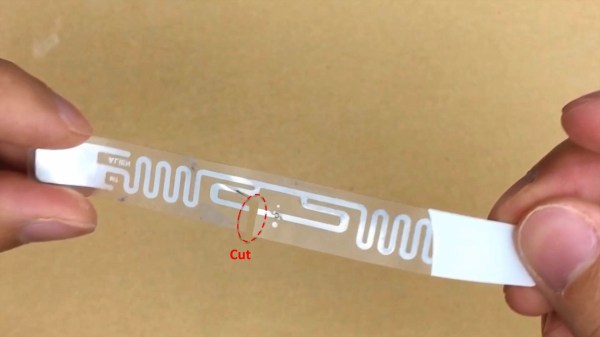
Not long ago, we published an article about researchers adding sensor data to passive RFID tags, and a comment from a reader turned our heads to a consumer/maker version which anyone can start using right away (PDF). If you’re catching up, passive RFID technology is behind the key fobs and stickers which don’t need power, just proximity to the reader’s antenna. This is a much “hackier” version that works with discrete signals instead of analog ones. It will not however require writing a new library and programming new tags from the ground up just for the user to get started, so there is that trade-off. Sparkfun offers a UHF reader which can simultaneously monitor 25 of the UHF tags shown in this paper.

To construct one of these enhanced tags, the antenna trace is broken and then routed through a switching device such as a glass-break sensor, temperature limit switch, doorbell, or light sensor. Whenever continuity is restored the tag will happily send back its pre-programmed data, and the reader will acknowledge that somewhere one of the tags is seeing some activity. Nothing says this could not be applied to inexpensive RFID readers should you just want a temperature warning for your gecko terrarium or light sensor to your greenhouse‘s sealed controller.

Thank you, [Mike Massen], for your tip on RFID Doing More Than ID.

Continue reading “Long-Range RFID With Feedback”

Wireless Charging Without So Many Chargers

[Nikola Tesla] believed he could wirelessly supply power to the world, but his calculations were off. We can, in fact, supply power wirelessly and we are getting better but far from the dreams of the historical inventor. The mainstream version is the Qi chargers which are what phones use to charge when you lay them on a base. Magnetic coupling is what allows the power to move through the air. The transmitter and receiver are two halves of an air-core transformer, so the distance between the coils exponentially reduces efficiency and don’t even think of putting two phones on a single base. Well, you could but it would not do any good. [Chris Mi] at San Diego State University is working with colleagues to introduce receivers which feature a pass-through architecture so a whole stack of devices can be powered from a single base.

Efficiency across ten loads is recorded at 83.9% which is phenomenal considering the distance between each load is 6 cm. Traditional air-gap transformers are not designed for 6 cm, much less 60 cm. The trick is to include another transmitter coil alongside the receiving coil. By doing this, the coils are never more than 6 cm apart, even when the farthest unit is a long ways from the first supply. Another advantage to this configuration is that tuned groups continue to work even when a load changes in the system. For this reason, putting ten chargeables on a single system is a big deal because they don’t need to be retuned when one finishes charging.

We would love to see more of this convenient charging and hope that it catches on.

Via IEEE Spectrum.

No Moving Parts: Phased Array Antennas Move While Standing Still

If you watch old science fiction or military movies — or if you were alive back in the 1960s — you probably know the cliche for a radar antenna is a spinning dish. Although the very first radar antennas were made from wire, as radar sets moved higher in frequency, antennas got smaller and rotating them meant you could “look” in different directions. When most people got their TV with an antenna, rotating those were pretty common, too. But these days you don’t see many moving antennas. Why? Because antennas these days move electrically rather than physically using multiple antennas in a phased array. These electronically scanned phased array antennas are the subject of Hunter Scott’s talk at 2018’s Supercon. Didn’t make it? No problem,  you can watch the video below.

While this seems like new technology, it actually dates back to 1905. Karl Braun fed the output of a transmitter to three monopoles set up as a triangle. One antenna had a 90 degree phase shift. The two in-phase antennas caused a stronger signal in one direction, while the out-of-phase antenna canceled most of the signal and the resulting aggregate was a unidirectional beam. By changing the antenna fed with the delay, the beam could rotate in three 120 degree steps.

Today phased arrays are in all sorts of radio equipment from broadcast radio transmitters to WiFi routers and 5G phones. The technique even has uses in optics and acoustics.

Continue reading “No Moving Parts: Phased Array Antennas Move While Standing Still”

WiFi Remote Control Those Cheap LED Strips With An ESP8266 Passthrough

The explosion of cheap LED lighting products has given a never-ending array of opportunities for the resourceful hacker. A few dollars can secure strings of colourful illumination, but without further expenditure they lack the extra utility of electronic control. This is something that [Albert David has addressed] with his simple ESP8266-based WiFi switcher that he’s added to a string of USB-powered LEDs, and he’s neatly mounted the ESP-12 module it used atop a USB plug.

The circuitry is pretty straightforward, with only a couple of I/O lines being used. A transistor takes care of the heavy lifting, and the software comes courtesy of the Tasmota firmware for Sonoff (and similar) devices. We suspect with this economy of connection, the same task could be achieved even with the limited resources provided by the lesser ESP-01 module.

There was a time not so long ago when performing a task such as controlling a light over a wireless network involved significant cost, power, and complexity. In the nearly five years since we reported on the arrival of the ESP8266 we have progressed to the point at which that task is a simple project using commodity components, and that represents something of a miracle.