RC Paper Airplane From Guts Of Quadcopter

Mini indoor drones have become an incredibly popular gift in the last few years since they’re both cool and inexpensive. For a while they’re great fun to fly around, until the inevitable collision with a wall, piece of furniture, or family member. Often not the most structurally sound of products, a slightly damaged quad can easily be confined to a cupboard for the rest of its life. But [Peter Sripol] has an idea for re-using the electronics from a mangled quad by building his own RC controlled paper aeroplane.

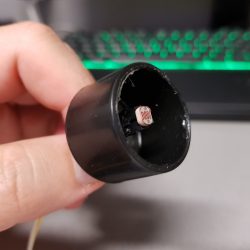
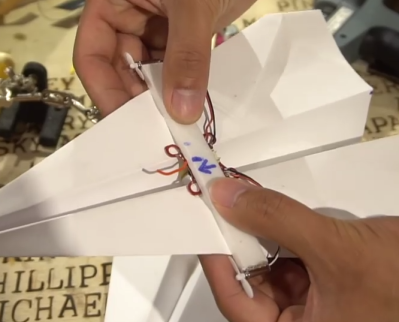
[Peter] uses the two rear motors from a mini quadcopter to provide the thrust for the aeroplane. The key is to remove the motors from the frame and mount them at 90 degrees to their original orientation so that they’re now facing forwards. This allows the drone’s gyro to remain facing upwards in its usual orientation, and keep the plane pointing forwards.

The reason this works is down to how drones yaw: because half of the motors spin the opposite direction to the other half, yaw is induced by increasing the speed of all motors spinning in one direction, mismatching the aerodynamic torques and rotating the drone. In the case of the mini quadcopter, each of the two rear motors spin in different directions. Therefore, when the paper plane begins to yaw off-centre, the flight controller increases power to the appropriate motor.

Mounting the flight controller and motors to the paper plane can either be achieved using a 3D-printed mount [Peter] created, or small piece of foam. Shown here is the foam design that mounts the propellers at wing level but the 3D printed version has then under the fuselage and flies a bit better.

Making paper planes too much effort? You could always use the one-stroke paper plane folder, or even the paper plane machine gun.

Continue reading “RC Paper Airplane From Guts Of Quadcopter”

Pick And Place Machine Is Mirror Image Of 3D Printer

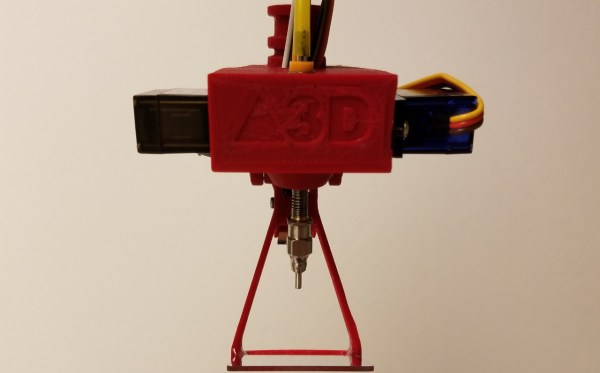
For his Hackaday prize entry, [Daren Schwenke] is creating an open-source pick-and-place head for a 3D printer which, is itself, mostly 3D printable. Some serious elbow grease has gone into the design of this, and it shows.

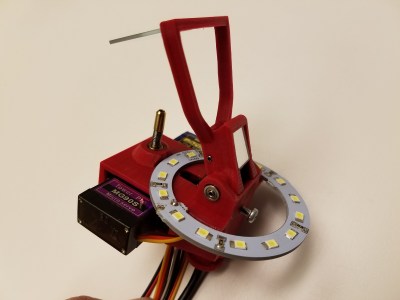
The really neat part of this project comes in the imaging of the part being placed. The aim is to image the part whilst it’s being moved, using a series of mirrors which swing out beneath the head. A Raspberry Pi camera is used to grab the photos, an LED halo provides consistent lighting, and whilst it looks like OpenPnP may have to be modified slightly to make this work, it will certainly be impressive to see.

Two 9g hobby servos are used: one to swing out the mirrors (taking 0.19 seconds) and one to rotate the part to the correct orientation (geared 2:1 to allow 360 degrees part rotation). Altogether the head weighs 59 grams – lighter than an E3D v6.

In order to bring this project to its current state, [Daren] has had to perform some auxiliary hacks.  The first was an aquarium to vacuum pump conversion – by switching around the valves and performing some other minor mods, [Daren] was able to produce a vacuum of 231mbar. The second was hacking a two-way solenoid valve from a coffee machine into a three-way unit. As [Daren] says, three-way valves are not expensive, but “a part in hand is worth two on Alibaba.”

The Quest For The Reuleaux Triangle Bearing

[Angus Deveson] published a video on “solids of constant width” nearly a year ago. Following the release of the video, he had a deluge of requests asking if he could make a bearing from them. Since then, he’s tried a number of different approaches – none of which have worked. Until now…

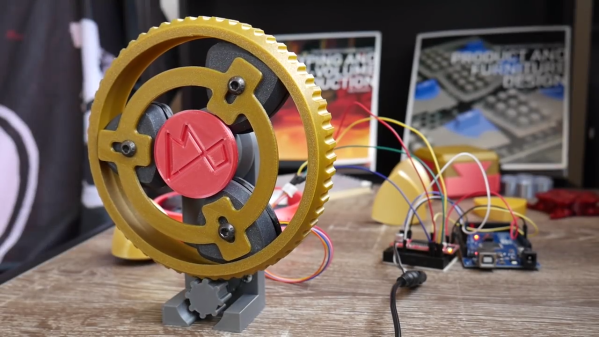
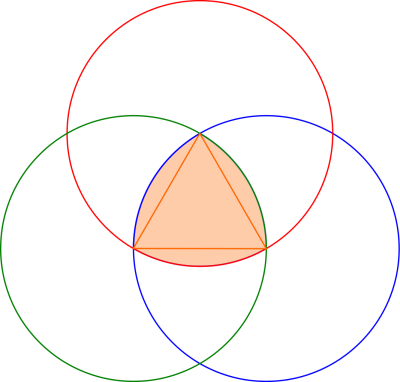
What is a solid of constant width? A shape whose diameter is the same in all orientations, despite the fact that they aren’t circular. In particular, the Reuleaux Triangle is of interest; if you’ve heard of square drill bits, a Reuleaux Triangle is probably at play. Constructed from three circles, they make a neat geometrical study. When placed between two surfaces and rolled, the surfaces will stay parallel, despite the fact that the center of the triangle does not stay level.

In theory, this means they could be easily substituted for spheres in a classic roller bearing, but this turned out to be problematic – the first attempt determined how hard it was to get the shapes to roll instead of slide.

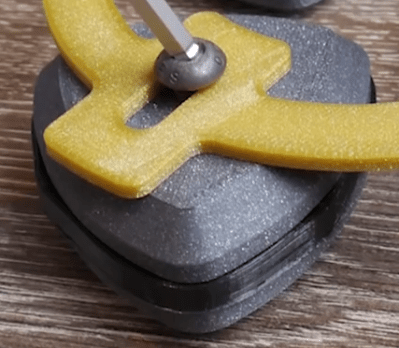
[Angus] finally arrived at a working bearing after a ton of suggestions from the community, and trying a number of attempts until he was able to achieve what he set out to do. The trick was to create a flexible insert (3D printed as well) for the center of the triangle edge, which grips the surfaces the triangle comes into contact with. A frame is also made to hold the bearings in place and allows their centers to move up and down as necessary.

If the thrill seeker within you still isn’t satisfied, maybe you should try the Reuleaux Coaster

Continue reading “The Quest For The Reuleaux Triangle Bearing”

Precision DIY Calipers? That’s A Moiré!

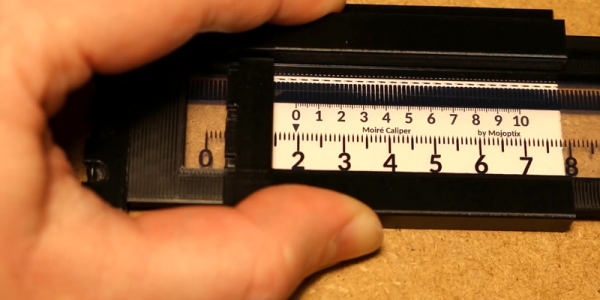
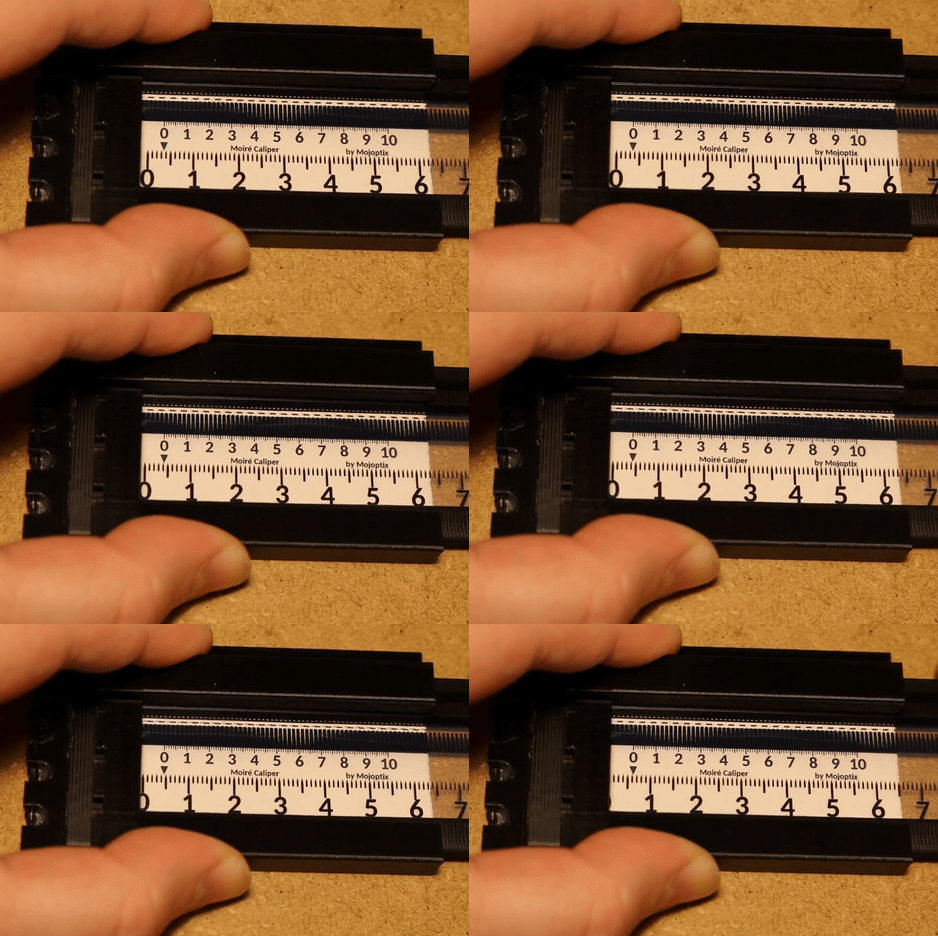
Moiré patterns are a thing of art, physics, and now tool design! [Julldozer] from Mojoptix creatively uses a moiré pattern to achieve a 0.05 mm precision goal for his custom designed 3D printed calipers. His calipers are designed to validate a 3D print against the original 3D model. When choosing which calipers are best for a job, he points out two critical features to measure them up against, accuracy and precision which he explains the definition of in his informative video. The accuracy and precision values he sets as constraints for his own design are 0.5 mm and 0.05 mm respectively.

By experimenting with different parameters of a moiré pattern: the scale of one pattern in relation to the other, the distance of the black lines on both images, and the thickness of black and white lines. [Julldozer] discovers that the latter is the best way to amplify and translate a small linear movement to a standout visual for measurement. Using a Python script which he makes available, he generates images for the moiré pattern by increasing line thickness ratios 50:50 to 95:5, black to white creating triangular moiré fringes that point to 1/100th of a millimeter. The centimeter and millimeter measurements are indicated by a traditional ruler layout.

Looking for more tool hacks and builds? Check out how to prolong the battery life of a pair of digital calipers and how to build a tiny hot wire foam cutter.


Continue reading “Precision DIY Calipers? That’s A Moiré!”

3D Printed Key Saves The Day

When [Odin917’s] parents went away on vacation, they took the apartment mailbox key with them. With the mail quickly piling up in the mailbox, he needed to get in there. He could have had the building super replace the lock, for a fee of course. Instead he had his parents email a photo of the key, which he used to 3D print his own copy.

Using a photograph as a template for a 3D printed copy is nothing new. We’ve covered it in-depth right here. However, this is the first time we’ve seen the technique put to use for good – in this case avoiding a hefty lock replacement fee.

He did his modeling in Autodesk’s free Fusion 360 CAD software. He then printed it out, and the box didn’t open. It took three revisions before the perfect key popped out of the printer. This particular mailbox uses a 4 pin tumbler, which makes it a bit less forgiving than other mailbox locks we’ve seen.

Admittedly this isn’t [Odin917’s] first time working with locks. Back in 2013, he submitted a parametric bump key model to Thingiverse.

Picking locks isn’t just for getting the mail. Locksport is a popular pastime for hardware hackers.

A 3D Printed Junction Transistor Model

Transistors are no doubt one of humankinds greatest inventions. However, the associated greatness brings with it unprecedented complexity under the hood. To fully understand how a transistor works, one needs to be familiar with some Quantum Mechanics! As perhaps any EE undergraduate would tell you, one of the hardest subject to fathom is in fact semiconductor physics.

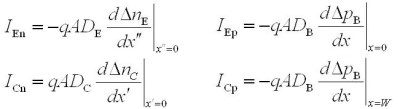
Take your pick: Mathematical equations governing the various currents inside a BJT

A good place to start to comprehend anything complex is by having an accurate but most importantly, tangible model at hand. Semiconductors are hard enough to describe with elaborate mathematical tools, is a physical model too much to ask?

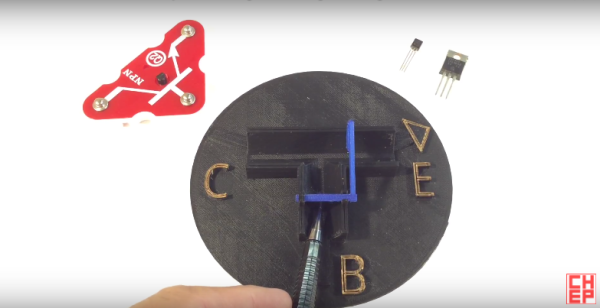
[Chuck] has designed, printed and explained the workings of a BJT transistor using a 3D printed model. We really like this model because it goes a long way to shed light on some of the more subtle features of BJT transistors for beginners.

For example, the simplest “electronic switch” model completely ignores the application of a transistor as a linear amplifier and cannot be used to explain important transistor parameters such as hfe (DC current gain Beta) or the VBE (voltage to forward bias the base-emitter junction). [Chuck’s] model on the other hand certainly offers better intuition on these, as the former can be linked to the length of the levers arm and the latter to the minimum force needed to rotate the lever. The Tee structure even signifies the combination of base current with the collector current during operation!

If physical models are not your thing, the classic pictorial depiction, the “Transistor Man” in the Art of Electronics might be of interest. If you’ve even outgrown that, its time to dig into the quantum mechanics involved.

Continue reading “A 3D Printed Junction Transistor Model”

TORLO Is A Beautiful 3D Printed Clock

What if you could build a clock that displays time in the usual analog format, but with the hands moving around the outside of the dial instead of rotating from a central point? This is the idea behind TORLO, a beautiful clock built from 3D printed parts.

The clock is the work of [ekaggrat singh kalsi], who wanted to build a clock using a self-oscillating motor. Initial experiments had some success, however [ekaggrat] encountered problems with the motors holding consistent time, and contacts wearing out. This is common in many electromechanical systems — mechanics who had to work with points ignition will not remember them fondly. After pushing on through several revisions, it was decided instead to switch to an ATtiny-controlled motor which was pulsed once every two seconds. This had the benefit of keeping accurate time as well as making it much easier to set the clock.

The stunning part of the clock, however, is the mechanical design. The smooth, sweeping form is very pleasing to the eye, and it’s combined with a beautiful two-tone colour scheme that makes the exposed gears and indicators pop against the white frame. The minute and hour hands form the most striking part of the design — the indicators are attached to a large ring gear that is turned by the gear train built into the frame. The video below the break shows the development process, but we’d love to see a close-up of how the gear train meshes with the large ring gears which are such an elegant part of the clock.

A great benefit of 3D printing is that it makes designing custom gear trains very accessible. We’ve seen other unconventional 3D printed clock builds before. 

Continue reading “TORLO Is A Beautiful 3D Printed Clock”