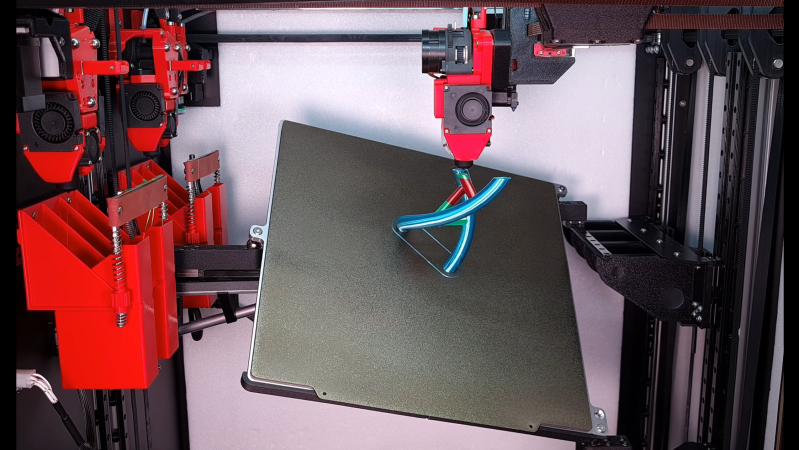
A 3D printer is shown, with the print bed pitched sharply toward the camera. The hotend is depositing plastic on a model at a sharp angle to the print bed.

Multicolor 5-Axis 3D Printing

Usually, when we see non-planar 3D printers, they’re rather rudimentary prototypes, intended more as development frames than as workhorse machines. [multipoleguy]’s Archer five-axis printer, on the other hand, breaks this trend with automatic four-hotend toolchanging, a CoreXY motion system, and print results as good-looking as any Voron’s.

The print bed rests on three ball joints, two on one side and one in the center of the opposite side. Each joint can be raised and lowered on an independent rail, which allows the bed to be tilted on two axes. The dimensions of the extruders’ motion system limit how much the bed can be angled when the extruder is close to the bed, but it can reach sharp angles further out.

The biggest difficulty with non-planar printing is developing a slicer; [multipoleguy] is working on a slicer (MaxiSlicer), but it’s still in development. It looks as though it’s already working rather well, to the point that [multipoleguy] has been optimizing purge settings for tool changes. It seems that when a toolhead is docked, the temperature inside the melt chamber rises above the normal temperature in use, which causes stringing. To compensate for this, the firmware runs a more extensive purge when a hotend’s been sitting for a longer time. The results speak for themselves: a full three-color double helix, involving 830 tool changes, could be printed with as little as six grams of purge waste.

As three-axis 3D printers become consumer products, hackers have kept looking for further improvements to make, which perhaps explains the number of non-planar printing projects appearing recently, including a few five-axis machines. Alternatively, some have experimented with non-planar print ironing.
Open Source 5-Axis Printer Has Its Own Slicer

Three-axis 3D printing has been with us long enough that everybody knows the limitations, but so far, adding extra axes has been very much a niche endeavor. [Daniel] at Fractal Robotics wants to change that, with the Fractal 5 Pro 5-axis printer, and its corresponding Fractal Cortex slicer.

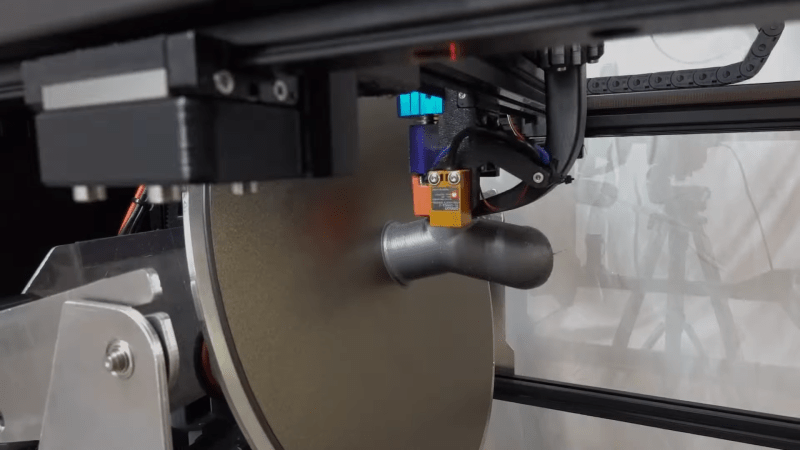
The printer looks like an extra-beefy Voron from a distance, which is no surprise as [Daniel] admits to taking heavy inspiration from the Voron Trident. The Fractal 5 shares a core-XY geometry with the Voron, using beefy 30 mm x 30 mm extrusions. Also like the Voron, it runs Klipper on a Raspberry Pi hiding in the base. Under a standard-looking printhead using a BondTech extruder and E3D volcano hotend, we find the extra two axes hiding under the circular build plate. The B axis is a gantry that can pivot the build plate assembly a full 90 degrees; the A axis spins the plate without limit thanks to the slip rings built into the design.

The extruder may look fairly normal, but it has actually been designed very carefully to allow the nozzle to get as close as possible to the build plate when the B-axis is at 90 degrees. It looks like the E3D hotend is actually the limiting factor there, which gives plenty of design freedom when planning prints in the accompanying Fractal Cortex slicer.

Continue reading “Open Source 5-Axis Printer Has Its Own Slicer”

Hackaday Prize 2023: Gen5X A Generatively Designed 5-Axis 3D Printer

[Ric Real] is entering the 2023 Hackaday Prize with the Gen5X, a generatively designed 3D printed five-axis 3D printer. The concept is not a new one, with the type of construction being seen a few times here and there. In addition to the usual three directions of motion, we’re familiar with, with the cartesian bot design, these types of machines add an additional two rotation axes, one which can swing the build platform front and back around the X-axis, and a second that provides rotation around the Z-axis. These combined motions give rise to some very interesting capabilities, outside of our familiar 3D printing design constraints.

As for the generative side of things, this is a largely theoretical idea. Essentially the concept is that the machine’s design can be iteratively updated and optimised for performance to fit into the constraints of available hardware such as motors and other ‘vitamins’ needed to create the next generation of machines. The design files should be parameterised enough such that this optimisation process can be automated, potentially via input from AI, but we suspect we’re a way off from that yet. Whether this project as yet satisfies any of these lofty goals remains to be seen, but do keep an eye on it if you’re so inclined. There is a Fusion 360 project here to dig into, but if you’re not interested in the research side of the project, but just want to build a 5-axis machine to play with, then you can find the project source on the GitHub Page.

If this feels familiar, you’d be on the right track, as we covered at least one other 5D printer recently. We have also touched upon generative design at least once. We’re sure we will see more on this topic in the future.

Continue reading “Hackaday Prize 2023: Gen5X A Generatively Designed 5-Axis 3D Printer”

Adding Two Axes Makes CNC Router More Than The Sum Of Its Parts

The problem with building automated systems is that it’s hard to look at any problem and not see it in terms of possible automation solutions. Come to think of it, that’s probably less of a bug and more of a feature, but it’s easy to go overboard and automate all the things, which quickly becomes counterproductive in terms of time and money.

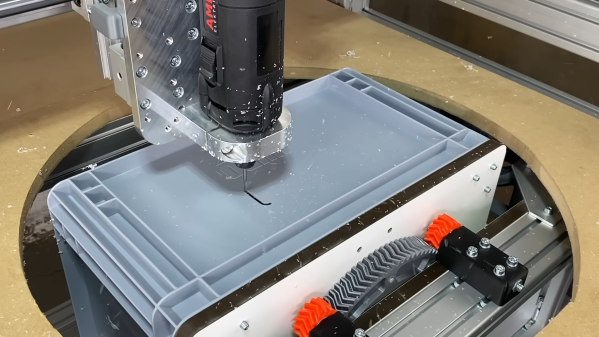
If you’re clever, though, a tactical automation solution can increase your process efficiency without breaking the budget. That’s where [Christopher Helmke] seems to have landed with this two-axis add-on fixture for his CNC router. The rig is designed to solve the problem of the manual modification needed to turn off-the-shelf plastic crates into enclosures for his line of modular automation components, aspects of which we’ve featured before. The crates need holes drilled in them and cutouts created in their sides for displays and controls. It’s a job [Christopher] tackled before with a drill and a jigsaw, with predictable results.

To automate the job without going overboard, [Christopher] came up with a tilting turntable that fits under the bed of the CNC router and sticks through a hole in the spoil board. The turntable is a large, 3D printed herringbone gear driven by a stepper and pinion gear. A cheap bearing keeps costs down, while a quartet of planetary gears constrain the otherwise wobbly platform. The turntable also swivels 90 degrees on a herringbone sector gear; together, the setup adds pitch and roll axes to the machine that allow the spindle access to all five sides of the crates.

Was it worth the effort? Judging by the results in the video below, we’d say so, especially given the number of workpieces that [Christopher] has to process. Add in the budget-conscious construction that doesn’t sacrifice precision too much, and this one seems like a real automation win.

Continue reading “Adding Two Axes Makes CNC Router More Than The Sum Of Its Parts”

Spindle Upgrade Makes PocketNC Faster And Smoother

Conventional wisdom says that rigidity is the name of the game when it comes to machine tool performance. After all, there’s got to be a reason for CNC machines that need specialized rigging companies just to deliver them. But is there perhaps a way for the hobby machinist to cheat a little on that?

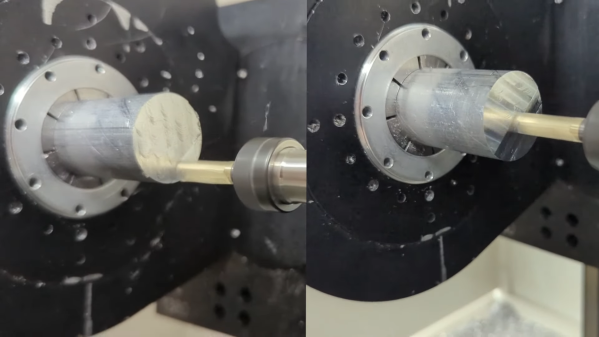
From the look of [Ryan]’s PocketNC spindle upgrade, it seems like the answer just might be yes. The PocketNC, a much-coveted five-axis CNC mill sized for the home shop, has a lot going for it, but as with most things, there are trade-offs. Chief among these is a lack of the usual huge, heavy castings used for CNC machines, which results in the tendency for the cutting tool to chatter or even stall out if you push the speeds and feeds too far. After a good intro to some of the important metrics of machining, such as “material removal rate,” the video below delves into how MRR affects chip load which in turn results in chatter.

The easy fix for chatter, of course, is to take smaller cuts. But [Ryan] decided to increase the spindle speed to take lighter cuts, but to do it really fast. The hardware for this includes a 3,500 KV high-torque brushless DC motor and a custom spindle attachment. The motor is connected to the spindle shaft using pulleys and a drive belt, and the shaft is supported with stout bearings that can be pre-loaded to fight backlash. The end result is three times the stock 10,000 RPM spindle speed, which lets [Ryan] see a 300% increase in cycle time on his PocketNC. And as a bonus, the whole thing requires no permanent modification to the machine and can be easily removed.

We think [Ryan] did a great job breaking this problem down to the essentials and hacking up a low-cost solution to the problem. Continue reading “Spindle Upgrade Makes PocketNC Faster And Smoother”

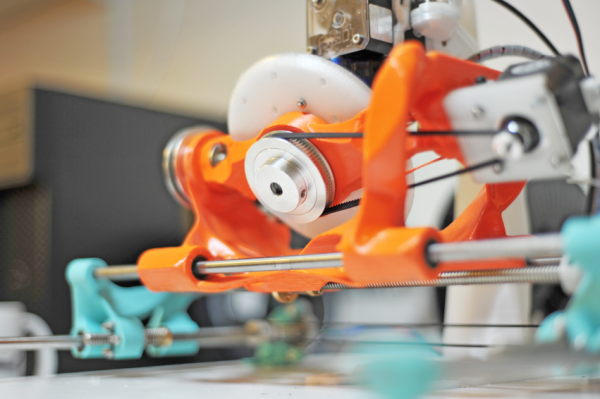
The underside of the rotational base of the Gen5X 3D printer. A belt connects a pulley on the bottom of the stage to a stepper motor on the right side. The carriage for the stage looks organic in nature and is printed in bright orange PLA. The stage can rotate within the carriage which is mounted on two stainless steel rods connected to teal mounting points on either side of the printer (ends of the X-axis).

5-Axis Printer Wants To Design Itself

RepRap 3D printers were designed with the ultimate goal of self-replicating machines. The generatively-designed Gen5X printer by [Ric Real] brings the design step of that process closer to reality.

While 5-axis printing is old hat in CNC land, it remains relatively rare in the world of additive manufacturing. Starting with “a set of primitives… and geometric relationships,” [Real] ran the system through multiple generations to arrive at its current design. Since this is a generative design, future variants could look different depending on which parameters you have the computer optimize.

The Gen5X uses the 5 Axis Slicer from DotX for slicing files and runs a RepRap Duet board with Duex expansion. Since the generative algorithm uses parametric inputs, it should be possible to to have a Gen5X generated based on the vitamins you may have already. With how fast AI is evolving, perhaps soon this printer will be able to completely design itself? For now, you’ll have to download the files and try it yourself.

If you want to see some more printers with more than 3-axes, check out the RotBot or Open5X.

Continue reading “5-Axis Printer Wants To Design Itself”

5-Axis 3D Printing For The Rest Of Us

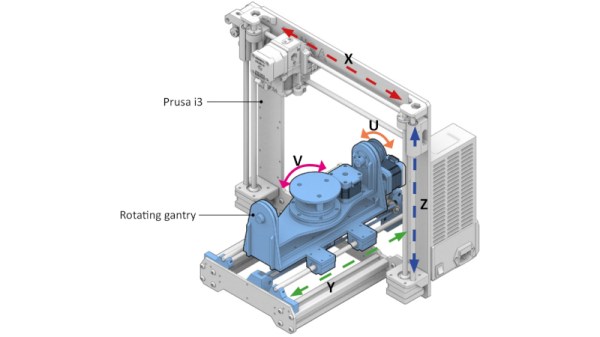
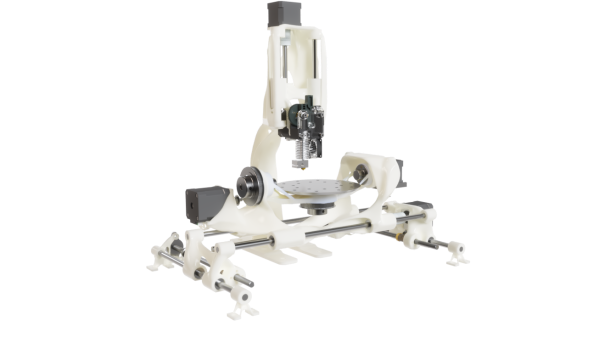
By now we’re all used to the idea of three dimensional printing, as over the last fifteen years or so it’s become an indispensable tool for anyone with an interest in making things without an industrial scale budget. There are still a few limitations to the techniques used in a common 3D printer though, in particular being tied to layers in a single orientation. It’s something that can be addressed by adding tilt and rotational axes to the printer to deliver a five-axis device, but this has not been available in an affordable form. [Freddie Hong] and colleagues have tackled the production of an affordable printer, and his solution fits neatly on the bed of a Prusa i3 to convert it to five-axis machine without breaking the bank.

The quantity and quality of the work is certainly impressive, with suitable slicing software being developed alongside the 3D printed parts to fit the two extra axes. For now all we can do is look at the pictures and the video below the break, but once the work has been presented the promise that all the necessary files will be made public. We can see versions of the hardware finding their way onto printers other  than the Prusa, and we can see this becoming yet another piece of the regular armory available to those of us who make things.

Continue reading “5-Axis 3D Printing For The Rest Of Us”