
Today was the first day of the Vintage Computer Festival East X. As is the tradition, the first day was packed with talks and classes about various retrocomputing ephemera, with this year featuring a great talk from [David Riley] about 8-bit computer music, a class on system architecture from our own [Bil Herd] (video coming soon), and a talk about vintage teletypes. One of these talks was about creating new hardware: [Jim Brain]’s steering committee on a networking solution for vintage microcontrollers. It’s called Quarternet: a two-bit solution for an eight bit world.
While minicomputers are easily networkable, designed around multi-user operating systems, and have the hardware for a lot of networking hardware, 8-bit micros are the exact opposite. That doesn’t mean 8-bitters don’t have networking; you can get an Ethernet cart for a C64, and just about everything can connect to a BBS. [Jim]’s talk was about whittling down the use cases for the Quarternet to something that could be implemented easily, but still give the most capability.
During the talk, the audience settled on using a serial connection from the micro to the outside world; this makes sense, as everything has a serial port. A ‘lightweight API’ was suggested to take up the software side of the problem, but there wasn’t much agreement over what that API would actually do.
[Jim]’s idea is for a box that plugs into the serial port of any old microcomputer and would connect to the Internet somehow. Ethernet, WiFi, or even a modem isn’t out of the question here. That takes care of connecting to the Internet, but there’s also the question of the cooler side of networking – network drives, file sharing, and the like.
For this, [Jim] is imagining a box with a serial port on one end, and a network port on the other. In the middle would be a cartridge slot for any hardware imaginable. If you want to plug in an Apple II disk drive, just insert the right cartridge and you’re good to go. If you need network access to a Commodore 1541 drive, just insert another cartridge, and it’ll just work.
It’s an interesting idea, but [Jim] is really interested in getting even more feedback for a networking system for old microcomputers. If you have any ideas, leave a note for him in the comments.

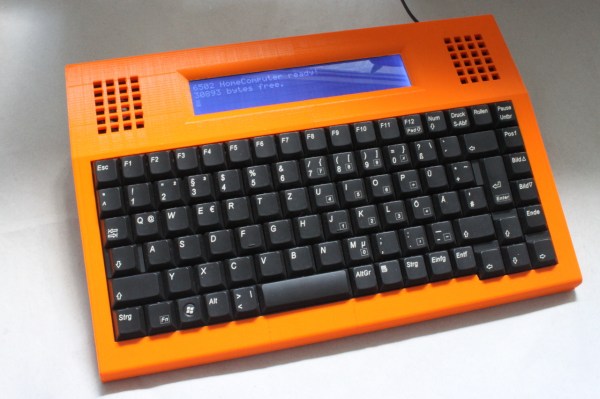
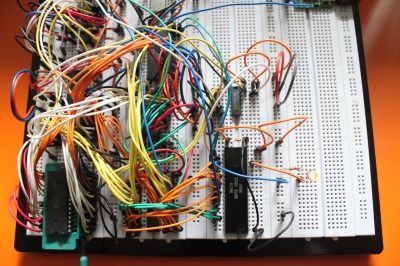 [Dirk] has some great documentation to go with his computer. He started with a classic MOS 6502 processor. He surrounded the processor with a number of support chips correct for the early 80’s period. RAM is easy-to -use static RAM, while ROM is handled by UV erasable EPROM. A pair of MOS 6522 Versatile Interface Adapter (VIA) chips connect the keyboard, LCD, and any other peripherals to the CPU. Sound is of course provided by the 6581 SID chip. All this made for a heck of a lot of wires when built up on a breadboard. The only thing missing from this build is a way to store software written on the machine. [Dirk] already is looking into ways to add an SD card interface to the machine.
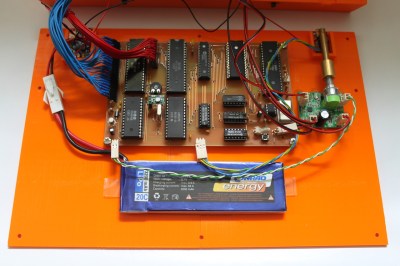 The home building didn’t stop there though. [Dirk] designed and etched his own printed circuit board (PCB) for his computer. DIY PCBs with surface mount components are easy these days, but things are a heck of a lot harder with older through hole components. Every through hole pin and via had to be drilled, and soldered to the top and bottom layers of the board. Not to mention the fact that both layers had to line up perfectly to avoid missing holes! To say this was a lot of work would be an understatement.
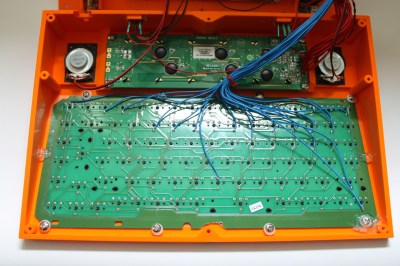 [Dirk] designed a custom 3D printed case for his computer and printed it out on his Ultimaker. To make things fit, he created his design in halves, and glued the case once printing was complete.